
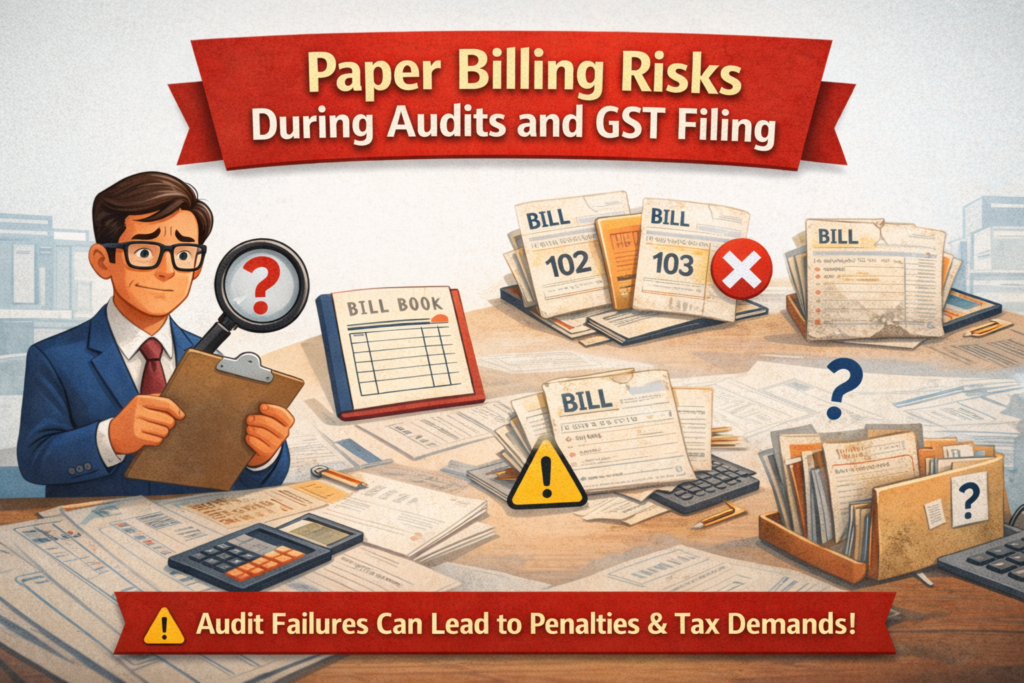
Paper and manual billing often feel simple and manageable, especially in small or growing businesses. At its core, billing is supposed to create clear, traceable records of sales, taxes, and payments.
But when billing is handled through handwritten bills and manual registers, the cracks appear during audits and GST filing. Invoices fade, pages tear, entries go missing, and calculations done months ago rarely match what tax authorities expect today.
GST is not merely a tax regime; it’s a data-matching system that demands precision, consistency, and traceability across invoices, returns, and input tax credits.
Unfortunately, paper billing often falls short in meeting these critical requirements, turning what seems manageable in everyday use into serious compliance risks during audits. This article examines the failures of paper billing, the reasons auditors flag it, and the potential impact on GST filings and audits.
How Paper Billing Works in Real Businesses
In many Indian businesses, paper billing remains the default method for recording sales. Bills are handwritten or manually printed using a bill book, with copies stored in physical files or cupboards. At the end of the day or month, these bills are tallied manually to calculate sales and tax, often using Excel sheets or rough registers. Corrections are made by overwriting, striking off entries, or issuing fresh bills, and the accuracy of records depends heavily on the person maintaining them.
This system feels manageable because it is familiar, quick at the counter, and does not require software or training. As long as daily operations run smoothly, paper billing appears “good enough.” However, this comfort comes from routine, not reliability. The moment GST filing or an audit demands exact data, invoice-level history, or traceable records, the limitations of paper billing become visible.
What GST Audits Actually Test
A GST Audit tests the following things –
- Accuracy of sales and purchase records reported in GST returns
- Continuity and sequence of invoice numbering without gaps or duplication
- Completeness of invoice details as prescribed under GST laws
- Consistency between books of accounts, GST returns, and portal data
- Proper calculation and payment of CGST, SGST, and IGST
- Validity and traceability of the Input Tax Credit claimed
- Availability of supporting documents for every reported transaction
- Existence of a clear audit trail linking invoices, returns, and tax payments
Invoice-Level Risks in Paper Billing
1. Missing or Lost Invoices
Paper invoices are physically stored, which makes them easy to misplace, tear, or lose over time. During GST audits, the inability to produce even a single invoice can raise doubts about unreported sales or incorrect tax payment.
2. Duplicate or Skipped Invoice Numbers
Manual billing often results in numbering gaps, duplicate invoice numbers, or out-of-sequence bills. These gaps are a common audit trigger because GST requires continuous, sequential invoice numbering.
3. Altered or Backdated Bills
Corrections in paper bills are usually done by overwriting, striking off, or reissuing invoices. Such changes weaken invoice authenticity and can appear suspicious during scrutiny, even when there is no intent to evade tax.
4. Incomplete or Incorrect GST Details
Handwritten or manually filled invoices frequently omit mandatory GST fields, such as GSTIN, HSN/SAC codes, tax rate breakdown, or place of supply. Incomplete invoices are treated as non-compliant during audits.
5. Faded, Illegible, or Damaged Records
Over time, ink fades, and paper degrades, making old invoices hard to read or unusable. Poor readability during audits creates delays and raises questions about the reliability of records.
6. Lack of Invoice Traceability
Paper invoices are difficult to link with GST returns, payments, and ITC claims. When invoices cannot be easily traced across records, auditors may question the accuracy of reported turnover and tax liability.
GST Return Mismatches Caused by Manual Records
Differences Between Actual Sales and Reported Sales
When sales data is compiled manually from paper bills, errors often creep in during month-end calculations. Missed invoices, incorrect totals, or overlooked cash sales can cause reported figures to differ from actual turnover.
GSTR-1 and GSTR-3B Inconsistencies
Since GSTR-1 and GSTR-3B are prepared separately using manual data, paper billing increases the risk of reporting different values in each return. Even small mismatches can trigger automated GST notices.
Errors in Tax Rate or Tax Amount Reporting
Manual calculation of GST components often results in incorrect tax rates, incorrect breakups, or rounding errors. These mistakes can result in underpayment or overpayment of tax and subsequent compliance issues.
Delayed or Missed Invoice Reporting
Invoices that are issued late, corrected after filing, or discovered later are usually adjusted in future returns. Such timing gaps create mismatches that attract scrutiny during audits.
Reconciliation Issues With GSTR-2A and 2B
Paper-based purchase records make it difficult to reconcile supplier invoices with GSTR-2A and 2B data. When ITC claims do not match portal data, they raise red flags for tax authorities.
Lack of Invoice-Level Audit Trail
Manual records do not offer a clear invoice-level link between sales, returns, and tax paid. During audits, this lack of traceability weakens the reliability of GST filings.
Input Tax Credit (ITC) Exposure and Denial Risk
- Paper invoices are often misplaced, damaged, or unreadable, making it difficult to produce valid proof for ITC claims during audits.
- Manual records make it harder to verify whether supplier invoices are properly reported and reflected in GSTR-2A and GSTR-2B.
- Missing or incorrect invoice details, such as GSTIN, tax rate, or invoice date, can result in partial or full denial of ITC.
- Delays in recording purchase invoices increase the risk of claiming ITC in the wrong tax period, triggering compliance issues.
- Lack of invoice-level tracking makes it difficult to justify ITC eligibility when questioned by tax authorities.
- Inconsistent documentation weakens the audit trail, increasing the chances of ITC reversal along with interest and penalties.
Why Digitised Billing Reduces Audit Risk
Automated and Sequential Invoice Generation
Digitised billing systems generate invoices in a continuous and sequential manner, eliminating gaps, duplicates, and manual numbering errors that commonly trigger audit scrutiny.
Complete and Compliant Invoice Details
Digital invoices are created using predefined GST-compliant formats, ensuring mandatory fields such as GSTIN, HSN codes, tax breakup, and place of supply are consistently captured.
Strong Invoice Traceability and Audit Trail
Every invoice is stored securely and can be easily traced across sales records, GST returns, and tax payments, making it easier to answer audit queries with confidence.
Faster and More Accurate GST Return Preparation
Digitised data reduces manual compilation and calculation errors, improving alignment between GSTR-1, GSTR-3B, and actual business transactions.
Easier ITC Reconciliation and Validation
Digital purchase records allow quick reconciliation with GSTR-2A and GSTR-2B, reducing ITC mismatches and the risk of credit denial or reversal.
Quick Access to Records During Audits
With searchable, cloud-stored invoices and reports, businesses can respond to audit notices promptly without disrupting daily operations.
Conclusion
Paper billing may feel familiar and manageable in day-to-day operations, but under GST audits and return filing, it introduces clear and measurable risks. Missing invoices, return mismatches, weak ITC documentation, and poor traceability can quickly turn routine compliance into stressful scrutiny. What appears to be a simple, low-cost system often ends up costing businesses time, penalties, and peace of mind during audits.
As GST continues to rely on data matching and audit trails, businesses need systems that, by default, support accuracy and transparency. Digitised billing does not just simplify invoicing—it strengthens compliance, reduces audit exposure, and prepares businesses to respond confidently to notices and inspections. In today’s GST environment, moving away from paper billing is less about convenience and more about protecting the business from avoidable compliance risk.
