
Debit Note Format in Excel, Word & PDF
Create a debit note to correct under-billed invoice values, add missed charges, or adjust GST amounts.
- Download ready-to-use debit note formats in Word, Excel, and PDF
- Add original invoice details, GSTIN, item value, tax rate, and reason for issuing
- Useful for GST billing, supplier adjustments, underbilling corrections, missed charges, and additional taxable value or tax adjustments.
Free GST Debit Note Format Templates
Get professional debit note formats for GST under Section 34, compatible with MS Word, Excel & printable PDF. Ideal for SMEs needing adjustment notes for suppliers and customers.
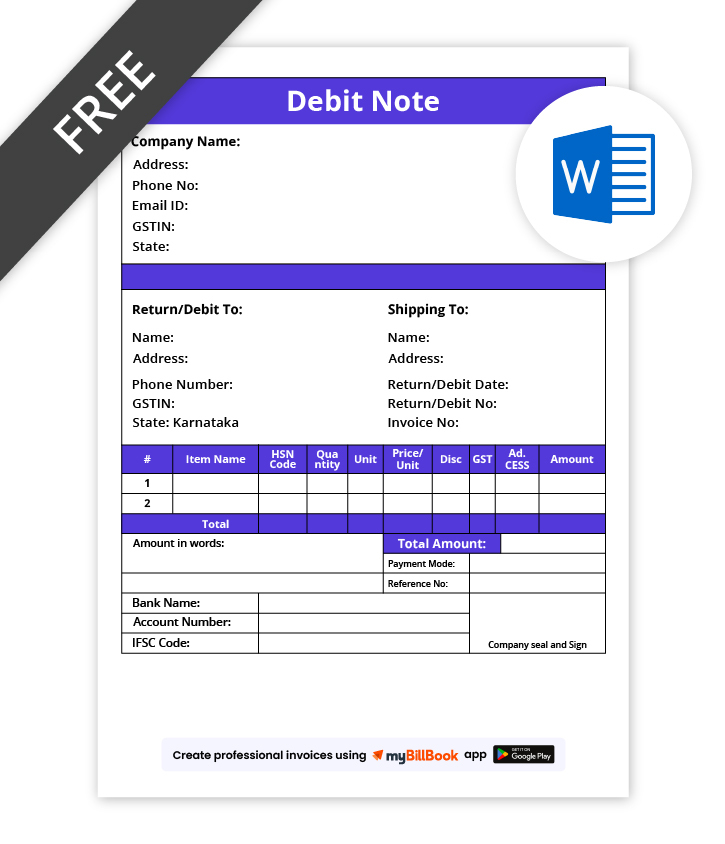


What is a Debit Note?
A debit note is a document issued to increase the value or tax amount of an earlier invoice. Under GST, a supplier issues a debit note when the taxable value or GST charged in the original invoice is lower than the amount actually payable.
A debit note helps record adjustments such as underbilling, missed charges, additional goods or services supplied, or an increase in taxable value or tax. It also links the adjustment to the original invoice for accurate accounting and GST records.
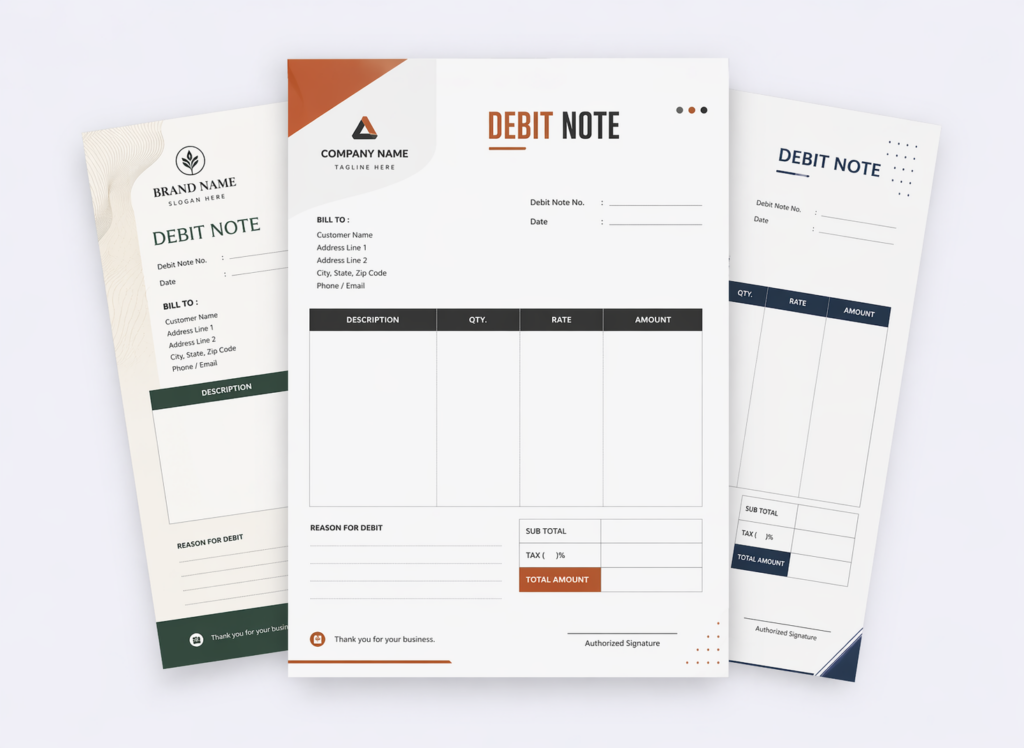
Features of myBillBook Debit Note Format

Invoice Linking
Link debit notes to original invoices instantly. Auto-fetch invoice number, date, and party details, ensuring accurate adjustments and proper compliance.

Auto Tax
Automatically compute CGST, SGST, IGST, and cess on value differences. Remove manual errors and guarantee every debit note is fully GST-compliant and accurate.

HSN/SAC Codes
Fetch HSN/SAC codes directly from your item catalog. Ensure proper classification of goods/services and accurate reporting in debit notes for GST compliance.

Stock Sync
When a debit note is created for an additional supply or value adjustment, myBillBook helps keep the related transaction and inventory records updated for better stock tracking.

Custom Templates
Personalise debit note templates with your logo, GSTIN, address, numbering, and predefined reasons. Present professional documents tailored to your business needs.

GSTR-1 Ready
Generate GSTR-1 reports including debit notes automatically. Ensure fast, error-free GST return filing with accurate data synced from your transactions directly into reports.
Debit Note in GST
As per the GST rules, when a seller issues a tax invoice, a debit note has to be issued if any of the below situations arises.
- The taxable value mentioned in the original invoice is lower than the actual taxable value.
- The GST charged in the original invoice is lower than the tax actually payable.
- Additional goods or services are supplied after the original invoice and the taxable value or tax payable increases.
- Additional charges that were missed in the original invoice need to be included.
- To regularise these kinds of situations, the seller can issue a debit note to the customer. Thus, the debit note includes a supplementary invoice.
Use myBillBook free invoice tool to generate correct GST invoices before adjustments.
Debit Note Sample with Example
Below is a sample debit note format for GST (Section 34) that demonstrates the standard layout and field order. It shows how to reference the original tax invoice, list items with HSN/SAC, and capture taxable value differences. Note the CGST/SGST/IGST breakup, reason for issue, and serial numbering to keep records audit-ready. Use this example to structure your own debit notes or map fields in myBillBook templates.
| Field | Example |
|---|---|
| Debit Note No. | DN-001 |
| Debit Note Date | 08 October 2026 |
| Original Invoice | INV-1245 |
| Original Taxable Value | ₹50,000 |
| Revised Taxable Value | ₹55,000 |
| Additional Taxable Value | ₹5,000 |
| GST @18% | ₹900 |
| Additional Amount Payable | ₹5,900 |
| Reason | Additional goods supplied |
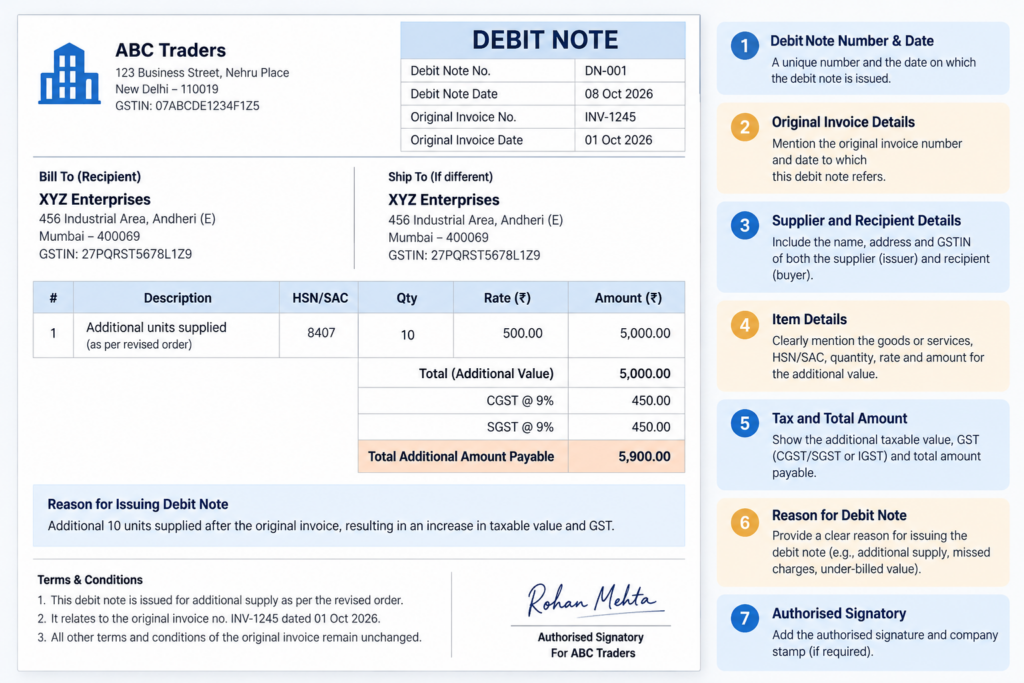
Debit Note Format – Details to Include
As per the GST regulation, there is no prescribed template for debit notes. However, it mandates the mention of the following particulars in a debit note.
| Seller’s Information | Details of the seller – name, address, and GSTIN (goods and services tax identification number) |
| Document Type | Name of the document – debit note or credit note |
| Serial Number | A unique consecutive serial number (not exceeding 16 characters and contains numbers, alphabets, alphanumeric, or special characters) |
| Date | Date of issue of document |
| Buyer’s Information | Details of the buyer – name, address, and GSTIN (in case of a registered business) |
| Other details to mention | Serial number and date of the actual invoice or bill |
| Value of goods as mentioned in the previous invoice, tax rate, and amount of tax credit to the buyer | |
| Signature of the supplier or authorised representative |
Debit Note Format Template in Different Formats - Word, Excel, PDF
Debit note templates can be created in many different templates and formats depending on your business needs and preferences. You can find free debit note templates online in various file types, including Excel, Word, PDF, and Google Docs. Some templates are more basic, while others are more detailed and include additional features such as automatic calculations.
Debit Note Format in Word
If you prefer to use Word to create your debit note, you can use a template or create your document from scratch.
To create a debit note format in Word, input the necessary information, such as the seller’s name and contact information, the buyer’s name and contact information, the invoice number, and the corrected amount. You can also include additional details, such as the reason for the correction and any other relevant information.
Debit Note Format in Excel
A better alternative to debit note format in Word is using MS Excel, which is an easy tool to deal with data and numbers.
To create a debit note format in Excel, open a blank Excel sheet, define the fields, enter the required headings for each field, specify the formulas for the addition of price, input tax, to auto-populate date, etc. Once all the required fields are defined, you can save the debit notes format.
Whenever, you wish to create a debit notes format in Excel, make a copy of the sheet, enter the customer and invoice details, and use it.
Debit Note Format in PDF
PDF is a popular tool for creating debit note format in PDF because it is easy to read and share and preserves the document’s formatting. To create a debit note in PDF, you can use a template or create your document using a PDF editor.
You’ll need to input the necessary information, such as the seller’s name and contact information, the buyer’s name and contact information, the invoice number, and the corrected amount. You can also include additional details, such as the reason for the correction and any other relevant information.
How to Create a Debit Note
A debit note should clearly mention the original invoice details, the additional amount being charged, and the reason for the adjustment. To create a debit note:
- Add supplier and recipient details
Enter the business name, address, GSTIN, and other relevant details of both parties. - Mention the original invoice
Add the original invoice number and invoice date so the debit note can be linked to the correct transaction. - Enter the reason for issuing the debit note
Clearly state why the debit note is being issued, such as an increase in taxable value, missed charges, or additional goods or services supplied. - Add the revised amount and GST
Mention the additional taxable value, applicable GST rate, tax amount, and the total additional amount payable. - Add the debit note number and date
Assign a unique debit note number and mention the date of issue for proper record keeping. - Authorise the document
Add the authorised signatory details or signature, wherever applicable.
Debit Note vs Credit Note
Debit notes and credit notes are both used to adjust an already issued invoice, but they serve opposite purposes.
| Basis | Debit Note | Credit Note |
|---|---|---|
| Purpose | Used when the invoice value or tax amount needs to be increased | Used when the invoice value or tax amount needs to be reduced |
| Common use | Under-billing, missed charges, or additional supply | Over-billing, discounts, deficiencies, or goods returned |
| Effect on amount | Increases the amount payable | Reduces the amount payable |
| GST impact | May increase the supplier’s tax liability | May reduce the supplier’s tax liability, subject to GST rules |
| Reference | Linked to the original invoice | Linked to the original invoice |
In simple terms, a debit note increases the value of an earlier invoice, while a credit note reduces it.
Creating Debit Note Format Using myBillBook
Using the myBillBook app to create and manage debit notes has several benefits, including
Convenience: The app allows you to create and send debit notes from anywhere, at any time, using your mobile device.
Accuracy: The app automatically calculates the total debit amount and helps you to ensure that all required information is included.
Efficiency: The app’s user-friendly interface and templates make it easy to quickly create and send debit notes.
Security: The app stores your debit notes securely and allows you to track and manage them easily.
A debit note helps request credits or adjustments from suppliers or other business partners. By using a debit note template and following a consistent format, you can ensure that your credit requests are clear and professional. myBillBook app can help you create and manage debit notes, helping you to streamline your financial processes and resolve any issues quickly and efficiently.
The jewellery billing software from myBillBook can help you create and manage debit notes, streamlining your financial processes and allowing you to resolve any issues quickly and efficiently.
Frequently Asked Questions
Is a debit note mandatory under GST?
Yes. Under Section 34 of the CGST Act, a supplier issues a debit note when the taxable value or tax charged in the original invoice is lower than the amount actually payable.
What is the difference between a debit note and a credit note?
A debit note generally increases the value or tax amount of an earlier invoice, while a credit note reduces it.
What details should a GST debit note contain?
A GST debit note should include the supplier and recipient details, GSTIN, debit note number and date, original invoice reference, taxable value, applicable GST, and reason for issuance.
Can I download a debit note format in Excel for free?
Yes. You can download an editable debit note format in Excel and enter invoice details, taxable value, GST, and the revised payable amount.
Can I create a debit note using billing software?
Yes. Billing software such as myBillBook can help create debit notes, link them to the original invoice, calculate GST, and maintain transaction records.
How long should debit notes be kept under GST?
GST-related debit notes and supporting records generally need to be preserved for 72 months from the due date of filing the annual return for the relevant financial year.
Is a GST debit note format different from a normal debit note?
Yes. A GST debit note includes GST-specific details such as GSTIN, original tax invoice reference, taxable value, applicable tax rate, and CGST, SGST, or IGST details.
Know More About Bill Formats