
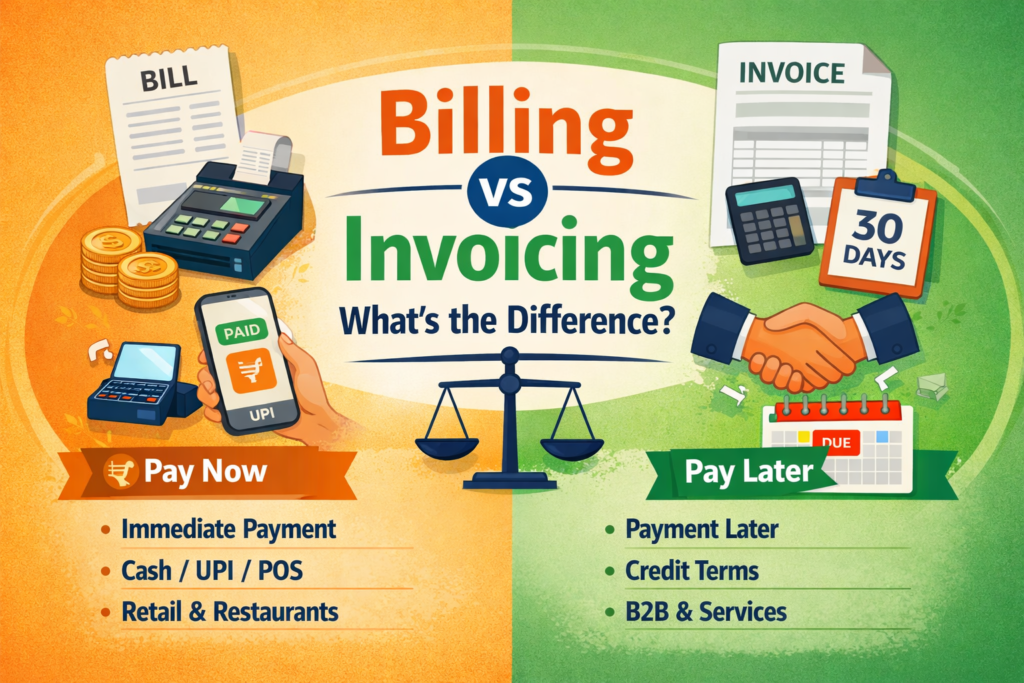
Billing and invoicing are often used interchangeably. In reality, they serve different purposes within a business’s payment cycle.
Understanding the difference between billing and invoicing is important because it directly affects how you collect payments, maintain records, and manage cash flow.
For small businesses, retailers, wholesalers, and service providers, using the wrong approach can lead to payment delays, accounting confusion, and compliance issues. Let’s break it down simply.
What Is Billing?
Billing is the process of requesting immediate payment for goods sold or services provided.
It usually occurs at the point of sale, when the customer is expected to pay immediately.
In billing:
- Payment is instant or near-instant
- The bill acts as a payment request
- Transactions are typically cash, card, UPI, or POS-based
Billing is common in retail shops, restaurants, supermarkets, and cash-and-carry businesses, where sales happen frequently, and payments are settled immediately.
What Is Invoicing?
Invoicing is the process of raising a formal payment request for future payment.
An invoice is issued after the sale, giving the customer time to pay within an agreed credit period.
In invoicing:
- Payment is deferred
- Credit terms apply (e.g., 7, 15, or 30 days)
- The invoice becomes a legal and accounting record
Invoicing is widely used in B2B businesses, wholesalers, distributors, service providers, and freelancers, where credit transactions are common.
When Billing Is Used vs When Invoicing Is Used in Business
Billing is used when the business expects immediate payment upon completion of the transaction.
This works best when:
- Sales are high-volume and frequent
- Credit is not involved
- Customer interaction is quick
Invoicing is used when the business allows credit and delayed payment.
This is suitable when:
- Transactions are high-value or recurring
- Businesses sell to other businesses
- Payment reconciliation happens later
In simple terms, billing supports instant settlement, while invoicing supports structured credit sales.
How Billing and Invoicing Differ in Payment Flow and Cash Collection
| Aspect | Billing | Invoicing |
| Payment timing | Payment is collected immediately at the time of sale | Payment is collected later, based on agreed credit terms |
| Cash flow impact | Cash flow is fast and predictable | Cash flow is delayed and depends on collections |
| Outstanding dues | No outstanding dues since payment is instant | Creates accounts receivable until payment is received |
| Follow-ups required | No follow-ups needed for payment | Regular follow-ups and reminders may be required |
| Risk of payment delay | Very low, as payment is taken upfront | Higher risk of late or missed payments |
| Cash collection effort | Minimal effort needed after the sale | Requires tracking, reconciliation, and collection effort |
| Best suited for | Retail, restaurants, supermarkets, cash sales | B2B, wholesalers, distributors, service providers |
Which One Should Your Business Use (Based on Business Type)
If your business is B2C-focused, operates on quick sales, and does not offer credit, billing is usually sufficient.
If your business is B2B-focused, offers credit, or manages large-value transactions, invoicing is essential.
Many growing businesses use both billing and invoicing together—billing for immediate payments and invoicing for credit customers. The choice depends less on size and more on how and when you get paid.
Conclusion:
The difference between billing and invoicing is not about terminology—it’s about payment timing, cash flow, and control.
Billing works when payments are instant.
Invoicing works when payments are delayed. Understanding this difference helps businesses avoid confusion, improve collections, and maintain cleaner financial records.
The smarter approach isn’t choosing one blindly—but using the right method for the right transaction.
