
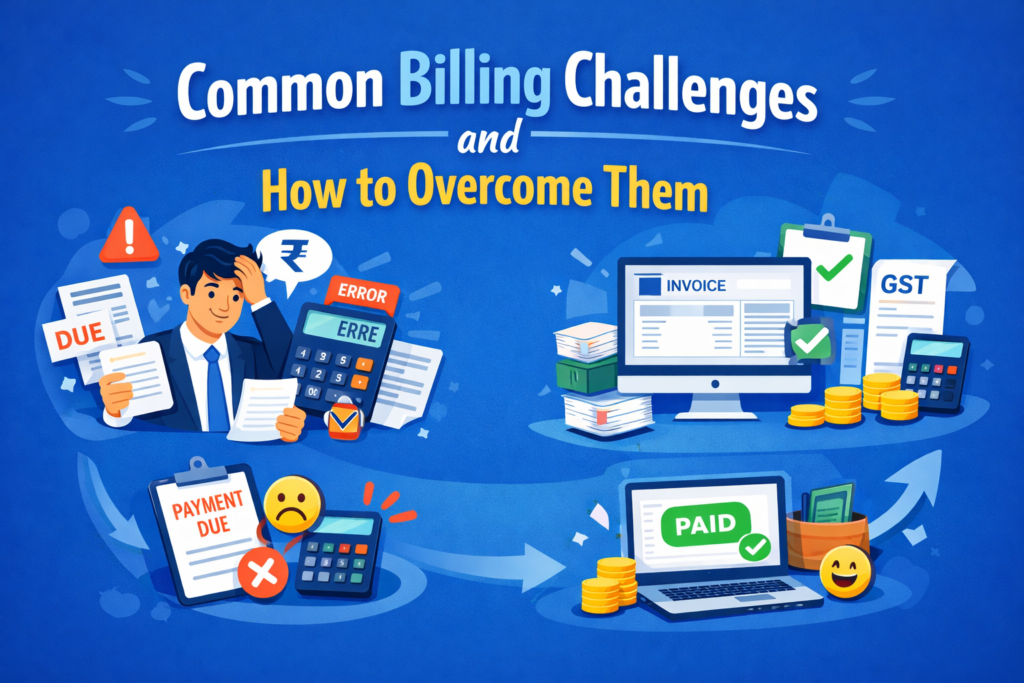
Billing is an important yet often overlooked part of running a business. It impacts revenue, compliance, and customer satisfaction. When billing works well, payments are on time, records are accurate, and businesses can focus on growth. However, when issues arise, it can lead to late payments, mistakes, and stress.
Many small businesses still rely on outdated methods such as paper bills and spreadsheets, which struggle to keep up as transaction volumes increase and compliance rules tighten. This blog will explore common billing challenges and offer practical tips to improve the process by leveraging smarter tools and technology.
What Is Billing?
Billing is the process of creating a record of a sale, including listing items sold, calculating taxes, applying discounts, and recording payment details.
While it’s often confused with invoicing and accounting, billing focuses on collecting payments. Invoicing is part of it, especially in business-to-business deals, while accounting covers broader financial aspects.
Effective billing is crucial for cash flow, tax compliance, inventory accuracy, and customer trust. Weak billing processes can lead to issues throughout the business.
Common Billing Challenges Faced by Businesses and How to Overcome Them
Manual Billing Errors
One of the most common billing challenges is manual error. When bills are created using paper, spreadsheets, or basic tools, mistakes like incorrect prices, wrong quantities, or miscalculated taxes are inevitable. These errors often go unnoticed initially but lead to customer disputes, revenue loss, and reconciliation problems later.
The most effective way to address manual billing errors is to automate the billing process. Digital billing systems use predefined product prices, tax rates, and calculation rules to ensure accuracy across every invoice. Automation removes guesswork and significantly reduces human error.
Delayed Invoice Generation
Many businesses delay invoice creation until the end of the day or week, resulting in missed transactions and slower payment cycles. Late billing also makes it harder to track sales accurately and follow up on payments.
This challenge can be solved by switching to real-time invoice generation. Creating invoices immediately at the point of sale or service completion ensures every transaction is recorded and payments are initiated promptly, improving cash flow and record accuracy.
GST and Tax Compliance Issues
GST compliance is a major pain point for businesses. Applying incorrect tax rates, missing HSN or SAC codes, or misclassifying transactions can result in filing mismatches and penalties. These issues often surface only during the return filing process, when corrections become time-consuming.
To address this, businesses should use GST-compliant billing systems that automatically apply tax rules. Such systems ensure correct tax calculations, maintain consistency across invoices, and simplify GST return preparation by keeping data structured and compliant.
Difficulty Tracking Payments and Outstanding Dues
Without a structured billing process, tracking who has paid and who hasn’t becomes difficult. Many businesses rely on memory or informal follow-ups, leading to missed collections and awkward customer conversations.
The solution is to centralise payment tracking by linking invoices with payment status. A system that clearly shows pending, partial, and completed payments allows businesses to follow up on dues systematically and maintain healthy cash flow without confusion.
Poor Invoice Format and Presentation
Unclear or unprofessional invoice formats often confuse customers. Missing details, an unclear tax breakdown, or a lack of payment instructions can delay payments and erode trust.
This issue can be resolved by standardising invoice formats. Clear, professional invoices with proper item descriptions, tax details, and payment terms improve customer confidence and reduce the need for repeated clarifications.
Inventory Mismatch Due to Billing Gaps
When billing and inventory are managed separately, stock records become inaccurate. Sales may not be reflected in inventory immediately, leading to overstocking, stockouts, or incorrect purchase decisions.
Integrating billing with inventory management effectively solves this problem. Every sale or return automatically updates stock levels, ensuring real-time inventory accuracy and better control over purchasing and storage.
Managing Multiple Payment Modes
Modern businesses accept payments through cash, UPI, cards, and bank transfers. Tracking these payment methods manually often leads to reconciliation errors and unclear records.
The best way to handle this challenge is to capture payment mode details at the time of billing. Recording each payment against its invoice simplifies reconciliation and provides businesses with a clear view of how funds are received.
Handling Returns, Cancellations, and Credit Notes
Returns and cancellations are often treated as exceptions, resulting in inaccurate sales and tax records. Without proper credit notes, businesses struggle to accurately adjust inventory and GST.
This challenge can be overcome by handling returns systematically through linked credit notes. Structured return handling ensures correct inventory adjustments and clean tax reporting, keeping records audit-ready.
Scaling Billing Operations as the Business Grows
As businesses grow, billing volumes increase, staff count expands, and operations may spread across multiple locations. Manual or basic billing systems fail to keep up, causing confusion and loss of control.
To overcome scaling challenges, businesses need centralised, cloud-based billing systems with multi-user access. Such systems maintain consistency across teams and locations while giving business owners real-time visibility into operations.
How the Right Billing Software Solves Most Billing Challenges
- Eliminates manual billing errors by automating price calculations, discounts, and tax application, ensuring consistent and accurate invoices for every transaction.
- Enables real-time invoice generation, allowing businesses to create bills instantly at the point of sale or service completion, reducing missed transactions and payment delays.
- Simplifies GST and tax compliance through automated tax rules, correct GST rate application, and mandatory field validation, such as HSN and SAC codes.
- Improves payment tracking and due management by linking invoices with payment status, giving businesses a clear view of pending, partial, and completed payments.
- Ensures clear, professional invoice formats with standardised layouts that include item details, tax breakdown, payment terms, and business information.
- Integrates billing with inventory management, automatically updating stock levels after every sale or return to prevent mismatches and stock-related issues.
- Simplifies multi-payment mode handling by recording cash, UPI, card, and bank transfer payments against individual invoices for easy reconciliation.
- Manages returns, cancellations, and credit notes systematically, ensuring accurate inventory adjustments and compliant tax reporting.
- Supports business growth with scalable systems, offering multi-user access, centralised data, and cloud-based visibility as transaction volumes increase.
Frequently Asked Questions
Billing challenges, such as delayed invoicing, incorrect billing, and poor payment tracking, slow collections and increased outstanding dues. Over time, this creates cash-flow gaps that make it harder for businesses to manage expenses and plan for growth.
Yes. Even small businesses benefit from billing software, which reduces manual effort, improves accuracy, and ensures compliance from the start. It also prepares the business to scale smoothly without requiring system changes later.
Modern billing software supports both GST and non-GST billing. Businesses can issue tax invoices, bills of supply, and pro forma invoices to meet compliance requirements while keeping records organised in a single system.
Before switching, businesses should consider ease of use, GST compliance features, inventory integration, payment tracking, and scalability. Choosing software that fits current needs while supporting future growth ensures a smooth transition.
