
For an electronics or mobile shop owner, billing is not just about adding the product name, price, GST, and total amount. When you sell phones or other serial-number-based devices, the IMEI number becomes one of the most important details on the bill. That is why understanding why IMEI numbers matter in electronics billing is important for accurate records, smoother warranty claims, better inventory control, and fewer disputes with customers.
A customer may remember the model name. Your staff may remember the selling price. But when two phones of the same model, colour, and storage are sold on the same day, only the IMEI number tells you exactly which device was sold to which customer, and tracking these IMEI numbers is made easy by electronic shop billing software.
Summary
IMEI numbers are important in electronics billing because they help identify the exact mobile phone or device sold to a customer. For electronics and mobile shops, adding IMEI numbers to bills helps with warranty claims, returns, exchanges, stock tracking, supplier records, and customer trust. A proper IMEI-based invoice makes it easier to prove which device was sold, when it was sold, and to whom it was sold.
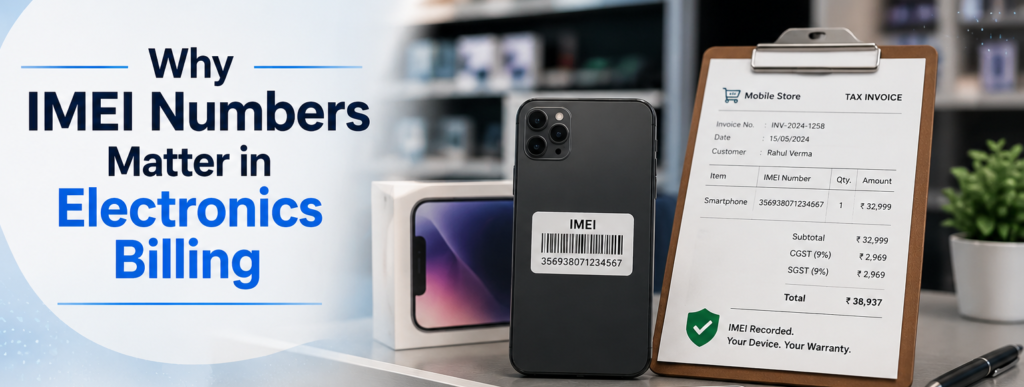
Table of Contents
- What is an IMEI Number?
- Why IMEI Numbers Matter in Electronics Billing
- How IMEI Numbers Help Customers
- How IMEI Numbers Help Electronics Shop Owners
- Where Should IMEI Appear in an Electronics Bill?
- IMEI Billing vs Normal Product Billing
- Common IMEI Billing Mistakes to Avoid
- How Billing Software Makes IMEI Tracking Easier
- When Should an Electronics Shop Start IMEI-Based Billing?
- Practical IMEI Billing Checklist for Shop Owners
What is an IMEI Number?
IMEI stands for International Mobile Equipment Identity. It is a unique identification number assigned to a mobile device. For most mobile phones, the IMEI number can be found on the phone box, inside device settings, on the purchase invoice, or by dialling *#06# from the phone.
In simple words, the IMEI number works like an identity proof for a mobile phone. Two phones may have the same brand, model, colour, storage, and price, but they should not have the same IMEI number.
For Indian mobile retailers, this detail is not only useful after the sale. It helps from the time stock enters the shop, until the product is sold, returned, exchanged, repaired, or checked for warranty.
Why IMEI Numbers Matter in Electronics Billing
IMEI numbers matter because electronics billing deals with high-value, unit-specific products. A mobile phone is not like a packet of biscuits or a notebook where only quantity matters. Each phone has its own identity, and the bill should clearly show which exact unit was sold.
Here is how IMEI numbers help in day-to-day electronics billing:
- They link one specific device to one specific customer.
- They make warranty and service claims easier to verify.
- They reduce confusion during returns and exchanges.
- They help shop owners track unsold and sold stock accurately.
- They make bills more complete and professional.
- They support better records for second-hand or refurbished phone sales.
Without IMEI tracking, your bill may show that a customer purchased “Samsung Galaxy A series” or “iPhone 15 128GB”. But it will not prove which exact device was handed over. That gap can create problems later.
How IMEI Numbers Help Customers
Customers usually need the bill when they face a phone issue, visit a service centre, claim warranty, or prove purchase ownership. If the invoice includes the correct IMEI number, the customer gets a stronger purchase record.
Warranty Claims Become Easier
Most mobile phone buyers keep the invoice mainly for warranty. If the bill clearly mentions the IMEI number, the service centre can match the device with the purchase record. This avoids confusion when the customer has bought more than one device from the same shop or when the model name is similar.
Example: A customer buys two phones of the same model for family members. After three months, one phone has a speaker issue. If both bills have IMEI numbers, it is easy to identify which phone is under which invoice.
Returns and Exchanges Are Clearer
Electronics shops often deal with exchange requests, wrong model complaints, display issues, or sealed-box disputes. When the IMEI number is printed on the bill, your staff can quickly check whether the returned phone is the same device that was sold.
This protects both sides. The customer gets a clear proof of purchase, and the shop avoids accepting a different device by mistake.
Second-Hand Purchases Feel Safer
If your shop deals in second-hand, refurbished, or exchange phones, IMEI-based billing becomes even more important. Customers want confidence that the phone they are buying is traceable and properly recorded.
In India, buyers can also check mobile handset genuineness through the Sanchar Saathi CEIR portal. The portal mentions that IMEI can be found on the mobile bill or invoice, packaging box, or by dialling *#06#. Adding IMEI to the bill makes this check easier for the customer.
How IMEI Numbers Help Electronics Shop Owners
For shop owners, IMEI numbers are not just customer-facing details. They also help manage stock, staff billing, supplier purchases, and after-sales service.
Accurate Stock Tracking
Mobile shops may keep several units of the same phone model. If your system only tracks quantity, you may know that five units are available, but not which five units are still in stock.
IMEI-based inventory tracking gives unit-level visibility. You can see which IMEI numbers came from which supplier, which ones are unsold, and which ones were billed to customers.
Fewer Billing Mistakes
During busy shop hours, staff may pick one phone box and enter another product detail by mistake. This is common when similar models, RAM variants, colours, or storage options are kept together.
When IMEI numbers are captured during billing, the invoice becomes more specific. This reduces mistakes like billing the wrong variant, missing warranty details, or selling a device without proper stock entry.
Better Supplier Records
Electronics retailers often buy stock from multiple distributors. If there is a defect, price dispute, replacement issue, or supplier return, IMEI records help you trace the device back to the original purchase entry.
Example: If a batch of phones from one supplier has repeated complaints, you can check which IMEI numbers came from that supplier and which customers bought them.
Smoother Staff Handover
Many mobile shops have multiple salespeople, counter staff, and store managers. If one person sells the device and another handles the return or service request later, the bill should explain everything clearly.
An invoice with IMEI number, customer name, date, model, price, GST, and payment status gives your team a clean record even when the original salesperson is not available.
Where Should IMEI Appear in an Electronics Bill?
An electronics bill does not need to be complicated, but it should include the details required to identify the product and complete the sale record.
For mobile phones, the invoice should ideally include:
- Shop name, address, and GSTIN, if applicable
- Invoice number and date
- Customer name and mobile number
- Brand and model name
- Colour, storage, or variant details
- IMEI number or serial number
- Quantity, price, discount, and GST breakup
- Total amount and payment mode
- Warranty or return terms, if applicable
If you need a simple structure for mobile invoices, you can also refer to a mobile bill format and adapt it for your shop’s billing process.
IMEI Billing vs Normal Product Billing
Normal retail billing usually focuses on item name, quantity, price, tax, and payment. IMEI billing goes one step deeper by tracking the exact unit sold.
| Billing Detail | Normal Retail Product | Mobile/Electronics Product |
|---|---|---|
| Product identity | Item name or SKU | Item name plus IMEI/serial number |
| Inventory tracking | Quantity-based | Unit-based |
| Warranty proof | Usually not required | Often required |
| Returns | Based on bill and item | Based on bill and exact device |
| Risk of mismatch | Lower | Higher without IMEI tracking |
This is why mobile and electronics retailers should not treat phones like regular stock items. The billing process must capture the device identity properly.
Common IMEI Billing Mistakes to Avoid
Even when shop owners understand the importance of IMEI numbers, small billing mistakes can still create problems. Here are the common ones to avoid:
Entering IMEI Manually Without Checking
A single wrong digit can make the bill difficult to use later. If your shop enters IMEI numbers manually, ask staff to cross-check the number from the box and device before completing the bill.
Writing IMEI Only on Paper Copies
If the IMEI number is written by hand on the customer copy but not saved in your digital records, your shop may struggle to search for it later. The IMEI should be stored in your billing system too.
Using the Same Item Entry for All Variants
A phone model may have different RAM, storage, colour, and price combinations. If all variants are billed under one generic item name, stock and margin reports can become confusing.
Not Linking IMEI to Purchase Entry
IMEI tracking should start when the product enters your shop, not only when it is sold. Recording IMEI at purchase helps trace supplier, cost, and stock status later.
How Billing Software Makes IMEI Tracking Easier
Small shops can start with manual records, but as sales grow, manual IMEI tracking becomes difficult. A billing software built for mobile and electronics shops can make this process faster and more reliable.
With the right billing system, you can:
- Record IMEI numbers while adding purchase stock
- Select or scan IMEI numbers during sales billing
- Print IMEI on the customer invoice
- Search old bills using customer name, invoice number, or IMEI
- Track sold and unsold devices separately
- Maintain customer, supplier, payment, and stock records in one place
This is where mobile shop billing software like myBillBook can help. It allows mobile retailers to create GST invoices, manage inventory, link IMEI numbers to bills, track payments, and access billing records from mobile or desktop.
For electronics shops that also sell accessories, chargers, headphones, smartwatches, speakers, or repair services, this helps keep phone inventory separate from fast-moving accessories. You can also use retail billing software features like inventory tracking, barcode billing, payment tracking, and business reports based on your shop’s needs.
When Should an Electronics Shop Start IMEI-Based Billing?
You should start IMEI-based billing as soon as your shop sells products where each unit has a unique identity. This includes:
- New mobile phones
- Second-hand or refurbished phones
- Tablets
- Smartwatches with device IDs
- Laptops or devices with serial numbers
- High-value electronics that need warranty tracking
If your shop only sells accessories, you may not need IMEI tracking for every item. But if even a part of your business involves mobile phones or device sales, recording IMEI numbers from the start is a safer practice.
Practical IMEI Billing Checklist for Shop Owners
Before handing over a phone to a customer, your billing team should check these points:
- Is the model name correct?
- Is the variant correct?
- Is the IMEI number captured correctly?
- Does the IMEI on the bill match the phone box?
- Is GST calculated correctly?
- Is the payment mode recorded?
- Are warranty or return terms mentioned clearly?
- Has the customer received a printed or digital copy?
This simple checklist can prevent many avoidable issues after the sale.
Conclusion
IMEI numbers matter in electronics billing because they connect the bill to the exact device sold. For customers, this creates stronger proof for warranty, returns, and ownership. For shop owners, it improves stock tracking, supplier records, staff handover, and dispute handling.
If your business sells mobile phones or high-value electronics, do not treat IMEI as an optional detail. Make it a regular part of your billing process from purchase entry to final invoice.
