
For many garages, spare parts shops, tyre dealers, and automobile service centres, collecting payments is not always as simple as raising a bill. Some customers pay a small advance, some ask for credit, some pay through UPI later, and some clear only part of the amount after delivery. That is why knowing how automobile shops can track customer dues and payments is important for daily cash flow.
If dues are tracked only in notebooks, WhatsApp chats, or memory, it becomes difficult to know who has paid, who still owes money, and which bills need follow-up. A simple automobile shop billing software can help automobile shop owners avoid confusion and collect payments more confidently.
Summary
Automobile shops can track customer dues and payments by keeping every bill, advance, partial payment, credit sale, and final collection connected to the right customer record. The easiest process is to create bill-wise records, maintain customer ledgers, set due dates for credit customers, track payment modes separately, review overdue reports regularly, and send clear reminders before dues become difficult to collect.
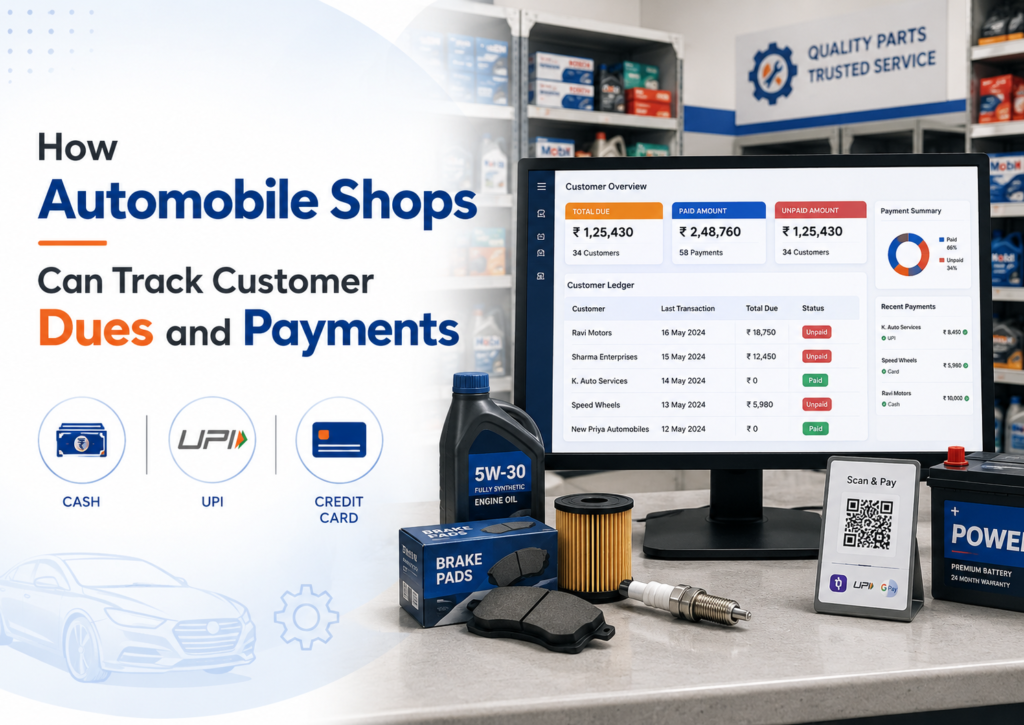
Table of Contents
- Why Payment Tracking Is Difficult in Automobile Shops
- Start with Bill-Wise Customer Records
- Use Customer Ledgers for Repeat Buyers
- Record Advance, Partial, and Final Payments Separately
- Set Clear Due Dates for Credit Customers
- Track Payment Modes Daily
- Separate New Sales from Old Due Collections
- Use Reports to Find Overdue Customers
- Send Payment Reminders Without Sounding Harsh
- Avoid These Common Mistakes
- How myBillBook Helps Automobile Shops Track Dues
- Simple Payment Tracking Checklist for Automobile Shops
Why Payment Tracking Is Difficult in Automobile Shops
Automobile businesses usually deal with different types of sales and services in the same day. A shop may sell spare parts in the morning, repair a two-wheeler in the afternoon, replace tyres for a regular customer in the evening, and supply parts to another garage on credit.
Because of this mixed workflow, customer dues can get missed easily. The problem becomes bigger when multiple staff members handle billing and collections.
Common payment tracking issues include:
- Advance payment collected but not adjusted in the final bill
- Partial payment received through UPI but not marked against the right invoice
- Regular customers buying parts on credit without clear due dates
- Old unpaid bills getting mixed with new purchases
- Owner not knowing daily cash, UPI, and pending collections separately
- Staff forgetting to follow up with customers after service delivery
These small gaps may look manageable at first. But over time, they affect working capital because the shop still has to pay suppliers, staff, rent, and other expenses on time.
Start with Bill-Wise Customer Records
The first step is to stop tracking dues only by customer name and start tracking them bill-wise. Every invoice should clearly show the customer details, bill amount, amount received, payment mode, and balance amount.
For example, if a customer buys brake pads worth ₹2,500 and pays ₹1,000 immediately, the remaining ₹1,500 should be linked to that specific bill. Later, when the customer pays the balance through UPI, the payment should be adjusted against the same invoice.
This avoids confusion when the same customer visits again for another service or purchase. Instead of asking “Kitna baaki tha?”, you can check the previous bill and payment status directly.
Use Customer Ledgers for Repeat Buyers
Many automobile shops have regular buyers such as taxi owners, fleet operators, mechanics, small garages, transporters, and nearby businesses. These customers may not pay for every bill immediately. They may clear payments weekly, fortnightly, or monthly.
For such customers, a customer ledger is more useful than a simple notebook entry. A ledger shows every sale, every payment received, every adjustment, and the final outstanding balance in one place.
A good customer ledger should answer four questions:
- How much has the customer purchased?
- How much has the customer paid?
- Which invoices are still unpaid?
- How old are the pending dues?
This is especially helpful for automobile spare parts shops and service centres where regular customers may have many small bills instead of one large bill.
Record Advance, Partial, and Final Payments Separately
Automobile businesses often collect payments in stages. A garage may take an advance before ordering a part. A repair shop may collect labour charges after work is completed. A tyre shop may receive part payment on delivery and the remaining amount later.
Instead of writing only “paid” or “pending,” it is better to record each payment stage separately.
Advance Payment
Advance payment should be recorded before the final bill is closed. For example, if a customer gives ₹3,000 advance for a clutch replacement, that amount should be visible when the final invoice is prepared.
Partial Payment
Partial payment should show the amount received and the balance due. This helps the owner avoid mistakes when a customer says they have already paid some amount.
Final Payment
Once the full balance is cleared, the invoice should be marked as paid. This keeps the outstanding report clean and avoids unnecessary follow-ups.
Set Clear Due Dates for Credit Customers
Credit sales are common in automobile businesses, especially for known customers. But credit becomes risky when there is no due date. A customer may say they will pay “next week,” but without a date, follow-up becomes weak.
Every credit bill should have a clear due date. For example:
- Retail customer: payment due in 3 days
- Regular mechanic: payment due every Saturday
- Fleet customer: payment due every 15 days
- Wholesale buyer: payment due within 30 days
Due dates help you separate normal credit from overdue payments. They also make follow-ups more professional because you are not randomly calling customers; you are following a clear billing record.
Track Payment Modes Daily
Automobile shops usually receive payments through cash, UPI, bank transfer, card, and sometimes cheque. If all payment modes are mixed together, daily reconciliation becomes difficult.
At the end of the day, the owner should be able to check:
- Total cash collected
- Total UPI payments received
- Total bank transfers received
- Total card payments received
- Total credit sales created
- Total old dues collected
This helps match billing records with the cash counter, bank account, and UPI app. It also helps identify whether a payment was received for today’s bill or an older outstanding bill.
Separate New Sales from Old Due Collections
One common mistake in small shops is treating every payment received today as today’s sale. This can make sales look higher than they actually are.
For example, suppose your shop bills ₹18,000 today and also collects ₹7,000 from an old customer due. Your total cash and UPI collection may be ₹25,000, but today’s actual sales are still ₹18,000.
Keeping sales and old due collections separate helps you understand business performance correctly. It also makes it easier to share clean records with your accountant or CA.
Use Reports to Find Overdue Customers
A payment tracking system is useful only when it gives clear reports. Automobile shop owners should not wait until month-end to check pending payments. A weekly overdue report can show which customers need immediate follow-up.
Useful reports for automobile shops include:
- Customer-wise outstanding report
- Bill-wise pending payment report
- Due date-wise overdue report
- Payment mode report
- Daily collection report
- Sales vs collection report
These reports help the owner take action quickly. For example, if a mechanic has crossed the agreed credit limit, the shop can pause further credit until old dues are cleared.
Send Payment Reminders Without Sounding Harsh
Payment follow-up is sensitive. Automobile shop owners want to collect dues without damaging customer relationships. A simple reminder message works better than a harsh call.
Here is a practical reminder format:
Hello [Customer Name], your pending amount of ₹[Amount] for invoice #[Invoice Number] dated [Date] is due. Please clear it when possible. Thank you.
For regular customers, you can make the message warmer:
Hello [Customer Name], sharing your pending balance for this week. Total due: ₹[Amount]. Please check and let us know once paid.
The key is to mention the invoice number, date, and amount clearly. This reduces back-and-forth and helps the customer verify the bill.
Avoid These Common Mistakes
Many dues-related problems happen because the shop does not have a fixed payment process. Avoiding a few common mistakes can make collections easier.
- Do not give credit without creating a bill
- Do not depend only on WhatsApp chats for payment proof
- Do not mix personal transfers with business payments
- Do not delay updating partial payments
- Do not allow staff to collect money without recording the mode
- Do not wait for month-end to check overdue customers
Even a simple daily habit of updating payments after every bill can reduce confusion later.
How myBillBook Helps Automobile Shops Track Dues
myBillBook can help automobile shops manage billing and payment tracking in one place. Instead of maintaining separate notebooks for bills, customer credit, and daily collections, shop owners can create invoices, record payments, and check outstanding amounts from mobile or desktop.
For automobile shops, useful features include:
- GST and non-GST invoice creation for parts and services
- Customer-wise outstanding tracking
- Partial payment and balance amount recording
- Payment mode tracking for cash, UPI, bank, and other modes
- Daily sales and collection reports
- Invoice sharing with customers
- Inventory tracking for spare parts, tyres, oils, and accessories
- Data access on mobile and desktop for owners and staff
If your shop also manages spare parts stock, you can read this guide on how auto spare parts shops can track stock easily. For a broader setup, you can also explore billing software for automobile shops.
Simple Payment Tracking Checklist for Automobile Shops
Use this checklist to keep customer dues under control:
- Create a bill for every sale or service
- Add the customer name and mobile number
- Record advance payments before final billing
- Mark partial payments immediately
- Add a due date for credit bills
- Track cash, UPI, bank, and card payments separately
- Check outstanding reports every week
- Follow up overdue customers with invoice details
- Reconcile daily collections before closing the counter
- Stop new credit for customers with long-pending dues
Conclusion
Customer dues are common in automobile shops, but they should not depend on memory, rough notes, or scattered messages. A clear process for invoices, ledgers, due dates, partial payments, and daily reports can help shop owners know exactly how much money is pending and from whom.
With myBillBook, automobile shops can create bills, record payments, track outstanding amounts, manage spare parts inventory, and view business reports from one place. It helps owners stay organised without making daily billing complicated.
