
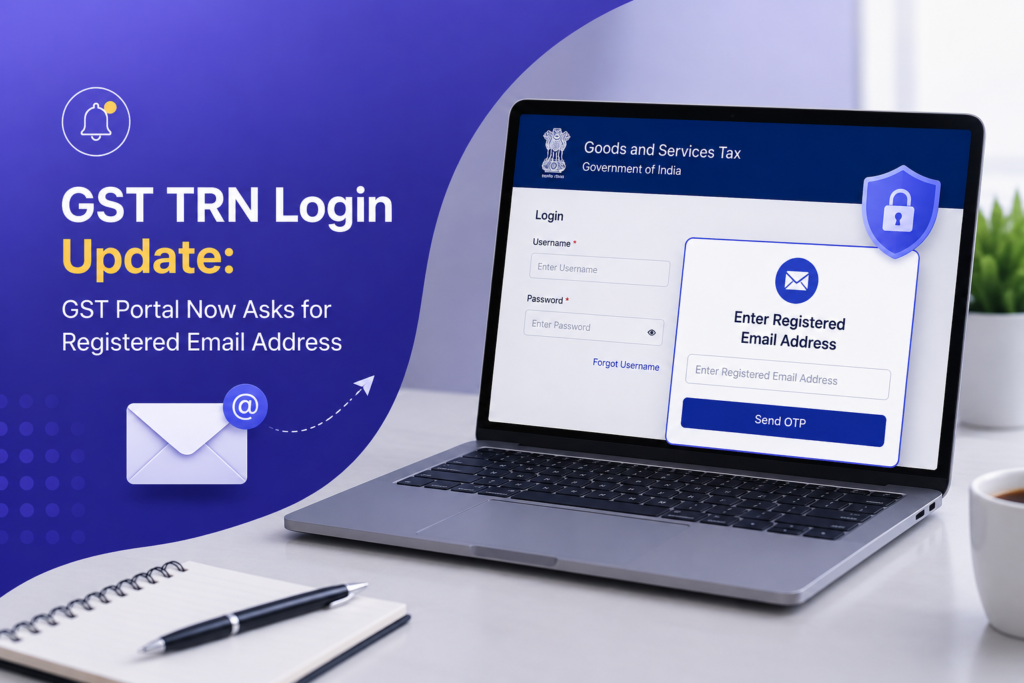
If you are returning to a saved GST registration application using a Temporary Reference Number (TRN), you may notice an additional field on the GST Portal. The TRN access screen now asks for the registered email address along with the TRN and CAPTCHA before the applicant proceeds to OTP verification.
This is an important portal workflow update, but it should not be confused with a new GST registration rule. Email address verification was already part of the GST registration process before a TRN was generated.
Important clarification: This update changes how an applicant accesses a saved registration application through TRN. It does not mean that email verification has become mandatory for the first time, and it does not create a new GST registration eligibility requirement.
What Has Changed in GST TRN Login?
The official GST registration tutorial has historically described the TRN access flow as entering the Temporary Reference Number and CAPTCHA, clicking Proceed, and then completing OTP verification.
The updated GST Portal interface now asks applicants to provide the email address associated with the registration application as an additional field at the TRN access stage.
| Earlier TRN access flow | Updated TRN access flow |
|---|---|
| Enter TRN | Enter TRN |
| Enter CAPTCHA | Enter registered email address |
| Click Proceed | Enter CAPTCHA |
| Complete OTP verification | Click Proceed and complete OTP verification |
The practical change is therefore at the TRN access stage, before OTP verification.
Is Email Address a New Requirement for GST Registration?
No. An email address was already required during the initial GST registration process.
Under the GST registration rules published by CBIC, an applicant provides basic information during the initial registration stage. The applicant’s PAN, mobile number and email address are verified, and after successful verification a Temporary Reference Number is generated and communicated to the applicant.
So, the new point is not that GST registration suddenly requires an email address. The change is that the GST Portal is now asking for the registered email address again when an applicant uses the TRN to access the saved application.
This distinction matters because describing the update as a “new mandatory email verification rule” would be misleading.
What Is a TRN in GST?
A Temporary Reference Number (TRN) is generated during the GST registration process after the required preliminary details are successfully verified. Applicants use the TRN to return to and continue an incomplete registration application before final submission.
The TRN is different from an Application Reference Number (ARN). A TRN is used while the registration application is still being prepared, whereas an ARN is generated after the application is submitted and is commonly used to track the application’s progress.
You can learn more about tracking submitted applications in our guide to GST Registration Status.
How to Access a GST Registration Application Using TRN After the Update
The GST Portal interface may change over time, but applicants using the current TRN access flow can generally follow these steps:
- Visit the official GST Portal at gst.gov.in.
- Go to Services > Registration > New Registration.
- Select Temporary Reference Number (TRN).
- Enter the TRN generated for your registration application.
- Enter the email address associated with the GST registration application when the field is displayed.
- Enter the CAPTCHA shown on the screen.
- Click Proceed.
- Complete the OTP verification requested by the portal.
- Open the saved application and continue completing the required registration details.
Use the same email address associated with the registration application rather than an unrelated or alternate email address.
Does the GST TRN Email Update Change GST Registration Rules?
Based on the official materials checked for this update, this should be treated as a GST Portal workflow change, not as a new GST law or a new category of registration compliance.
CBIC’s registration rules already provide for verification of the applicant’s email address before generation of the TRN. The older official GST tutorial, meanwhile, still describes the TRN login step using the TRN and CAPTCHA before OTP verification.
As of 11 August 2026, we did not find a separate CBIC or GSTN advisory stating that the additional email field represents a statutory amendment to GST registration rules.
Businesses, tax professionals and applicants should therefore avoid interpreting the new field as a change in who must register for GST, the documents required for GST registration, or the underlying eligibility conditions.
Why Might the GST Portal Ask for Email Address with TRN?
Requiring the registered email address at the TRN access stage adds another applicant-specific detail before the user reaches OTP verification. From a user perspective, this can make it harder to proceed with only a TRN and CAPTCHA.
However, unless GSTN publishes an advisory explaining the reason for the change, it is better not to claim that the field was introduced specifically for fraud prevention, security enhancement or any other stated policy objective.
What can be stated factually is that applicants may now need an additional piece of information—the email address linked to the application—to access their saved GST registration through TRN.
What Should GST Applicants Do Now?
If you are applying for GST registration, keep the TRN and the email address used during registration readily accessible until the application is submitted.
Before trying to access a saved application through TRN:
- use the same email address associated with the GST registration application;
- check the TRN carefully before submitting it;
- make sure you can access the registered email/mobile number for OTP verification;
- avoid relying only on old screenshots or tutorials because the GST Portal interface can be updated before help documentation is revised.
GST TRN Login Update: Key Takeaway
The latest TRN access change is small but important for anyone with a GST registration application saved on the portal.
The GST Portal now asks for the registered email address in addition to the TRN and CAPTCHA when accessing a registration application through TRN. But email verification itself is not new: it has already been part of the GST registration process before TRN generation.
Therefore, the safest way to understand the update is as a change to the GST Portal’s TRN access workflow, rather than a new GST registration law or a new email-verification requirement.
Official References
Note: GST Portal screens and processes can be updated from time to time. Always follow the fields and instructions displayed on the official portal while completing a registration application.
Frequently Asked Questions
Is email address now required for GST TRN login?
The updated TRN access interface may ask applicants to enter the email address associated with their GST registration application along with the TRN and CAPTCHA before proceeding to OTP verification.
Is email verification newly mandatory for GST registration?
No. Email verification was already part of the registration process. CBIC’s registration rules provide for verification of the applicant’s email address before a TRN is generated.
What email address should I enter with my GST TRN?
Use the email address associated with the GST registration application. Using a different email address may prevent the portal from validating the application details.
Is the TRN the same as the ARN in GST?
No. A TRN is used to access and continue a registration application before final submission. An ARN is generated after submission and can be used to track the application.
Has GSTN introduced a new GST registration rule through this update?
The additional email field should currently be treated as a portal workflow change. As checked on 11 August 2026, we did not find a separate official CBIC or GSTN advisory establishing it as a new statutory GST registration requirement.
