
Accounting software vs billing software is a common question for Indian business owners who want to move away from manual bills, Excel sheets, and scattered payment records. At first, both may look similar because both deal with money, invoices, customers, and reports. But they are not exactly the same.
Billing software mainly helps you create bills, manage GST invoices, track payments, update stock, and handle day-to-day sales. Accounting software focuses on recording financial transactions, managing ledgers, tracking expenses, preparing financial statements, and giving a complete view of your business accounts.
For a small shop, wholesaler, distributor, restaurant, pharmacy, or service business, the right choice depends on one simple question: do you first need faster daily billing, or do you need deeper accounting control?
Summary
Billing software is best when your main challenges are creating invoices, handling GST, tracking customer dues, managing stock, and keeping sales records organised. Accounting software is better when your main requirement is maintaining ledgers, tracking expenses, preparing profit and loss reports, balance sheets, and sharing complete books with your accountant.
Many Indian SMBs need both billing and basic accounting together because sales, GST, payments, inventory, and reports are connected in daily business. That is where a billing and accounting tool like myBillBook online accounting software can help businesses manage billing, GST, inventory, payments, and reports in one place.
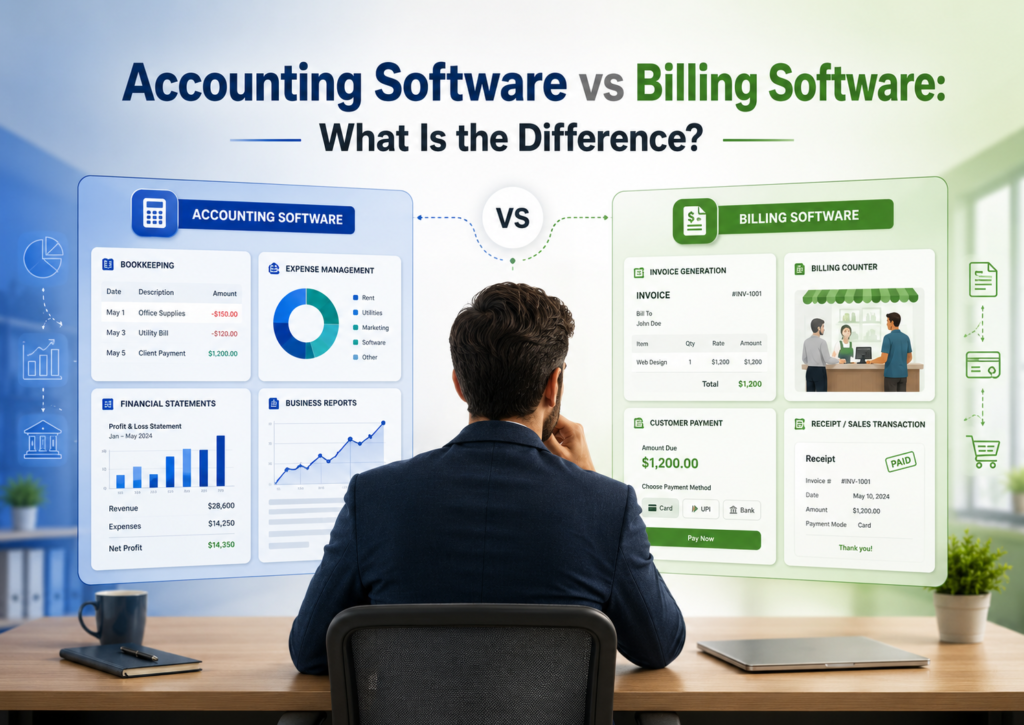
Table of Contents
- What Is Billing Software?
- What Is Accounting Software?
- Accounting Software vs Billing Software: Key Differences
- Where Billing and Accounting Software Overlap
- Which One Does Your Business Need?
- Examples for Indian SMBs
- Why Separate Tools Can Create Problems
- Checklist Before Choosing
- Conclusion
What Is Billing Software?
Billing software is a tool that helps businesses create and manage bills or invoices. For Indian businesses, this usually means GST invoices, non-GST bills, quotations, delivery challans, payment records, and sales reports.
For example, a garment shop owner can use billing software to scan an item, select the customer, apply GST, print the bill, and update stock automatically. A distributor can create GST invoices, track credit sales, and check which retailers still have pending payments.
Common billing software features
- GST invoice creation
- Sales and purchase billing
- Customer payment tracking
- Pending dues and reminders
- Inventory and stock updates
- Barcode billing and POS billing
- Quotation and estimate creation
- E-way bill and e-invoicing support, where required
- Basic business reports
In simple words, billing software is closer to the sales counter. It helps the business owner and staff manage daily transactions faster and more accurately.
What Is Accounting Software?
Accounting software helps businesses record, organise, and review financial transactions. It is used to maintain books of accounts, track income and expenses, manage ledgers, monitor payables and receivables, and prepare reports needed for financial review.
For example, a wholesaler may use accounting software to track supplier payments, customer receivables, purchase expenses, bank entries, cash flow, profit and loss, and tax-related records. A CA or accountant may also use the data to check whether the books are complete and accurate.
Common accounting software features
- Ledger management
- Expense tracking
- Receivables and payables tracking
- Profit and loss reports
- Balance sheet reports
- Cash and bank entries
- Tax reports
- Accountant or CA access
- Financial statement preparation
In simple words, accounting software is closer to the accounts desk. It helps the owner, accountant, or finance team understand the financial health of the business.
Accounting Software vs Billing Software: Key Differences
The biggest difference between accounting software and billing software is the scope. Billing software focuses on the transaction at the time of sale. Accounting software focuses on the overall financial record after transactions happen.
| Point of Difference | Billing Software | Accounting Software |
|---|---|---|
| Main purpose | Create bills, invoices, and sales records | Maintain complete financial accounts |
| Primary users | Shop owner, billing staff, cashier, sales team | Owner, accountant, CA, finance team |
| Daily use | Used at the billing counter or during sales | Used for reviewing and managing accounts |
| GST role | Helps create GST invoices with tax details | Helps organise GST-related records and reports |
| Inventory role | Often updates stock after sales and purchases | May connect stock value with financial reports |
| Payment role | Tracks paid, unpaid, and partially paid bills | Tracks receivables, payables, cash, and bank entries |
| Best for | Fast billing, stock movement, customer dues | Financial records, ledgers, reports, compliance review |
Where Billing and Accounting Software Overlap
Many business owners get confused because modern billing software and accounting software often share some features. For example, both may show sales reports, payment status, customer balances, GST summaries, and business performance reports.
This overlap is useful for small businesses because billing and accounting are connected. When you create a sales invoice, it affects your sales record, tax calculation, customer balance, and stock. When you record a payment, it affects your cash flow and outstanding amount.
That is why Indian SMBs often prefer a tool that combines billing, accounting, GST, inventory, and reports instead of using separate systems for every task.
Which One Does Your Business Need?
You do not need to choose based only on the software name. Choose based on the problem you are trying to solve.
Choose billing software if your main problem is daily billing
Billing software is usually the better starting point if you create many bills every day, manage stock, sell on credit, or need GST invoices quickly.
For example, a retail shop owner may not need complex accounting on day one. But they do need quick billing, item-wise stock, barcode support, customer dues, and daily sales reports. In this case, a billing-first solution is more practical.
You can also read this guide on choosing the right billing tool for your business if you are comparing paper bills, Excel, and billing software.
Choose accounting software if your main problem is financial control
Accounting software is useful when your business needs stronger control over ledgers, expenses, profit and loss, receivables, payables, and accountant-ready reports.
For example, a business with multiple suppliers, credit purchases, regular expenses, and monthly CA reviews may need accounting features along with billing. In this case, software that supports both billing and accounting is more useful than a basic invoice maker.
Choose both if billing and accounts are connected
Most Indian SMBs eventually need both. A pharmacy needs GST billing, batch-wise stock checks, expiry awareness, payment tracking, and reports. A distributor needs invoices, party-wise outstanding, stock movement, and sales reports. A restaurant needs quick billing, item-wise sales, staff access, and business reports.
In these cases, using one system for billing and another for accounts can create extra work. You may have to enter the same sale twice, correct mismatched records, or depend on your accountant for basic information.
Examples for Indian SMBs
Here are a few practical examples to understand the difference better.
Retail shop
A retail shop mainly needs fast billing, GST invoice creation, barcode billing, stock updates, and payment tracking. Billing software should be the first priority. Accounting features become useful when the owner wants to track expenses, profit, and reports more closely.
If you run a retail business, this guide on how to choose billing software for a retail shop can help with retail-specific checks.
Wholesaler or distributor
A wholesaler or distributor usually sells to many parties on credit. Here, billing software helps create GST invoices and track outstanding payments. Accounting software helps review receivables, payables, purchase records, and overall cash flow.
Restaurant or food business
A restaurant needs quick order billing, item-wise sales reports, staff access, and payment tracking. It may not need complex accounting at the counter, but it still needs clean sales and expense records for business review.
Pharmacy
A pharmacy needs GST billing, product-wise stock, batch details, expiry awareness, and customer bills. Billing software is important for daily operations, while accounting features help the owner understand purchases, sales, and payment records.
Why Separate Tools Can Create Problems
Using separate tools is not always wrong. Some larger businesses may prefer specialised systems. But for many small businesses, separate tools can create avoidable confusion.
- The same invoice may need to be entered in two places.
- Stock may not match sales records.
- Customer dues may not match accounting entries.
- Staff may use one system while the accountant uses another.
- Reports may take longer to prepare.
If your business is still small or growing, it is usually better to keep billing, GST, inventory, payments, and reports connected from the beginning.
Checklist Before Choosing Between Accounting and Billing Software
Before you decide, ask these questions:
- Do I create bills every day?
- Do I need GST invoice formats?
- Do I sell items on credit?
- Do I need to track customer dues?
- Do I need inventory or barcode billing?
- Do I need profit, expense, and business reports?
- Does my CA need access to organised records?
- Will my staff use the software at the billing counter?
- Do I need the same data on mobile and desktop?
If most of your answers are about invoices, stock, payments, and counter billing, start with billing software. If most answers are about ledgers, reports, expenses, and financial statements, you need accounting software. If you need both, choose an integrated billing and accounting solution.
Conclusion
The difference between accounting software and billing software is simple: billing software helps you manage daily sales and invoices, while accounting software helps you manage the overall financial records of your business.
For Indian SMBs, the practical answer is not always one or the other. If your business handles GST invoices, stock, credit sales, customer dues, expenses, and CA reviews, you may need a solution that connects billing and accounting together.
myBillBook helps small businesses create GST bills, manage inventory, track payments, review reports, and keep business records organised across mobile and desktop. If you want a simple way to manage billing and essential business accounting together, try myBillBook for your business.
