
A bad debts journal entry records money that a business no longer expects to recover from a customer. When a credit-sale amount becomes irrecoverable, debit Bad Debts A/c and credit the customer’s account. This removes the uncollectible receivable and recognises the loss.
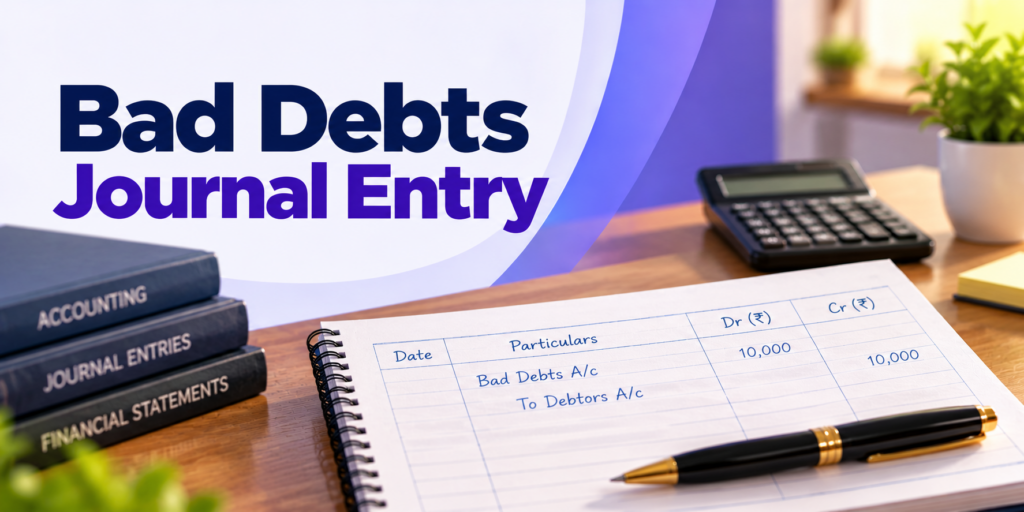
Table of Contents
- Bad debts journal entry format
- Bad debts journal entry with example
- Provision for doubtful debts entry
- Bad debts recovered journal entry
- Treatment in final accounts
- Income tax and GST considerations
- Common mistakes
- Frequently asked questions
What Is the Bad Debts Journal Entry?
Bad debts are customer dues that a business determines cannot be collected. The standard direct write-off entry is:
| Account | Debit (₹) | Credit (₹) |
|---|---|---|
| Bad Debts A/c Dr. | Amount written off | — |
| To Customer/Debtors A/c | — | Amount written off |
Narration: Being the amount due from the customer written off as irrecoverable.
Why? Bad debts are an expense (debit), while the customer receivable is an asset that must be reduced (credit). An overdue invoice alone does not automatically mean the debt should be written off.
Bad Debts Journal Entry With Example
Suppose a Jaipur stationery wholesaler sold goods on credit to a retailer for ₹18,000. After documented follow-ups, the retailer closes operations and the wholesaler determines the amount cannot be recovered.
| Particulars | Debit (₹) | Credit (₹) |
|---|---|---|
| Bad Debts A/c Dr. | 18,000 | — |
| To Retailer A/c | — | 18,000 |
The retailer’s outstanding balance falls by ₹18,000, and the business recognises a ₹18,000 loss. If only ₹6,000 of a ₹20,000 receivable is irrecoverable, write off ₹6,000, not the entire invoice; ₹14,000 remains receivable.
Entry to Transfer Bad Debts to Profit and Loss Account
| Account | Debit | Credit |
|---|---|---|
| Profit & Loss A/c Dr. | ₹18,000 | — |
| To Bad Debts A/c | — | ₹18,000 |
This closing entry transfers the expense to the profit and loss account when using traditional ledger accounts. In accounting systems where expenses already flow into the income statement, a separate manual closing entry may not be necessary.
Provision for Doubtful Debts Journal Entry
A doubtful debt may still be recovered. Instead of removing a specific customer’s balance, a business may estimate expected non-collection and recognise a provision (also called an allowance for doubtful debts).
| Account | Debit (₹) | Credit (₹) |
|---|---|---|
| Profit & Loss / Impairment Expense A/c Dr. | 5,000 | — |
| To Provision for Doubtful Debts A/c | — | 5,000 |
Example: Outstanding debtors are ₹1,00,000 and the estimated doubtful amount is 5%, or ₹5,000. The net receivable presented becomes ₹95,000, although individual customer balances remain unchanged.
Writing Off a Debt Against an Existing Provision
If ₹2,000 of that receivable later becomes irrecoverable and the provision covers the loss:
| Account | Debit (₹) | Credit (₹) |
|---|---|---|
| Provision for Doubtful Debts A/c Dr. | 2,000 | — |
| To Customer A/c | — | 2,000 |
This reduces both the provision and the receivable without recognising the same expense twice. At year end, adjust the remaining provision to the newly required balance; do not automatically charge the full estimated balance again. The exact allowance methodology depends on the accounting framework used.
Bad Debts Recovered Journal Entry
Sometimes a customer pays after their debt has been written off. If the wholesaler later receives ₹3,000 on a previously written-off balance, the traditional entry is:
| Account | Debit (₹) | Credit (₹) |
|---|---|---|
| Bank A/c Dr. | 3,000 | — |
| To Bad Debts Recovered A/c | — | 3,000 |
Recognise the recovery in the relevant income account. Under an allowance-based system, the business may first reinstate the receivable and then record its collection. The entry should follow the accounting policy consistently.
How Bad Debts Affect Final Accounts
| Statement | Effect |
|---|---|
| Profit and loss account | Bad-debt expense reduces profit when recognised. |
| Balance sheet | Direct write-off reduces trade receivables; a provision reduces their net carrying amount. |
| Cash flow | The write-off itself is non-cash; any later recovery creates a cash receipt. |
For example, ₹80,000 of trade receivables less a ₹10,000 write-off and ₹3,500 remaining provision gives net receivables of ₹66,500, assuming the provision relates to the remaining balance.
Bad Debts: Income Tax and GST Considerations in India
Under the Indian income-tax rules applicable to ordinary business bad debts, an actual write-off in the accounts is generally required for a deduction under Section 36(1)(vii), subject to Section 36(2) and other applicable conditions. A mere provision for doubtful debts generally does not qualify for ordinary businesses. Recovery of a previously deducted bad debt can also have tax consequences. Refer to Income Tax Department guidance and confirm the treatment with your CA.
GST is separate: Writing off an unpaid customer invoice in the books does not, by itself, cancel the original GST liability or automatically permit reversal of output GST. A valid GST credit note or another statutory adjustment requires its own legal conditions; do not issue one merely because the customer has not paid.
Common Mistakes to Avoid
- Writing off every overdue invoice: Verify whether collection is genuinely unlikely before recognising an irrecoverable debt.
- Debiting the customer: The customer’s receivable must be credited when written off.
- Confusing provision and write-off: A provision estimates loss; a write-off removes a specific debt.
- Charging the same loss twice: Use the existing provision correctly when writing off a covered debt.
- Ignoring supporting records: Keep invoices, correspondence, follow-up history and write-off approvals for reconciliation and tax review.
Frequently Asked Questions
Is bad debt debited or credited?
Bad Debts A/c is debited because it is an expense. The customer’s receivable account is credited to reduce the amount owed.
What is the journal entry for ₹10,000 bad debts?
Debit Bad Debts A/c ₹10,000 and credit the relevant Customer A/c ₹10,000.
What is the difference between bad debts and doubtful debts?
Bad debts are identified as irrecoverable and written off. Doubtful debts may still be collected, so an estimate or provision may be appropriate.
Is bad debt an expense or liability?
Bad debt is an expense or impairment loss, not a liability. It reduces profit and the net value of receivables.
Can bad debts be recovered after write-off?
Yes. Record a later receipt using the recovery treatment appropriate to the business’s accounting method.
Does writing off bad debts automatically reduce GST payable?
No. A book write-off alone does not reverse GST charged on the original supply.
