
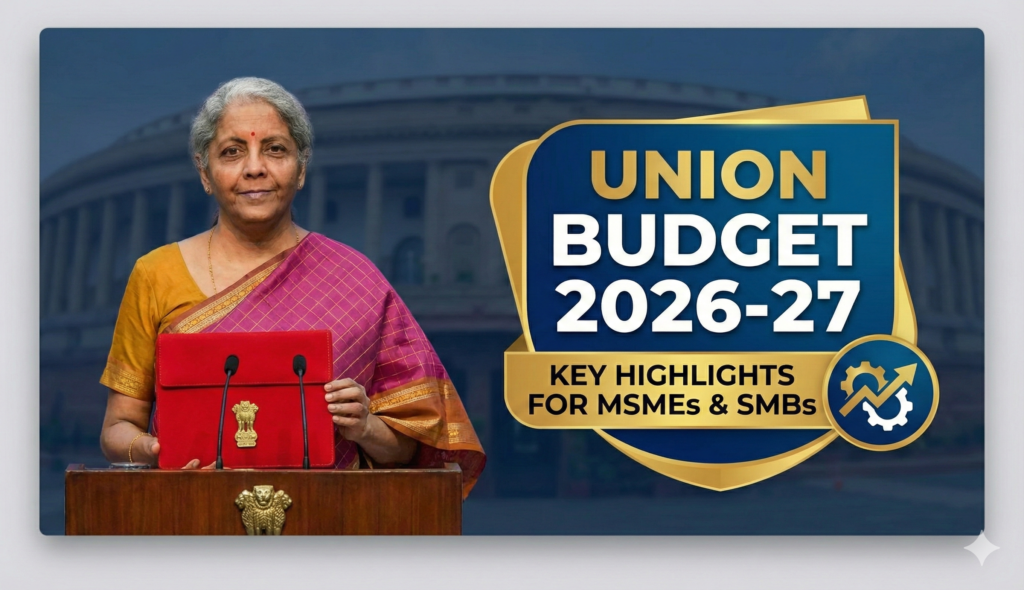
The Union Budget 2026-27, presented by Finance Minister Nirmala Sitharaman on February 1, 2026, marks a historic shift toward “Yuva Shakti” and a more resilient, technology-driven economy. For the millions of small business owners and B2B traders who power India, this budget isn’t just about numbers—it’s about structural reforms designed to solve your biggest pain points: cash flow, compliance, and capital.
The speech is built around three core “kartavyas” (duties):
- Accelerate and sustain economic growth by enhancing productivity and competitiveness.
- Fulfill aspirations and build the capacity of our people.
- Ensure inclusive progress for every family, community, and region under the vision of Sabka Sath, Sabka Vikas.
1. Creating “Champion MSMEs“
The government has introduced a targeted three-pronged approach to help small businesses scale up and compete globally.
A. Solving the Cash Flow Crisis
- Mandatory TReDS: TReDS is now mandated as the transaction settlement platform for all purchases from MSMEs by Central Public Sector Enterprises (CPSEs).
- Invoice Discounting Guarantees: A new credit guarantee support mechanism through CGTMSE will be introduced specifically for invoice discounting on the TReDS platform.
- GeM-TReDS Integration: Linking the Government e-Marketplace (GeM) with TReDS will allow for the sharing of government purchase information with financiers, encouraging cheaper and quicker financing.
- Secondary Market for Liquidity: TReDS receivables will be introduced as asset-backed securities to help develop a secondary market and enhance transaction settlement.
With mandatory TReDS, MSMEs can now look forward to faster payment cycles. You can prepare for this shift by switching to professional e-invoicing software like myBillBook that streamlines your receivables.
B. New Capital Avenues
- ₹10,000 Crore SME Growth Fund: A dedicated fund to create future “Champions” by providing equity support and incentivizing enterprises based on select criteria.
- Self-Reliant India Fund Top-up: An additional ₹2,000 crore has been added to the fund set up in 2021 to maintain access to risk capital for micro-enterprises.
C. Professional Compliance Support
- “Corporate Mitras”: The government will facilitate professional institutions like ICAI, ICSI, and ICMAI to train a cadre of accredited para-professionals known as “Corporate Mitras”.
- Affordable Compliance: These professionals will be stationed especially in Tier-II and Tier-III towns to help MSMEs meet compliance requirements at affordable costs.
While ‘Corporate Mitras’ offer affordable help, myBillBook already allows you to add your CA as a user to your account for real-time collaboration and error-free filing.
2. Taxation: The “New Income Tax Act, 2025”
A major highlight for small business owners is the complete overhaul of the direct tax system to improve the ease of living and doing business.
- New Act Timeline: The Income Tax Act, 2025 was completed in record time and will officially come into effect from April 1, 2026.
- Staggered Filing Deadlines: While individuals with ITR 1 and ITR 2 returns will continue to file by July 31, non-audit business cases and trusts now have a due date of August 31.
- Extension for Revised Returns: The time available for revising returns has been extended from December 31 to March 31 following the tax year.
- Decriminalization of Technical Errors: The budget decriminalizes the non-production of books of account and certain TDS payment requirements where payment is made in kind.
- Penalties Converted to Fees: Penalties for certain technical defaults, such as failure to get accounts audited or non-furnishing of transfer pricing reports, are being converted into simple fees.
- Automated Lower TDS Certificates: A new rule-based automated process will allow small taxpayers to obtain lower or nil tax deduction certificates online instead of filing a manual application with an assessing officer.
While the August 31 deadline provides extra time, using automated accounting software ensures your books are audit-ready and compliant with the new tax laws well in advance.
3. Sector-Specific Wins for Traders & Manufacturers
- Textiles Expansion: For the labour-intensive textile sector, a new Integrated Programme will modernize traditional clusters with capital support for machinery and technology upgradation.
- E-commerce Exports: To support small businesses and artisans, the current value cap of ₹10 lakh per consignment on courier exports is being completely removed.
- The removal of the export value cap is a massive win for online sellers. Scaling your international presence is easier when you have integrated e-commerce billing software to manage global orders.
- Infrastructure (B2B Impact): Public capital expenditure is proposed to increase to ₹12.2 lakh crore. This includes establishing new Dedicated Freight Corridors (East-West) and operationalizing 20 new National Waterways to reduce logistics bottlenecks.
- Digital Tools for Agri-Business: The launch of Bharat-VISTAAR, a multilingual AI tool, will integrate agricultural portals to enhance farm productivity and provide customized advisory support.
The government’s push for digital tools mirrors the need for modern entrepreneurs to manage their business anywhere. Our mobile bookkeeping app puts this power directly in your pocket.
Summary for myBillBook Customers
- August 31 Deadline: You now have an extra month to file tax returns for non-audit business cases.
- Mandatory TReDS: Faster payment cycles are now a reality when dealing with CPSEs.
- Corporate Mitras: Affordable, accredited professional help is coming to Tier-II and Tier-III towns for your compliance needs.
- Decriminalization: Major relief as minor technical defaults no longer carry the risk of prosecution.
- No Cap on Courier Exports: Scale your global reach through e-commerce without the previous ₹10 lakh limit.
The 2026-27 Budget is clearly designed to shift small businesses from the “informal” to the “champion” category. By streamlining payments and simplifying the tax code, the government is betting on you to drive the next phase of India’s growth.
Beyond Business: Other Key Budget Highlights
While the focus for many of our readers is on business growth, the Union Budget 2026-27 also introduces several measures aimed at social welfare, health, and personal ease of living:
Personal Tax & Ease of Living:
- Interest awarded by the Motor Accident Claims Tribunal is now exempt from income tax for individuals.
- The TCS rate for pursuing education and medical purposes under the Liberalized Remittance Scheme (LRS) has been reduced from 5% to 2%.
- A one-time 6-month foreign asset disclosure scheme will be introduced for small taxpayers to disclose overseas assets below ₹1 crore.
Healthcare & Mental Health:
- To strengthen rural health, Emergency and Trauma Care Centres in District Hospitals will see a 50% capacity increase.
- The government will establish NIMHANS-2 in North India and upgrade mental health institutes in Ranchi and Tezpur.
- A new “Biopharma SHAKTI” initiative (outlay of ₹10,000 crore) will focus on domestic production of biologic medicines and biosimilars.
Education, Skills & Youth:
- To support girl students in STEM, one girls’ hostel will be established in every district.
- Five University Townships will be created near major industrial and logistic corridors to bridge the gap between education and industry.
- Content creator labs for Animation, Visual Effects, Gaming, and Comics (AVGC) will be set up in 15,000 secondary schools.
Agriculture & Rural Entrepreneurship:
- Bharat-VISTAAR, a multilingual AI tool, will be launched to provide farmers with customized advisory support and reduce agricultural risk.
- SHE-Marts (Self-Help Entrepreneur Marts) will be established as community-owned retail outlets to help rural women-led enterprises scale.
- Dedicated schemes were announced to boost production of high-value crops like coconut, cashew, cocoa, and sandalwood.
Infrastructure & Environment:
- Seven High-Speed Rail corridors will be developed as “growth connectors,” including Mumbai-Pune and Delhi-Varanasi.
- 20 new National Waterways will be operationalized over the next five years to promote environmentally sustainable cargo movement.
The Union Budget 2026-27 is a landmark roadmap designed to transition Indian businesses from survival to scaling. By prioritizing MSMEs as a “vital engine of growth,” the government has replaced long-standing structural hurdles with digital-first solutions like mandatory TReDS adoption and the simplified Income Tax Act, 2025.
For the myBillBook community, this budget serves as an invitation to dream bigger. It offers the capital, liquidity, and professional support through “Corporate Mitras” needed to transform local shops and factories into national “Champions”. As India marches toward Viksit Bharat, the focus remains clear: empowering the entrepreneur is the primary key to empowering the nation.
