
For small hospitals, collecting money is not always as simple as creating one final bill. A patient may pay an admission advance, add another deposit during treatment, buy medicines from the pharmacy, pay partly before discharge, and still have a pending balance after insurance, family approval, or doctor concession.
That is why how small hospitals can track advance payments, deposits, and pending dues is not just an accounting question. It directly affects cash flow, patient communication, counter accuracy, and daily reconciliation.
If these payments are managed only in notebooks, WhatsApp messages, loose receipts, or Excel sheets, it becomes difficult to answer basic questions like how much advance a patient has already paid, whether a deposit has been adjusted, which patients still have pending dues, and whether the day-end collection matches the counter report.
A simple hospital billing software can help small hospitals keep patient bills, advance payments, deposits, receipts, and pending dues connected in one place.
This guide explains a practical way for small hospitals, nursing homes, clinics, and diagnostic centres to manage advances, deposits, part payments, refunds, and pending dues without confusion.
Summary
Small hospitals can track advance payments, deposits, and pending dues more accurately by maintaining patient-wise ledgers, issuing receipts for every payment, recording payment modes, adjusting advances at discharge, and reviewing pending due reports regularly. A clear system helps hospital owners reduce billing disputes, speed up discharge settlements, and improve daily cash flow visibility.
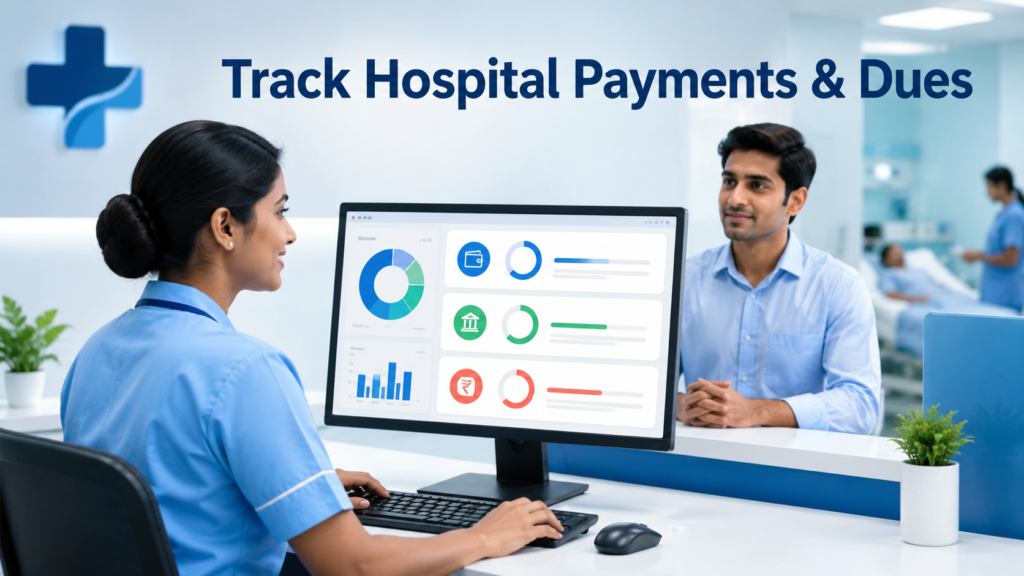
Table of Contents
-
- Why payment tracking is difficult for small hospitals
- Common payment tracking mistakes to avoid
- Create a patient-wise ledger for every admission
- Separate advance, deposit, part payment, and pending due entries
- Issue receipts for every payment mode
- Track running bills for admitted patients
- Maintain pending due reports by patient and date
- Reconcile daily collections before closing the counter
- Handle refunds and deposit adjustments carefully
- Give controlled access to the billing and accounts staff
- Use billing software instead of separate registers and Excel sheets
- Practical checklist for small hospitals
- Conclusion
Why payment tracking is difficult for small hospitals
Small hospitals usually work with lean teams. The same front desk or billing staff may handle registration, OPD receipts, IPD advances, lab bills, pharmacy payments, refunds, and discharge settlements.
The problem starts when every transaction is recorded separately without a single patient-wise view.
For example, a patient admitted for surgery may go through this payment journey:
- ₹10,000 paid as admission advance
- ₹5,000 paid the next day by UPI
- ₹2,500 pharmacy bill generated separately
- ₹1,500 discount approved by management
- ₹8,000 balance pending at discharge
- ₹3,000 collected later from the family
If these entries are not connected to one patient account, the hospital may miss collections, adjust the wrong amount, or create confusion during discharge.
Common payment tracking mistakes to avoid
Many small hospitals do not lose track of dues because the team is careless. They lose track because the process is split across registers, receipts, Excel files, and verbal updates. These are the most common mistakes to fix first.
Recording advances only in a notebook
A notebook may work for a few patients, but it becomes risky when admissions increase. Handwritten entries can be missed, overwritten, or difficult to verify during shift changes.
Not issuing receipts for every payment
Every advance, deposit, part payment, refund, or balance collection should have a receipt. Without receipts, patients may dispute the amount paid, and staff may struggle to prove the collection.
Mixing OPD, IPD, pharmacy, and lab collections
When all collections are recorded together, it becomes difficult to know whether the amount came from consultation, admission advance, medicine sale, lab test, or pending dues.
Adjusting deposits manually at discharge
Manual adjustment increases the chance of mistakes. If the billing person forgets one deposit entry, the final payable amount may become incorrect.
Not tracking who collected the payment
In small hospitals with multiple staff members, each transaction should show who collected the amount, which payment mode was used, and when it was received.
Create a patient-wise ledger for every admission
The simplest way to track hospital payments is to maintain a patient-wise ledger. This means every financial entry linked to a patient should appear in one place.
A good patient ledger should show:
- Patient name and registration number
- OPD or IPD details
- Admission date, if applicable
- Bill amount
- Advance received
- Additional deposits
- Payment mode such as cash, UPI, card, bank transfer, or cheque
- Discounts or concessions
- Refunds
- Final payable amount
- Pending balance
This gives the billing team a clear view before discharge or follow-up.
Example: patient-wise ledger view
Let us say Mr. Sharma is admitted for a minor procedure.
| Transaction | Amount | Type | Balance Impact |
|---|---|---|---|
| Admission advance | ₹10,000 | Receipt | Advance available |
| Lab charges | ₹2,000 | Bill item | Bill increased |
| Pharmacy bill | ₹3,500 | Bill item | Bill increased |
| Second deposit | ₹5,000 | Receipt | Advance increased |
| Final bill | ₹22,000 | Invoice | Total payable |
| Advance adjusted | ₹15,000 | Adjustment | Payable reduced |
| Balance due | ₹7,000 | Pending | To be collected |
With a ledger, the hospital does not need to search through multiple registers to calculate the balance.
Separate advance, deposit, part payment, and pending due entries
Many billing errors happen because hospitals use these words interchangeably. For better tracking, define them clearly.
Advance payment
An advance payment is usually collected before or during treatment. It is later adjusted against the final bill.
Example: A hospital collects ₹15,000 before admitting a patient for a procedure.
Deposit
A deposit is also collected upfront, but it may be linked to admission, room booking, equipment use, or package confirmation. Depending on hospital policy, it may be adjusted or refunded.
Example: A maternity centre collects a booking deposit for delivery.
Part payment
A part payment is collected against an already generated bill or running bill.
Example: A patient’s total bill is ₹28,000 and the family pays ₹10,000 immediately.
Pending due
A pending due is the unpaid balance after billing and payment adjustment.
Example: After adjusting all advances, ₹6,500 remains payable.
When these categories are recorded correctly, reports become easier to understand.
Issue receipts for every payment mode
Small hospitals often receive payments through cash, UPI, card, bank transfer, and sometimes cheque. Every payment should be recorded with the correct mode.
This helps during day-end reconciliation.
For example:
- Cash collected at counter: ₹42,000
- UPI payments received: ₹68,500
- Card payments: ₹21,000
- Bank transfers: ₹15,000
- Pending dues collected: ₹9,500
If the hospital uses billing software, each receipt can be linked to the patient and invoice. This reduces confusion when the accountant or owner checks daily collections.
Track running bills for admitted patients
For IPD patients, billing does not happen only at discharge. Charges may be added every day for room rent, nursing, doctor visits, procedures, medicines, lab tests, consumables, and other services.
A running bill helps the hospital see the current payable amount before the final bill is created.
This is useful because:
- Families can be informed before the bill becomes too large
- Additional deposits can be collected during treatment
- Discharge billing becomes faster
- The hospital can avoid last-minute payment disputes
A simple process can help:
- Create patient admission entry
- Add services, medicines, and tests as they happen
- Record every advance or deposit
- Review the running balance daily
- Ask for additional payment when required
- Adjust all payments at discharge
- Generate the final bill and receipt
Maintain pending due reports by patient and date
Pending dues should not stay hidden inside old bills. Small hospitals need a clear report that shows who owes money, how much is pending, and since when.
A useful pending due report should include:
- Patient name
- Mobile number
- Invoice or bill number
- Bill date
- Total bill amount
- Amount received
- Balance pending
- Due age
- Staff member responsible for follow-up
This helps the hospital owner or accounts team take action without checking each patient file manually.
Example: pending due report
| Patient | Bill Date | Bill Amount | Paid | Pending | Follow-up Status |
|---|---|---|---|---|---|
| Anil Kumar | 12 May | ₹18,000 | ₹14,000 | ₹4,000 | Call today |
| Farida Khan | 14 May | ₹9,500 | ₹5,000 | ₹4,500 | WhatsApp sent |
| Ramesh Patel | 16 May | ₹22,000 | ₹20,000 | ₹2,000 | Promise to pay |
This kind of report makes collection follow-ups more systematic.
Reconcile daily collections before closing the counter
Daily reconciliation is important because hospital billing involves many small and large transactions. At the end of each day, the billing team should match receipts with actual collections.
The day-end check should answer:
- How much cash was collected?
- How much came through UPI, card, or bank transfer?
- Which receipts were cancelled?
- Were any refunds issued?
- Which pending dues were collected today?
- Are there any unpaid bills created today?
This routine helps owners identify mistakes early instead of discovering them at month-end.
Handle refunds and deposit adjustments carefully
Refunds are common in hospitals. A patient may pay an advance, but the final bill may be lower because a procedure was cancelled, a package changed, or unused services were removed.
Refunds should be recorded separately, not deleted from the ledger.
A proper refund record should include:
- Original receipt number
- Refund amount
- Reason for refund
- Payment mode used for the refund
- Approval, if required
- The staff member who processed it
This creates transparency and protects the hospital from disputes.
Give controlled access to the billing and accounts staff
Not every staff member needs access to every billing action. Small hospitals can reduce mistakes by giving role-based access.
For example:
- Reception staff can create OPD bills and collect payments
- IPD billing staff can add admission advances and running charges
- Pharmacy staff can bill for medicines and consumables
- The accounts team can view collection reports
- The owner or manager can approve discounts and refunds
This creates accountability without slowing down daily work.
Use billing software instead of separate registers and Excel sheets
Registers and spreadsheets can work in the early stage, but they become difficult to manage when patient count, departments, and payment modes increase.
Billing software helps small hospitals manage payment tracking in a more organised way.
The right system should help you:
- Create patient-wise bills
- Record advance payments and deposits
- Generate receipts for every collection
- Adjust advances against final bills
- Track partial payments and pending dues
- View daily collection reports
- Separate cash, UPI, card, and bank payments
- Share billing data with the accountant or CA
- Maintain item-wise billing for pharmacy, lab, and services
For Indian hospitals, it is also important to handle GST correctly where applicable. Some healthcare services may have different tax treatment from medicines, consumables, diagnostics, or pharmacy sales, so the billing setup should be reviewed with a CA.
If the hospital also manages medicines or consumables, inventory management software can help track stock movement along with billing.
Practical checklist for small hospitals
Use this checklist to improve payment tracking:
- Create a patient-wise record for every admission
- Issue receipts for every advance, deposit, and part payment
- Record payment mode for each transaction
- Link every payment to a bill or patient account
- Review running bills for IPD patients daily
- Adjust advances before creating the final discharge bill
- Track pending dues separately from current-day collections
- Record refunds with reasons and approval details
- Reconcile cash and digital payments every day
- Use billing software when registers become difficult to manage
Conclusion
Small hospitals cannot afford confusion in advance payments, deposits, and pending dues. Even a few missed entries can create patient disputes, delayed collections, and cash flow pressure.
The best approach is to maintain patient-wise ledgers, issue receipts for every payment, track running bills, review pending dues regularly, and reconcile collections daily.
If your hospital is still using registers, Excel sheets, or scattered WhatsApp updates for billing, it may be time to move to a more organised system. myBillBook can help small healthcare businesses create bills, track payments, manage pending amounts, and view reports from one place.
