Home > Services > Hospital Billing Software

Hospital Billing Software for Faster OPD, IPD & GST Billing

myBillBook helps hospitals, clinics, and nursing homes manage OPD/IPD billing, GST invoices, payments, and inventory reports faster from one place.

Trusted by 1 Crore+ Businesses

What is Hospital Billing Software?

Hospital billing software is a digital system that helps hospitals, clinics, and nursing homes create OPD bills, IPD bills, GST invoices, medicine bills, lab test bills, payment records, and billing reports from one place. It replaces manual registers and spreadsheets with a faster billing process that helps reduce errors, track payments, manage inventory, and keep billing records organised.

It also helps staff manage different billing needs, such as consultation charges, admission fees, room rent, medicines, lab tests, and procedure costs more systematically.

With digital billing records, hospitals can quickly find past invoices, check pending payments, and review daily collections without searching through physical files.
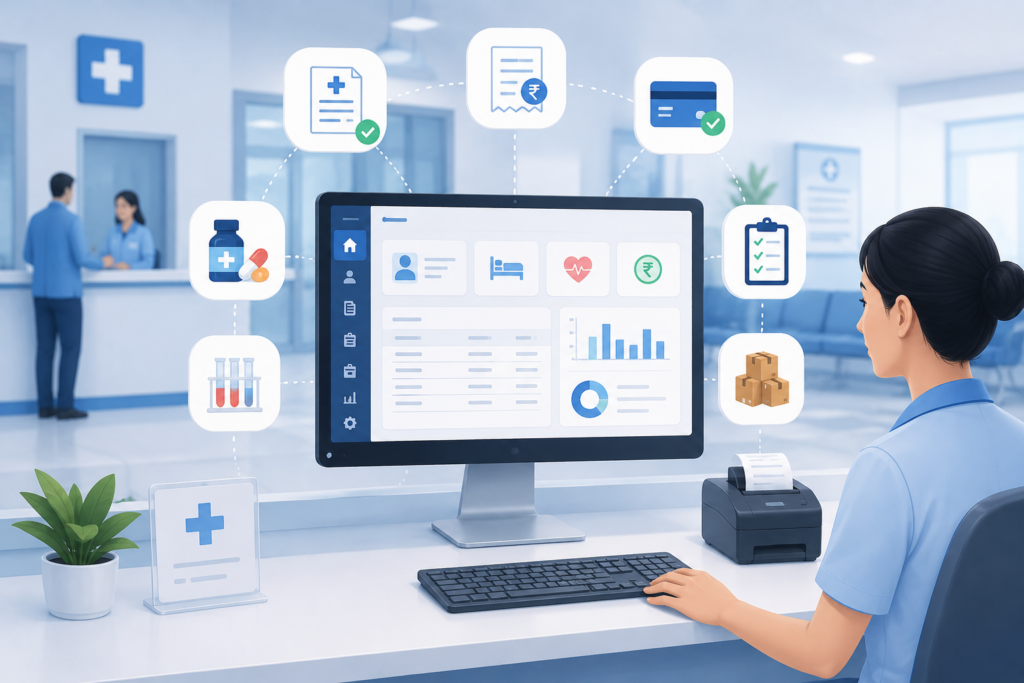
Hospital billing software dashboard used at a hospital reception desk for managing patient bills, invoices, payments, lab records, and inventory

Why Hospitals & Clinics Need Dedicated Billing Software

Running a hospital practice is complex. Unlike normal retail or pharmacy operations, hospitals deal with dynamic patient journeys — from admission to discharge — involving multiple departments, variable charges, consumables, diagnostics, and insurance approvals.

Multi-Department Billing

Manage OPD, IPD, pharmacy, lab, room, and procedure charges together without depending on manual billing calculations.

Billing Errors & GST Risks

Reduce wrong charges, missed items, duplicate entries, and GST errors with structured bills and organised billing records.

Medicine & Consumable Tracking

Track medicines, injections, disposables, and consumables used during treatment so stock updates stay easier to manage.

Scattered Patient Records

Keep patient-wise bills, payment details, pending dues, and past invoices organised for faster access when needed.

Delayed Discharge Billing

Prepare final discharge bills faster by adding room rent, medicines, tests, procedures, and pending payments accurately.

Limited Revenue Visibility

View collections, pending amounts, department-wise billing, and daily reports to understand hospital revenue.

Key Features of myBillBook Billing Software for Hospitals & Clinics

myBillBook gives hospitals, clinics, and nursing homes the billing tools they need to manage patient invoices, payments, inventory, and reports from one place.

OPD & IPD Billing

Create consultation, admission, treatment, room rent, and discharge bills quickly for different patient billing needs.

GST Invoice Creation

Generate GST-compliant invoices for hospital services, medicines, lab tests, procedures, and other billable charges.

Medicine & Inventory Tracking

Track medicines, consumables, injections, while creating bills to reduce inventory mismatches.

Payment & Due Tracking

Record cash, UPI, card, and credit payments while keeping pending dues visible for faster follow-ups.

Patient-Wise Billing Records

Store patient bills, payment history, service charges, and past invoices digitally for easier access anytime.

Reports & Revenue Insights

View sales, collections, pending dues, stock, and billing reports to understand daily hospital performance better.

Who Can Use myBillBook Hospital Billing Software?

myBillBook is suitable for healthcare businesses that need simple billing, payment tracking, without the need for complicated hospital management software.

Small Hospitals

Clinics

Nursing Homes

Diagnostic Centres

In-House Pharmacy Counters

Healthcare Businesses

How to Choose the Best Hospital Billing Software for Hospitals & Clinics

Understand Your Hospital’s Needs

A good hospital billing software must fit the exact workflows of your facility. Hospitals handle OPD consultations, IPD admissions, procedure charges, ward/bed transfers, doctor fees, diagnostic tests, and pharmacy billing — all within a single patient journey. Before choosing software, list down your needs: multi-department visibility, doctor-level billing, claim workflows, and inventory control.

Compare Desktop, Cloud & Hybrid Billing Systems

Desktop-Only

Works on a single machine and may need manual backups or local system maintenance.

Hybrid Systems

Offer some online access, but may still depend on local devices or manual syncing.

Cloud-Based

Helps teams access billing records, reports, and data across devices with easier backups.

Choose a Solution That Keeps Daily Billing Simple
Your hospital front desk should not struggle with complicated tools. Choose software that is easy for billing staff, reception teams, pharmacy counters, and admin users to understand, so they can create bills faster and avoid avoidable mistakes.

Ensure It Works Across Devices & Counters
Hospitals may have multiple billing points, such as OPD, reception, pharmacy, lab, or admin counters. Pick software that can be used on desktop or mobile so billing records and payment details stay accessible when teams switch counters or devices.

Look for GST-Ready Invoice Creation
Hospital invoices should be clear, accurate, and easy to share. Choose software that helps create GST invoices for services, medicines, lab tests, procedures, and other billable charges without depending on manual calculations every time.

Pick Software That Handles Billing and Stock Together
If your hospital or clinic manages medicines, consumables, injections, or other stock items, choose billing software that helps track inventory along with bills. This reduces stock mismatches and gives better visibility into items used or sold.

See How myBillBook is Transforming Pharmacies Across India

freelancer Balram Jain, Savi Clinic

“Keeping track of our hospital supplies is effortless with myBillBook. We automatically update stock levels with each use, set low-stock alerts, and manage expiration dates and batch numbers. This ensures compliance with healthcare regulations and avoids stockouts, streamlining our supply chain management.”

Sandesh Gupta, Fortis Hospital

“myBillBook has transformed our hospital’s cash flow management. We can now track payments from patients, insurance companies, and government programs seamlessly. The detailed financial reports provide insights into cash flow, receivables, and payables, ensuring smooth and efficient financial operations.”

Mahesh Rao, Kids Hospital

“Staying GST-compliant is easy with myBillBook’s robust reporting tools. We effortlessly generate GST-compliant invoices, track input tax credits, and maintain accurate records for audits. The real-time GST filing and detailed compliance reports all keep us ahead of regulatory standards, which ensures complete peace of mind.”

Simple, Affordable Plans for Hospitals & Clinics

upto 20% off
Diamond
Essential plan for small business owners
₹403 ₹291 /month
Pay  ₹4833  ₹3490/year.  Billed annually
₹349 /month
Billed monthly
Includes
  • Create unlimited invoices
  • Access to 1 business, 1 user & 1 CA
  • Inventory management
  • Android, iOS & Web
  • Custom Invoice Themes
  • Create your Online Store
  • Generate, Print & Scan Barcodes
1 Business, 1 User + 1 CA • Custom Themes • Online Store • Print & Scan Barcodes
Platinum
More flexibility and a Desktop app
₹665 ₹333 /month
Pay  ₹7982  ₹3990/year.  Billed annually
₹399 /month
Billed monthly
Everything on Diamond Plan +
  • Desktop app
  • SMS + WhatsApp marketing*
  • Unlimited Godown management
  • Print Barcode (Label printer)
  • Bulk Download & Bulk Print Invoices
1 Business, 1 User + 1 CA • Diamond features + Desktop App • Godowns • SMS & WhatsApp Marketing
Enterprise
Fully customizable for bigger businesses
Starts at
₹1026 ₹570 /month
Billed annually
Starts at
₹1026 ₹570 /month
Billed annually
Everything on Platinum Plan +
  • Access to 2 businesses, 3 users & 1 CA
  • e-Way Bills (Unlimited)
  • Generate e-Invoicing
  • Loyalty & Rewards
  • Automate Recurring Billing
  • POS Billing (Desktop App, Web app)
  • Data Export to Tally (on request)
  • User Activity Tracker
2 Businesses, 3 Users (Upgrade to add more) + 1 CA • Platinum features + E-Invoices • POS • Recurring Billing + Tally Export

Guide to Hospital Billing Software

Your complete guide to making an informed decision

Benefits of Using Hospital Billing Software

Improves Accuracy

Automated billing minimises the risk of human errors, such as incorrect billing amounts or tax calculations, ensuring patients are charged accurately and fairly.

Secure data Storage with Cloud-Based Billing

Cloud-based hospital billing software provides secure data storage with multiple backups. Even in the event of a natural disaster, your data is safely stored across various servers.

Enhances Cash Flow Management

Hospitals can better manage their cash flow with clear and detailed invoicing and expense tracking. This ensures timely patient payments and better control over operational expenses.

Optimises Decision-Making

With access to comprehensive financial reports, hospital management can make informed decisions regarding budgeting, resource allocation, and investments, leading to better financial health.

Ensures Compliance with Tax Regulations

The software keeps hospitals compliant with GST laws, reducing the stress of manual tax calculations and preventing costly errors that could lead to penalties.

Saves Time

By automating the billing process, hospitals can significantly reduce the time spent on manual calculations and paperwork. This allows staff to focus on patient care rather than administrative tasks.

How does Hospital Billing Software Handle IPD & OPD billing?

Hospital billing systems allow staff to manage two billing workflows in one platform:

  • OPD Billing: Quick registration, consultation fees, lab tests, pharmacy billing, and instant invoices.
  • IPD Billing: Admission records, bed charges, nursing fees, doctor visits, OT charges, consumables, and discharge summary–linked billing.
    The system automatically consolidates charges, avoids duplication, and ensures accurate final billing.

Does Hospital Billing Software Support TPA and Insurance Workflows?

Yes. Most hospital billing systems include:

  • Cashless & reimbursement workflows
  • Pre-authorisation entry & tracking
  • TPA rate card management
  • Required document uploads (policy, bills, reports)
  • Claim status tracking

This speeds up settlements and reduces manual paperwork.

What is the Difference between Hospital Billing and General Billing Software?

Feature Hospital Billing Software General Billing Software
IPD Billing Supports admissions, bed charges, nursing, OT, and discharge billing Does not support inpatient workflows
OPD Billing Supports consultation, lab tests, procedures, and prescription-linked billing Limited to basic sales billing
Department & Doctor-wise Billing Provides department-wise and doctor-wise charge allocation Not available
Lab & Radiology Billing Includes lab and radiology billing or integrates with existing systems Typically requires separate tools
TPA & Insurance Billing Supports TPA processes, pre-authorisation, insurance claims Not supported
Patient Records Integration Integrates with HIS/EHR to sync patient and clinical data No medical data integration
Consumables & Procedure Tracking Tracks consumables, procedures, nursing charges Not supported
Bed & Ward Management Includes bed, room, and ward management Not available
Rate Card Flexibility Allows multi-layered rate cards (service, doctor, department based) Only basic item-level pricing
Healthcare Compliance Built for healthcare workflows and regulatory needs Not designed for medical compliance

How does Hospital Billing Software Integrate with HIS/EHR Systems?

Most hospital billing systems integrate via APIs or HL7-based connectors.
This allows billing teams to pull:

  • Patient demographics
  • Clinical notes
  • Lab reports
  • Admission details
  • Treatment history

The integration reduces manual entry and eliminates billing errors by syncing clinical data with financial records.

Why are Hospitals Moving to cloud-based Billing, and is Migration from Manual Billing Easy?

Hospitals shift to the cloud because it offers:

  • Anywhere access for admins
  • Auto-backups & stronger data security
  • Faster updates without IT teams
  • Zero server maintenance

Migration from manual billing is easy because staff can import basic patient & service records, replicate rate cards, and start using templates immediately.
Most systems also provide onboarding support to make the transition smoother.

Explore More myBillBook Solutions for Healthcare Businesses

Hospital Accounting

A hospital accounting system simplifies expense tracking, profit analysis, and payment reconciliation, helping administrators maintain transparency, manage revenue, and performance.

Pharma Inventory

Learn 11 practical tips to manage pharma inventory effectively, reduce expired stock losses, maintain supply levels, and optimize ordering for your wholesale pharmacy.

Medical Bill

Explore medical bill formats suitable for pharmacies and clinics. Create professional GST-ready invoices easily using billing software designed for pharmacy shops.

Drug License

Understand how to apply for a drug license in India. Learn documentation, registration process, and compliance essentials for legally operating a pharmacy store.

Pharmacy Billing

Reliable pharmacy billing software streamlines prescription billing, monitors drug stock levels, and simplifies vendor-wise tracking - improving accuracy, and speed.

Medical Shop

Discover how to start a medical shop in India—covering licensing, billing setup, pharmacy inventory planning, and compliance steps for running a profitable retail pharmacy business.

Frequently Asked Questions

Which software is used for billing in hospitals?

Hospitals use specialised billing software designed to manage patient billing, charges, records, and GST compliance. Such systems streamline financial workflows, reduce manual errors, and improve accuracy across multiple hospital departments and services.

What is the billing system used in hospitals?

A hospital billing system tracks patient charges from registration to discharge, capturing services, tests, procedures, and payments. It ensures every department’s billing is recorded accurately while supporting faster reconciliation and transparent financial reporting.

Is myBillBook GST compliant for hospital billing?

Yes. myBillBook supports full GST compliance for hospital billing, enabling accurate tax calculations, error-free GST invoices, easy reporting, and smooth filing. Hospitals can manage taxation confidently while maintaining regulatory accuracy and operational efficiency.

Can myBillBook generate detailed hospital invoices?

Yes. myBillBook generates detailed hospital invoices with patient information, service charges, treatment details, consumables, and GST. Customisable formats help hospitals maintain clarity, transparency, and professionalism across all billing and patient communication touchpoints.

Does myBillBook help manage hospital inventory effectively?

Yes. myBillBook tracks hospital inventory such as medicines, consumables, and supplies. It monitors stock levels, expiry dates, purchase batches, and usage trends, helping hospitals reduce shortages, prevent wastage, and maintain accurate inventory records.

Can hospitals import OPD and IPD patient records easily?

Yes. Hospitals can import OPD and IPD patient records into the system, enabling continuity across billing, services, and documentation. Imported records simplify patient tracking, reduce manual entry, and maintain accurate financial and clinical information.

Does the software support multi-department and service-wise billing?

Yes. The software supports billing across multiple departments, services, and specialties. It allows hospitals to allocate charges accurately, track revenue sources, manage department-wise billing flows, and ensure transparent financial reporting for each service category.

Can doctors and hospital staff have separate secure logins?

Yes. Doctors and staff can have separate secure logins with role-based access. This ensures controlled data visibility, protects sensitive information, improves coordination, and supports smooth hospital operations with clear responsibility across users.

Can hospitals track patient room changes and bed transfers?

Yes. The system enables tracking of room changes, bed transfers, and updated charges in real time. This ensures accurate billing, prevents discrepancies, and provides complete visibility into a patient’s stay and associated cost adjustments.

Explore More Hospital Billing Guides on myBillBook Blog