
Managing cash, UPI, and credit payments is one of the biggest daily challenges for FMCG businesses. A retailer may pay cash for one order, send UPI for the next, and keep a part of the bill on credit. For distributors, wholesalers, kirana suppliers, and route sales teams, this mix can quickly create confusion if every payment is not recorded against the right bill and party.
FMCG products move fast, margins are tight, and orders are frequent. Even a small mismatch in cash collection, UPI confirmation, or credit balance can affect daily cash flow. That is why FMCG businesses need a simple fmcg billing software to record every sale, track every payment mode, and know exactly which customer still has pending dues.
Summary
FMCG businesses often collect payments through cash, UPI, and credit on the same day. The safest way to manage this is to record every payment against the correct invoice, keep cash and UPI entries separate, maintain party-wise credit ledgers, and reconcile collections daily. This helps distributors, wholesalers, and retailers reduce payment confusion, avoid missed dues, and get a clear view of outstanding balances.
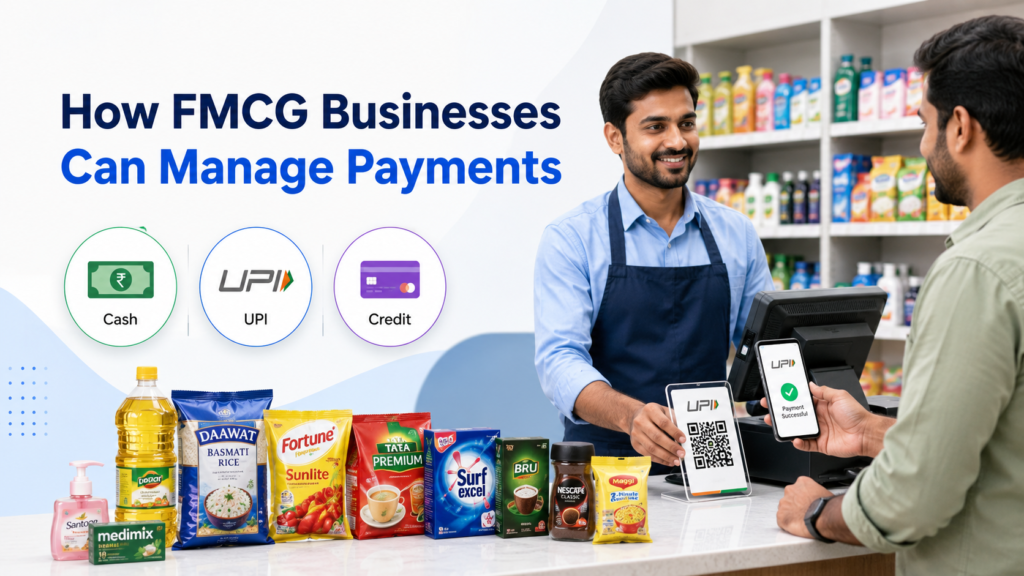
Table of Contents
- Why Payment Management Matters in FMCG
- Common Payment Challenges for FMCG Businesses
- How to Manage Cash Payments
- How to Manage UPI Payments
- How to Manage Credit Payments
- Daily Payment Reconciliation Checklist
- How Billing Software Helps
Why Payment Management Matters in FMCG
FMCG businesses usually deal with high-volume, repeat transactions. A shop may buy biscuits, beverages, packaged food, personal care items, cleaning products, and other fast-moving goods several times a week. Payments may not always happen in one mode or on the same day.
For example, an FMCG distributor may raise a bill of ₹18,000 for a kirana store. The store owner may pay ₹8,000 in cash, transfer ₹5,000 through UPI, and keep ₹5,000 as credit to be paid after the next sale cycle. If this is written only in a notebook or remembered verbally, the chances of error are high.
Clear payment management helps FMCG businesses:
- Know how much money was collected today
- Separate cash, UPI, and credit entries
- Track customer-wise pending balances
- Reduce disputes with retailers and dealers
- Follow up on overdue payments on time
- Share cleaner records with the accountant or CA
The goal is not only to collect money faster. The real goal is to keep every invoice, payment, and outstanding amount connected in one place.
Common Payment Challenges for FMCG Businesses
Most FMCG payment problems happen because sales, collection, and credit records are maintained separately. One person creates the bill, another collects cash, someone else checks UPI, and the owner later tries to match everything at night.
Cash Collected but Not Matched to Bills
Cash is common in many kirana, wholesale, and small retail transactions. The problem starts when cash is collected during delivery but not marked against the correct invoice. At the end of the day, the cash box may show money, but the owner may not know which party paid and which party is still due.
UPI Payment Received Without Clear Reference
UPI is convenient, but it can create confusion when multiple customers send payments through different names, phone numbers, or QR codes. A distributor may receive several UPI credits in a day, but unless each payment is marked against the correct invoice, reconciliation becomes difficult.
Credit Given Without a Follow-Up System
Credit sales are common in FMCG because retailers often pay after selling the goods. But when credit is tracked only in notebooks, follow-ups depend on memory. This can delay collections and increase the risk of missed dues.
Partial Payments Across Different Modes
Many FMCG customers do not pay the full invoice in one mode. They may pay part cash, part UPI, and keep the balance pending. Without split payment tracking, the invoice may look unpaid even when some money has already been received.
How to Manage Cash Payments
Cash payments need discipline because cash can be collected at the counter, during delivery, or by a salesman on a route. The easiest way to manage cash is to record it immediately against the bill instead of waiting until the end of the day.
Record Cash Against the Invoice
Whenever a customer pays cash, mark the amount received against that invoice. If the customer pays only part of the amount, record the paid amount and leave the remaining amount as outstanding.
Example: If a retailer’s bill is ₹12,500 and they pay ₹7,500 in cash, the system should show ₹7,500 received and ₹5,000 pending. This keeps the bill status clear for both the owner and the collection team.
Maintain a Daily Cash Summary
At day end, the total cash in hand should match the cash recorded in bills and receipts. This helps identify missing entries, excess cash, or unrecorded expenses before they become bigger accounting issues.
Avoid Mixing Business Cash With Personal Cash
Small FMCG businesses often use business cash for quick purchases, transport payments, or staff expenses. These expenses should be recorded separately so the owner knows the real cash collected from sales.
How to Manage UPI Payments
UPI has become a regular payment mode for Indian businesses. For FMCG businesses, the challenge is not accepting UPI; the challenge is matching every UPI payment with the right customer, invoice, and date.
Ask Customers to Share Payment Confirmation
When a customer pays through UPI, ask them to share the screenshot or transaction reference, especially for B2B payments. This helps when the payer name is different from the shop name.
Mark UPI Payments Separately
Do not club UPI with cash in daily records. Keep UPI as a separate payment mode so you can match it with bank credits and UPI transaction history. This is useful when checking whether all digital payments have reached the correct account.
Reconcile UPI With Bank Entries
At the end of the day, compare UPI payments recorded in your billing system with bank or UPI app entries. If any payment is received but not marked in the bill, update it immediately. If any payment is marked but not received in the bank, check with the customer before closing the day.
Use One Main Business QR Where Possible
Using multiple personal QR codes can make reconciliation difficult. A business QR or one fixed collection account helps the owner track money more clearly. If salesmen collect UPI on route, they should record the payment mode and customer name immediately.
How to Manage Credit Payments
Credit is part of FMCG trading, especially when supplying to retailers, dealers, hotels, canteens, or small shops. But credit should be controlled, not guessed. A proper credit system shows how much each party owes, how old the dues are, and whether fresh supply should continue.
Create Party-Wise Ledgers
Every customer should have a separate ledger. The ledger should show invoices raised, payments received, credit notes, returns, and the current balance. This avoids confusion when a customer says they already paid or returned some stock.
Set Credit Limits for Regular Customers
For repeat retailers, set an internal credit limit based on their payment habit. For example, if a shop usually pays within 7 days, you may continue supply within a fixed limit. If payments are delayed often, review the credit before sending fresh stock.
Track Ageing of Outstanding Payments
Ageing means grouping pending dues by how long they have been unpaid. For example, 0–7 days, 8–15 days, 16–30 days, and more than 30 days. This helps the owner focus on older dues first instead of only checking the total pending amount.
Record Partial Payments Properly
If a customer pays ₹10,000 against a total outstanding of ₹24,000, record the payment immediately and keep the remaining ₹14,000 visible. This makes follow-ups easier and avoids arguments during the next delivery.
Daily Payment Reconciliation Checklist
FMCG businesses should not wait until month-end to check payments. A simple daily reconciliation routine can prevent most collection and accounting mistakes.
- Check total sales invoices created during the day
- Match cash collected with cash entries
- Match UPI received with bank or UPI app entries
- Check pending amount for each credit invoice
- Update partial payments before closing the day
- Review party-wise outstanding balances
- Follow up on overdue customers before sending fresh supply
- Record sales returns, damaged goods, or credit notes separately
This routine is especially useful for FMCG distributors and wholesalers who handle multiple bills, routes, and collection staff every day.
How Billing Software Helps FMCG Businesses Manage Payments
Manual registers can work when orders are few. But as the number of customers, SKUs, and payment modes increases, FMCG businesses need a cleaner way to connect billing, payment tracking, inventory, and reports.
With myBillBook distributor billing software, FMCG distributors can create GST invoices, track retailer-wise credit, record payments, and view outstanding balances from one place. For businesses that sell in bulk from a shop or godown, wholesale billing software can help manage party-wise rates, stock, and payment records together.
GST Billing With Payment Status
When every sale is recorded through a GST invoice, the payment status can be tracked clearly. You can see whether the invoice is paid, partially paid, or unpaid. This is better than checking separate notebooks for bills and payments.
Party-Wise Outstanding Reports
myBillBook helps businesses view customer-wise dues, payment history, and balances. This is useful for FMCG owners who need to know which retailers should be followed up today and which customers are safe for fresh supply.
Inventory and Payments in One Flow
FMCG businesses also need to know what was sold, what stock is left, and which bills are pending. When billing and inventory management work together, stock updates and payment records stay connected.
Reports for Better Decisions
Payment reports help owners understand cash collected, UPI received, credit pending, and overdue balances. Instead of depending only on staff updates, the owner can check business reports and act faster.
Best Practices for FMCG Payment Management
Here are a few practical habits that can make payment tracking easier:
- Create bills before dispatching goods, not after delivery
- Record the payment mode at the time of collection
- Keep customer ledgers updated after every payment
- Do not allow long credit without checking old dues
- Use UPI references to match digital payments
- Review daily collection reports before closing the shop or office
- Share pending balance details with customers during follow-up
These steps help reduce confusion between the owner, billing staff, delivery person, and customer.
Conclusion
FMCG businesses cannot manage payments properly by looking only at total sales. They need to know how much was collected in cash, how much came through UPI, how much is still on credit, and which customer is responsible for each pending amount.
A simple payment management process helps FMCG distributors, wholesalers, and retailers avoid missed entries, delayed collections, and daily reconciliation stress. Start by recording every invoice, payment mode, partial payment, and party-wise due clearly.
