
Table of Contents
- What Does AI Mean in India’s Tax System?
- Why India’s Tax System Is Moving Towards AI
- How AI Is Changing GST Compliance for Businesses
- How AI Helps Detect Tax Fraud and Fake Invoices
- What AI Means for Small and Medium Businesses
- Examples of AI Impact on Different Businesses
- How Businesses Can Prepare for AI-Driven Tax Compliance
- Benefits of AI-Driven Tax Systems for Genuine Businesses
- Challenges Businesses Should Be Aware Of
- FAQs
India’s tax system is becoming more digital, data-driven, and intelligent. For businesses, this change is not only about filing GST returns online. Artificial intelligence is now helping tax departments detect mismatches, identify suspicious transactions, review invoice patterns, and make compliance more transparent.
For Indian business owners, this means one simple thing: clean records matter more than ever.
Whether you run a retail shop, wholesale business, pharmacy, restaurant, supermarket, electronics store, garment shop, or distribution business, your invoices, e-way bills, purchase records, payment entries, and GST returns are becoming part of a larger digital tax trail. AI is making it easier for tax systems to compare this data and spot errors early.
This blog explains how AI is transforming India’s tax system for businesses and what small and medium business owners should do to stay ready.
What Does AI Mean in India’s Tax System?
Artificial intelligence in taxation means using technology to study large amounts of tax data and identify patterns, risks, errors, or unusual activity.
In simple words, AI helps tax systems answer questions like:
- Do sales invoices match GST returns?
- Does the buyer’s input tax credit match the seller’s reported sales?
- Are e-way bills matching actual business movement?
- Are there unusual invoice patterns between related parties?
- Is a business claiming ITC on doubtful or incorrect invoices?
- Are there repeated mismatches in filings?
Earlier, many of these checks depended heavily on manual review. Today, digital tax platforms can compare data much faster. AI does not replace tax laws or tax officers, but it helps them find areas that need attention.
For businesses, this makes tax compliance more real-time and record-based.
Why India’s Tax System Is Moving Towards AI
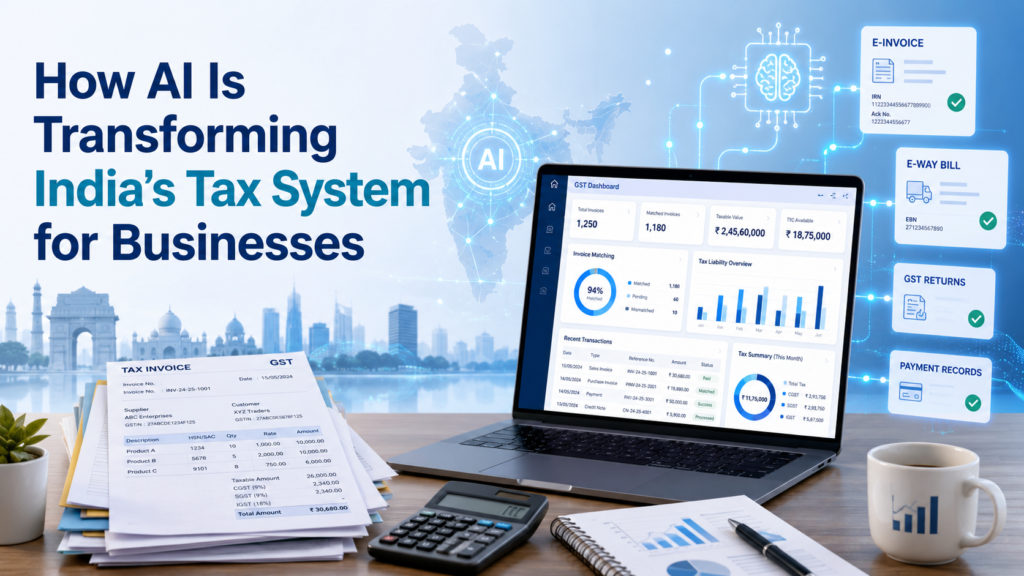
India’s GST system already works on digital records. GST returns, e-invoices, e-way bills, GSTR-2B, input tax credit details, and payment records are all part of a connected compliance ecosystem.
As the number of transactions grows, manual checking becomes difficult. AI and data analytics help tax authorities study large volumes of information and identify high-risk cases faster.
For example, if a business generates high-value invoices but does not show matching stock movement, payments, or e-way bills, the system may flag it for review. Similarly, if a buyer claims ITC but the supplier has not reported the sale correctly, it can create a mismatch.
This shift is happening because tax compliance is no longer limited to return filing at the end of the month. It now depends on the quality of daily business data.
How AI Is Changing GST Compliance for Businesses
GST compliance is one of the biggest areas where AI can make a difference. Since GST is invoice-based, every sale and purchase entry creates a data point.
Better Invoice Matching
AI can help compare sales invoices, purchase invoices, GST returns, and ITC records. This makes it easier to identify missing invoices, duplicate entries, incorrect GSTINs, wrong tax rates, and mismatch between supplier and buyer records.
For a small business, this means GST bills should be created carefully from the beginning. A wrong GSTIN or incorrect tax rate may not look serious at the billing counter, but it can create problems during return filing or ITC reconciliation.
Faster Error Detection
AI-based systems can detect repeated mistakes across large data sets. For example, if a business keeps using the wrong HSN code, applying the wrong GST rate, or reporting taxable value incorrectly, the system can identify the pattern.
This helps tax teams and businesses correct errors before they become bigger compliance issues.
Stronger ITC Checks
Input tax credit is an important part of GST compliance. Businesses need correct purchase records to claim ITC properly.
AI can help identify unusual ITC claims, missing supplier filings, fake invoice patterns, and mismatches between GSTR-2B and purchase records. For genuine businesses, this makes proper purchase entry and supplier tracking more important.
A distributor, wholesaler, or manufacturer should regularly check whether supplier invoices are available, GST details are correct, and eligible ITC is recorded properly.
How AI Helps Detect Tax Fraud and Fake Invoices
One major use of AI in India’s tax system is fraud detection. Fake invoices, circular trading, false ITC claims, and e-way bill misuse are difficult to track manually when transaction volumes are high.
AI can study patterns such as:
- Businesses issuing invoices without real stock movement
- Frequent high-value transactions between connected entities
- E-way bills generated for doubtful vehicle movement
- Sudden spikes in sales or ITC claims
- Mismatch between invoices, returns, and transport records
- Suppliers with unusual filing or payment behaviour
This does not mean every mismatch is fraud. Many small businesses make genuine mistakes due to manual billing, delayed entries, wrong GST rates, or missing purchase records. But with AI-led checks, even genuine mistakes can come under scrutiny if records are not clear.
That is why businesses should focus on creating accurate GST invoices and maintaining a proper audit trail.
What AI Means for Small and Medium Businesses
For Indian SMBs, AI in taxation should not be seen as something only large companies need to worry about. It directly affects daily business operations.
Here is how it changes expectations for small businesses:
Billing Must Be Accurate
Every GST invoice should have the correct customer details, GSTIN, invoice number, date, item details, taxable value, GST rate, and tax amount. Manual billing increases the chance of missing or incorrect information.
Purchase Records Must Be Updated
ITC depends on purchase data. If purchase bills are missing or supplier details are incorrect, reconciliation becomes difficult.
Stock Movement Should Match Sales
For businesses dealing in goods, stock records should support invoices and e-way bills. This is especially important for wholesalers, distributors, supermarkets, electronics shops, pharmacies, and manufacturers.
Return Filing Should Not Be Last-Minute
When records are updated daily, GST return filing becomes easier. When records are prepared only near the deadline, mistakes are more likely.
CA Sharing Should Be Simple
Business owners and CAs need access to clean data. When sales, purchases, expenses, payments, and GST reports are stored properly, CAs can review returns faster and with fewer follow-ups.
Examples of AI Impact on Different Businesses
AI-led tax systems affect different businesses in different ways. Here are some practical examples.
Retail Shops
A retail shop generating daily GST bills needs accurate item-level billing and tax rates. If the shop sells items with different GST rates, incorrect billing can create return filing issues.
Wholesalers and Distributors
Wholesalers and distributors usually manage bulk invoices, multiple parties, credit sales, e-way bills, and payment follow-ups. Their tax records should clearly show sales, purchases, transport details, and outstanding payments.
Pharmacies
Pharmacies handle batch-wise stock, expiry, GST billing, and supplier purchases. Proper purchase and sales records help avoid stock mismatch and ITC confusion.
Restaurants
Restaurants need correct GST billing for dine-in, takeaway, and delivery orders. If sales data is scattered across manual bills, POS counters, and online orders, tax reporting becomes difficult.
Electronics Shops
Electronics businesses often deal with high-value items, serial numbers, warranties, accessories, and GST invoices for business customers. Accurate invoicing helps during warranty support, returns, and GST filing.
How Businesses Can Prepare for AI-Driven Tax Compliance
AI-driven tax systems reward businesses that maintain clean, timely, and consistent records. Here are a few practical steps Indian SMBs can follow.
Use GST-Compliant Billing
Create proper GST invoices with correct tax rates, GSTIN details, invoice numbers, HSN or SAC details where applicable, and item-wise breakup.
Keep Sales and Purchase Data Together
Do not maintain sales in one notebook, purchases in another file, and payments in WhatsApp chats. Keep your business data in one system so reports are easier to verify.
Reconcile ITC Regularly
Check purchase entries against supplier invoices and available GST data. Do not wait until the filing deadline to identify missing or mismatched invoices.
Track Payments Clearly
Untracked credit sales and delayed payments can create confusion in reports. Proper payment tracking helps you understand receivables and keeps business records cleaner.
Maintain Stock Records
For goods-based businesses, stock records should match purchases and sales. This is useful not only for tax compliance but also for reducing stock loss and improving purchase planning.
Share Reports With Your CA
Give your CA structured reports instead of screenshots, manual notes, or scattered files. This reduces filing errors and saves time during compliance checks.
Benefits of AI-Driven Tax Systems for Genuine Businesses
AI in taxation is often discussed only from the government’s point of view. But genuine businesses can also benefit from this shift.
Fewer Manual Checks
When records are digital and structured, businesses can avoid repeated manual explanations for basic mismatches.
Better Compliance Confidence
Clean data helps business owners and CAs file returns with more confidence.
Faster Issue Identification
Errors in invoices, purchases, tax rates, or ITC can be identified earlier instead of becoming problems later.
More Transparent Business Records
Digital records make it easier to prove genuine sales, purchases, stock movement, and tax payments.
Easier Growth
As businesses grow, manual billing becomes harder to manage. A digital system helps maintain consistency across counters, branches, users, and devices.
Challenges Businesses Should Be Aware Of
AI is helpful, but it is not perfect. Businesses should understand its limitations.
First, AI depends on data quality. If invoice data is wrong, the system may still flag issues. Second, tax decisions still need human review, especially where interpretation is involved. Third, businesses must be careful about data privacy and access control when using digital tools.
Most importantly, AI does not remove the need for proper compliance. It only makes mistakes and mismatches easier to detect.
For SMBs, the best approach is not to fear AI. The right approach is to maintain accurate records, use reliable billing software, and work closely with a CA.
FAQs
How is AI used in India’s tax system?
AI is used to analyse tax data, detect mismatches, identify unusual transaction patterns, support fraud detection, and improve compliance monitoring. It helps tax systems review large volumes of invoice, GST, ITC, and e-way bill data faster.
Will AI make GST compliance harder for small businesses?
AI will not make GST compliance harder if businesses maintain proper records. It may create problems for businesses that depend on manual billing, missing invoices, wrong tax rates, or delayed entries.
Can AI detect fake GST invoices?
AI can help identify suspicious invoice patterns, unusual ITC claims, mismatches, and transactions that do not match normal business behaviour. Final action still depends on verification by tax authorities.
What should businesses do to stay ready for AI-led tax checks?
Businesses should create accurate GST invoices, maintain purchase records, reconcile ITC, track payments, update stock, generate e-way bills where needed, and share clean reports with their CA.
Does myBillBook help with GST compliance?
Yes. myBillBook helps businesses create GST invoices, manage sales and purchases, track inventory, generate reports, record payments, and share data with their CA. It also supports e-way bills and e-invoicing for eligible businesses.
