
Discharge should be a smooth final step for the patient, family, billing counter, doctor, pharmacy, and accounts team. But in many small hospitals and nursing homes, small billing mistakes can delay discharge and payment collection at the exact moment when everyone wants clarity.
A missing pharmacy charge, unadjusted advance, wrong GST calculation, unclear discount approval, or pending payment entry can create confusion at the billing desk. The patient’s family may wait longer, the counter staff may recheck multiple registers, and the hospital owner may still be unsure whether the full amount was collected.
This blog explains the most common hospital billing mistakes that delay discharge and payment collection, why they happen, and how small hospitals in India can avoid them with a hospital billing software.
Summary
Hospital discharge billing gets delayed when charges, advances, discounts, pharmacy items, and payment entries are not updated before the patient is ready to leave. For small hospitals and nursing homes, these mistakes can create long billing-counter waits, unclear final amounts, missed collections, and uncomfortable conversations with patients.
The best way to avoid this is to follow a daily patient-wise billing process, update pharmacy and lab charges on time, record every payment clearly, document discount approvals, and use a pre-discharge checklist before preparing the final bill. A practical billing system like myBillBook can help hospitals keep bills, payments, stock, and reports more organised.
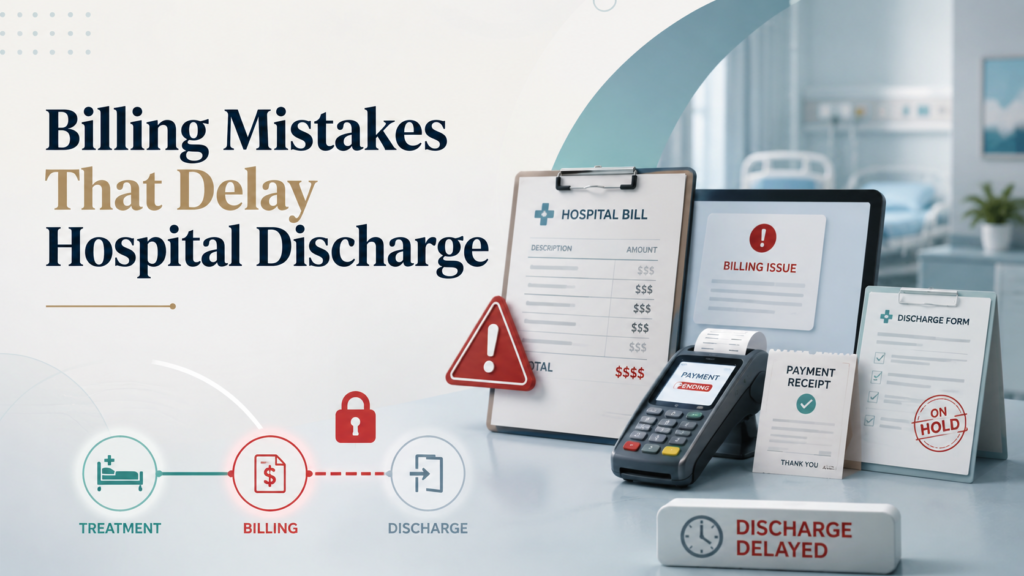
Table of Contents
- Why Billing Mistakes Become Serious During Discharge
- Updating Charges Only at the Time of Discharge
- Missing Pharmacy and Consumable Charges
- Not Adjusting Advance Payments Correctly
- Wrong or Incomplete Patient Details on the Bill
- Unclear Discount or Concession Approval
- Not Recording Partial Payments and Pending Dues Properly
- Confusing Cash, UPI, Card, and Bank Transfer Entries
- Using Separate Registers for Billing, Pharmacy, and Accounts
- Not Preparing a Pre-Discharge Billing Checklist
- Giving the Patient a Bill That Is Hard to Understand
- Not Training Counter Staff on the Discharge Workflow
- Not Reviewing Discharge Billing Errors After They Happen
- Final Checklist to Avoid Discharge Billing Delays
- Conclusion
Why Billing Mistakes Become Serious During Discharge
In OPD billing, most transactions are short. A consultation bill, lab receipt, medicine bill, or procedure charge is usually settled quickly.
IPD discharge billing is different. A single final bill may include:
- Room rent
- Doctor visit charges
- Nursing charges
- Pharmacy items
- Lab and diagnostic tests
- Procedure or surgery charges
- Consumables
- Ambulance charges
- Advance payments
- Partial payments
- Discounts or concessions
- GST where applicable
- Insurance or TPA-related adjustments
If even one detail is missing or wrongly entered, the final bill may need to be corrected. This delays discharge clearance and can also make payment collection uncomfortable.
For a small hospital, the goal is not just to create a bill. The goal is to create a final bill that is complete, clear, approved, and easy to settle.
Updating Charges Only at the Time of Discharge
One of the biggest reasons for discharge delay is adding all charges only after the patient is ready to leave.
For example, a patient may have stayed for three days. During this time, medicines were issued, tests were done, doctor visits happened, and consumables were used. If these charges are not updated daily, the billing team has to collect information from different departments at the last minute.
This creates avoidable back-and-forth between the billing counter, pharmacy, nurses, lab, and doctor.
How to avoid this mistake
Maintain patient-wise billing records from admission itself. Every charge should be added as soon as it is known, or at least reviewed once daily.
Small hospitals can create a simple rule: before evening closing, the billing team checks whether room rent, pharmacy, lab, procedure, and doctor charges are updated for every admitted patient.
This helps the discharge bill become a final review, not a full-day investigation.
Missing Pharmacy and Consumable Charges
In many hospitals, medicines and consumables are issued during treatment but not always updated in the patient’s final bill immediately.
Common examples include syringes, gloves, IV sets, injections, dressings, surgical items, emergency medicines, and ward consumables. These may look small individually, but if they are missed repeatedly, the hospital loses revenue and the final bill becomes incomplete.
The problem becomes worse when pharmacy and billing records are separate.
How to avoid this mistake
Keep pharmacy issue records connected with patient billing. If the pharmacy is inside the hospital, the team should record whether an item was sold directly, issued to a patient account, returned, or adjusted.
For hospitals using billing software, pharmacy stock and patient bills can be managed more systematically, reducing the chance of missed entries.
Not Adjusting Advance Payments Correctly
Many hospitals collect an admission advance or deposit before starting treatment. During discharge, this amount must be adjusted against the final bill.
Delays happen when the billing team cannot quickly confirm:
- How much advance was collected
- Whether another deposit was added later
- Which payment mode was used
- Whether a receipt was issued
- Whether any amount was refunded or still pending
This is especially common when advances are recorded in notebooks, Excel sheets, WhatsApp messages, and cash counter registers separately.
How to avoid this mistake
Issue a receipt for every advance payment and link it to the patient’s account. At discharge, the final bill should clearly show total bill amount, advance received, balance payable, and refund or pending due if any.
This topic is closely related to patient-wise deposit tracking, but the discharge-specific point is simple: if advance records are not connected to the final bill, discharge settlement slows down.
Wrong or Incomplete Patient Details on the Bill
Incorrect patient details may look like a minor issue, but they can delay the final handover, especially when the patient needs bills for reimbursement, insurance, employer claims, or tax records.
Common errors include:
- Wrong patient name spelling
- Incorrect age or gender
- Missing mobile number
- Wrong admission or discharge date
- Incorrect doctor name
- Missing patient ID or bill number
- Wrong GST details where applicable
If the family notices the mistake after payment, the billing staff may need to cancel, edit, or recreate the bill.
How to avoid this mistake
Verify patient details at admission and again before final bill generation. Do not wait until the patient’s family is standing at the billing counter.
A simple pre-discharge check can help: patient name, mobile number, doctor name, admission date, bill type, and payment details.
Unclear Discount or Concession Approval
Hospitals often give discounts or concessions based on doctor approval, management approval, package negotiation, patient request, or long-term relationship.
The issue starts when the discount is discussed verbally but not recorded clearly.
At discharge, the billing staff may not know:
- Who approved the discount
- Whether the discount applies to the full bill or selected charges
- Whether medicines are included or excluded
- Whether GST should be recalculated
- Whether the owner has approved the final amount
This can delay discharge and create uncomfortable conversations with patients.
How to avoid this mistake
Create a clear discount approval process. Even if the hospital is small, the billing team should know who can approve discounts and how they should be recorded.
For example, a discount note can mention the approved amount, reason, approver name, and final payable amount. This reduces confusion at the counter.
Not Recording Partial Payments and Pending Dues Properly
Some patients do not pay the full amount at once. A family member may pay part of the bill through UPI, another amount in cash, and the remaining amount later.
If these partial payments are not recorded properly, the hospital may struggle to answer basic questions:
- How much has been paid till now?
- Which payment mode was used?
- Who received the amount?
- What is still pending?
- Has the discharge been allowed with due approval?
This affects cash flow and creates follow-up problems after discharge.
How to avoid this mistake
Record every payment against the patient’s bill with date, mode, and receipt details. If any amount is pending after discharge, it should be visible as a due amount, not hidden in a notebook or staff memory.
Hospital owners should also review pending dues regularly, so collections do not depend only on manual follow-ups.
Confusing Cash, UPI, Card, and Bank Transfer Entries
Payment collection is not just about receiving money. It is also about matching the collected amount with the correct bill and payment mode.
At busy counters, mistakes happen when the billing team forgets to record whether a payment came through cash, UPI, card, or bank transfer. Sometimes a UPI screenshot is received, but the bill is not marked as paid. Sometimes a cash payment is entered later and gets mixed with another patient’s receipt.
This creates day-end mismatch and can delay discharge clearance when the team cannot confirm payment status.
How to avoid this mistake
Record payment mode at the time of collection. At the end of the day, reconcile bill-wise collections with cash in hand, UPI settlement, card machine report, and bank transfer entries.
A digital billing system can make this easier by keeping payment mode and invoice details in one place.
Using Separate Registers for Billing, Pharmacy, and Accounts
Many small hospitals still use separate registers for admission, pharmacy, lab, billing, deposits, and accounts. This may work when patient volume is low, but it becomes risky as the hospital grows.
The issue is not that registers are bad. The issue is that separate records do not always match.
For example, the pharmacy register may show medicine issued, but the billing register may not show it. The accounts register may show a deposit, but the final bill may not adjust it. The lab record may show tests done, but the final invoice may miss them.
How to avoid this mistake
Move towards one connected billing process. Even if the hospital does not use a full hospital management system, it should avoid keeping critical billing information scattered across too many places.
A practical setup is to maintain patient-wise bills, payment receipts, item/service charges, and pending dues in one billing system that the billing and accounts team can access.
Not Preparing a Pre-Discharge Billing Checklist
Many delays happen because the billing team starts checking details only after the discharge instruction is received.
A pre-discharge billing checklist can reduce this pressure. It gives the staff a fixed process to follow before generating the final bill.
Pre-discharge billing checklist for small hospitals
Before preparing the final discharge bill, check:
- Are admission and discharge dates correct?
- Is room rent updated till the right time?
- Are doctor visit charges added?
- Are procedure or surgery charges added?
- Are pharmacy items updated?
- Are medicine returns adjusted?
- Are lab and diagnostic charges added?
- Are consumables included?
- Are advance payments adjusted?
- Are partial payments recorded?
- Is discount or concession approval documented?
- Is GST applied correctly where relevant?
- Is the final payable amount clear?
- Is payment mode recorded?
- Is pending due or refund clearly shown?
This checklist is simple, but it can prevent many last-minute billing corrections.
Giving the Patient a Bill That Is Hard to Understand
A final hospital bill should not confuse the patient’s family. If the bill has unclear descriptions, missing receipts, unexplained deductions, or vague service names, the family may ask for repeated clarification.
This does not always mean the patient is refusing to pay. Often, they simply want to understand what they are paying for.
How to avoid this mistake
Make the bill easy to read. Use clear item names, service descriptions, payment adjustments, and final balance details.
For example, instead of showing only “miscellaneous charges,” break important charges into understandable categories such as room charges, pharmacy, lab tests, procedure charges, consultation, nursing, and consumables.
Clear billing reduces disputes and helps the discharge process move faster.
Not Training Counter Staff on the Discharge Workflow
Even with a good billing system, mistakes can happen if staff members do not follow the same process.
In small hospitals, different staff members may handle admission, OPD billing, pharmacy billing, IPD billing, payment collection, and final discharge. If each person follows a different method, billing errors become more likely.
How to avoid this mistake
Create a standard discharge billing workflow and train the team on it. The workflow should explain:
- Who updates daily charges
- Who confirms pharmacy and lab entries
- Who checks advance payments
- Who approves discounts
- Who collects final payment
- Who confirms pending dues
- Who prints or shares the final bill
Staff training does not need to be complicated. Even a one-page internal checklist can help everyone follow the same steps.
Not Reviewing Discharge Billing Errors After They Happen
When a discharge gets delayed, most teams solve the immediate problem and move on. But if the same type of mistake keeps happening, the hospital needs to fix the process.
For example, if pharmacy charges are missed every week, the issue may not be staff carelessness. It may be that pharmacy and billing records are not connected properly. If discounts cause repeated confusion, the approval process may be unclear.
How to avoid this mistake
Review discharge billing issues regularly. Track the reason for corrections, disputes, pending dues, or delayed clearance.
A simple monthly review can reveal patterns such as missing charges, wrong patient details, late payment entries, or unclear concession approvals.
Final Checklist to Avoid Discharge Billing Delays
Use this quick checklist before releasing the final discharge bill:
| Billing Area | What to Check |
|---|---|
| Patient details | Name, mobile number, doctor, admission and discharge date |
| Treatment charges | Room rent, consultation, procedure, nursing and service charges |
| Pharmacy | Medicines issued, returns, consumables and stock adjustments |
| Lab and diagnostics | Tests, reports and pending entries |
| Advance payments | Deposits received and adjusted correctly |
| Discounts | Approval, amount and reason recorded |
| Payment collection | Cash, UPI, card or bank transfer recorded clearly |
| Pending dues | Balance payable or approved credit noted |
| Final bill | Easy to read, accurate and ready to share |
Conclusion
Hospital billing mistakes that delay discharge and payment collection usually come from scattered records, missed charges, unclear payment entries, and last-minute verification. For small hospitals and nursing homes, these mistakes affect patient experience, staff productivity, and cash flow.
The solution is to make discharge billing more organised. Update charges regularly, connect pharmacy and billing records, issue receipts for every payment, document discounts clearly, and follow a pre-discharge checklist.
If your hospital still depends on manual registers or disconnected spreadsheets, myBillBook can help you create clear bills, track payments, manage records, and keep billing data organised in one place. Explore myBillBook’s hospital billing software to simplify everyday billing and reduce discharge-time confusion.
