
For cafés and food counters, billing speed directly affects customer experience.
During morning coffee rush, lunch breaks, evening snacks, or weekend crowd, customers do not want to wait while staff search for items, calculate totals, confirm payment, or write bills manually.
A slow billing counter can create long queues, confused staff, missed orders, and payment mismatches. For small cafés, juice shops, snack counters, bakeries, canteens, and quick-service food businesses, even a few seconds saved on every bill can make daily operations smoother.
This guide explains practical ways cafés and food counters can speed up daily billing without making the process complicated.
Summary
Cafés and food counters can speed up daily billing by keeping the menu organised, using quick item selection, preparing common order shortcuts, keeping payment modes ready, reducing unnecessary customer details, training staff for rush-hour billing, and reviewing billing delays at the end of the day. The goal is to reduce counter waiting time and make every order move faster from selection to payment.
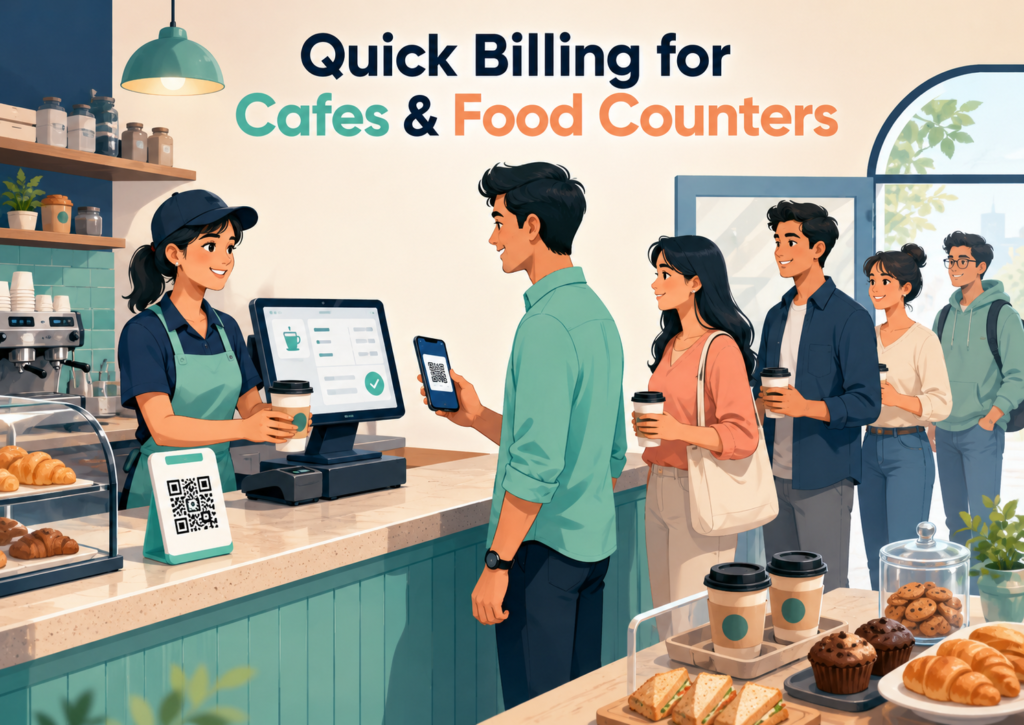
Table of Contents
- Why Billing Speed Matters for Cafes and Food Counters
- Keep Your Menu Screen Simple
- Create Shortcuts for Fast-Moving Items
- Avoid Asking for Unnecessary Customer Details
- Keep Payment Options Ready at the Counter
- Prepare for Rush-Hour Billing
- Train Staff on One Fast Billing Flow
- Check Where Billing Gets Delayed
- Daily Billing Speed Checklist
- Final Thoughts
Why Billing Speed Matters for Cafes and Food Counters
Cafés and food counters usually handle small-ticket, high-frequency orders.
A customer may order one coffee, another may order two sandwiches, and someone else may want a quick takeaway bill. The order value may be small, but the speed expectation is high.
When billing is slow, three things happen:
- Customers wait longer
- Staff make more mistakes under pressure
- Payments become harder to match later
For food counters, billing should be quick, direct, and easy to repeat. The process should not feel like detailed accounting at the counter.
The ideal billing flow should be:
Select items → Confirm total → Accept payment → Print or share billThat is the basic speed goal for any café or food counter.
Keep Your Menu Screen Simple
A cluttered menu slows down billing.
If staff have to scroll through too many items, similar names, old dishes, or inactive menu items, every order takes longer to enter.
Keep the billing menu clean by arranging items into clear categories such as:
- Hot beverages
- Cold beverages
- Snacks
- Sandwiches
- Combos
- Desserts
- Packaged items
- Add-ons
Remove unavailable items from the active billing screen. Do not keep old seasonal items visible if they are not being sold.
For example, instead of showing every drink in one long list, group them as:
| Category | Example Items |
|---|---|
| Coffee | Espresso, cappuccino, cold coffee |
| Tea | Masala tea, lemon tea, green tea |
| Snacks | Samosa, veg puff, sandwich |
| Combos | Coffee + sandwich, tea + snack |
A simple menu screen helps staff find items faster and reduces wrong item selection.
Create Shortcuts for Fast-Moving Items
Most cafés and food counters have a few items that sell repeatedly every day.
Instead of making staff search for these items every time, keep them easily accessible.
Common fast-moving items may include:
- Tea
- Coffee
- Cold coffee
- Samosa
- Sandwich
- Burger
- Puff
- Juice
- Water bottle
- Combo meals
If your billing system allows favourites or quick item buttons, place these items on the first screen.
This works especially well during rush hours. Staff can tap the item, adjust quantity, and move to payment without wasting time.
Also review fast-moving items weekly. If a new item starts selling more, move it to the quick-access list.
The faster your staff can find the item, the faster the customer can pay and leave.
Avoid Asking for Unnecessary Customer Details
Many café and food counter orders do not need detailed customer information.
If staff ask for name, phone number, address, or GST details for every small order, billing becomes slow.
For quick counter sales, use a simple walk-in customer flow wherever possible.
Customer details are useful when:
- It is a bulk order
- It is a corporate order
- The customer needs a GST invoice
- The order is for delivery
- The customer has credit or pending payment
- You want to maintain repeat customer records
But for regular counter orders, avoid extra fields that slow down billing.
The rule is simple:
Capture only the information needed for that order.
This keeps billing fast and reduces queue pressure.
Keep Payment Options Ready at the Counter
Billing speed also depends on payment speed.
Even if the bill is created quickly, payment delays can slow down the counter. This usually happens when the QR code is not visible, the card machine is not ready, or staff forget to mark the payment mode correctly.
Keep these ready before opening:
- UPI QR code
- Card machine
- Cash change
- Receipt printer
- Bill sharing option
- Payment confirmation process
Train staff to mark the correct payment mode at the time of billing.
For example:
| Payment Mode | What Staff Should Do |
|---|---|
| Cash | Collect amount and return change immediately |
| UPI | Confirm payment before closing bill |
| Card | Wait for payment success confirmation |
| Split payment | Record both payment modes clearly |
| Credit | Mark pending amount properly |
Fast payment handling keeps the counter moving and helps avoid closing-time confusion.
For quick-service counters and canteens, using a cafeteria POS software can help staff manage quick billing, menu selection, and payments from one counter screen.
Prepare for Rush-Hour Billing
Cafés and food counters usually have predictable rush hours.
For cafés, it may be morning and evening.
For snack counters, it may be evening.
For canteens, it may be lunch break.
For food courts, it may be weekends.
Do not wait for rush hour to organise your counter.
Before peak time starts, check:
- Printer paper
- Internet or device connection
- UPI QR visibility
- Card machine battery
- Cash change
- Fast-moving item availability
- Staff counter roles
- Menu item availability
Also decide who will do what.
For example:
| Role | Responsibility |
|---|---|
| Staff 1 | Take order and create bill |
| Staff 2 | Prepare or pack order |
| Staff 3 | Handle payment and delivery, if available |
Even in a small setup, clear roles reduce confusion.
Rush-hour speed is not only about software. It is also about counter preparation.
Train Staff on One Fast Billing Flow
If every staff member follows a different billing process, mistakes increase.
Create one standard billing flow for your café or counter.
For example:
Select order type → Add items → Confirm quantity → Apply discount if allowed → Choose payment mode → Print/share billTrain every staff member to follow the same steps.
Also define what staff should do in common situations:
- Customer changes order
- Item is unavailable
- Customer wants split payment
- Bill needs to be cancelled
- Wrong item is added
- Customer asks for GST bill
- Payment fails but bill is already created
This avoids panic during rush hours.
For coffee shops and cafés, a coffee shop POS software can help keep menu items, billing, payments, and daily sales easier for staff to handle from one setup.
Check Where Billing Gets Delayed
To improve billing speed, first find where the delay happens.
At the end of the day, ask your staff:
- Which items were hard to find?
- Which payment mode caused delays?
- Were any items priced incorrectly?
- Did the printer or device slow down?
- Did customers wait because order details were unclear?
- Were discounts or cancellations confusing?
- Did staff need owner approval too often?
This helps you fix the exact problem.
For example:
| Delay Reason | Fix |
|---|---|
| Staff cannot find items | Improve menu categories |
| Payment confirmation takes time | Keep UPI/card process clear |
| Printer issues | Check paper and printer daily |
| Wrong item added | Rename items clearly |
| Discounts cause confusion | Limit who can apply discounts |
| Too many unavailable items visible | Hide inactive items |
Small changes can make billing much faster over time.
Daily Billing Speed Checklist
Use this checklist before opening your café or food counter:
| Billing Speed Check | Done? |
|---|---|
| Fast-moving items are easy to find | |
| Unavailable items are hidden or marked | |
| Menu prices are updated | |
| UPI QR code is visible | |
| Card machine is working | |
| Cash change is ready | |
| Printer has paper | |
| Staff knows the billing flow | |
| Discounts and cancellations are controlled | |
| Payment modes are recorded properly | |
| End-of-day sales and payments are reviewed |
This checklist helps reduce small delays that slow down the counter during the day.
Final Thoughts
Cafés and food counters do not need a complicated billing process. They need a fast and repeatable one.
Speed comes from a clean menu screen, quick item selection, ready payment options, trained staff, and simple counter rules. When the billing flow is clear, customers wait less, staff work faster, and daily sales records become easier to review.
For cafés, snack counters, bakeries, juice shops, and quick-service food businesses, the goal should be simple:
Take the order quickly. Bill correctly. Collect payment clearly.If you want to manage fast billing, payments, and daily sales from one place, restaurant billing software can help small food businesses run daily counter billing more smoothly.
