
eWay Bill PIN to PIN Distance Calculation & e-Way Bill Validity
Find the approximate PIN-to-PIN distance for eWay Bill, understand how validity is calculated, and avoid common GST compliance mistakes before dispatch.
Trusted by 1 Crore+ Businesses

eWay Bill Validity by Distance
| Distance | Validity (Regular Cargo) | What It Means |
|---|---|---|
| Up to 200 km | 1 day | Valid for 1 day from the time of generation |
| More than 200 km and up to 400 km | 2 days | 1 additional day after the first 200 km |
| More than 400 km and up to 600 km | 3 days | 2 additional days after the first 200 km |
| More than 600 km and up to 800 km | 4 days | 3 additional days after the first 200 km |
| More than 800 km and up to 1000 km | 5 days | 4 additional days after the first 200 km |
| Every additional 200 km or part thereof thereafter | +1 day | Validity increases by 1 more day |
How to Calculate eWay Bill PIN to PIN Distance
Before generating an eway bill, if you would like to calculate the distance between the source and destination station of a consignment, you can use the free tool provided by the eway bill official portal.
Follow these steps to calculate the PIN to PIN distance for eway bill generation.
- Visit eway bill official website at https://ewaybillgst.gov.in/
- From the top menu, go to ‘Search’ and select ‘Pin to Pin Distance’ option.
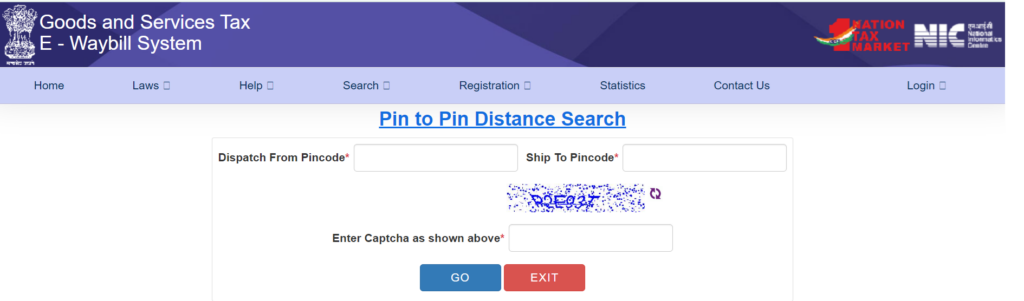
- The Pin to Pin Distance Search page appears. You can also hit the link to go to the page.
- On the page, enter ‘Dispatch From Pincode’ and ‘Ship to Pincode’, enter the Captcha and click on ‘Go’.
- The approximate distance between the pin codes will be displayed.
During physical inspections, the authorities can validate the entered PIN to PIN distance. If there are any discrepancies in the distance entered, the transporter may face penalties. Hence, the transporter must ensure the distance entered is accurate and reflects the actual route taken.
Common eWay Bill Distance & Validity Mistakes to Avoid
How to Extend Validity of an e-Way Bill
What Is Part B and How Does the 50 KM Rule Work in eWay Bill?
In an eWay Bill, Part B refers to the transport details used for moving goods from one place to another. This usually includes the vehicle number or other conveyance information, depending on how the goods are being transported. In simple terms, Part A covers the consignment and invoice details, while Part B covers the transport details.
The 50 km rule is connected to these transport details. In certain short-distance movements within the same State or Union Territory, Part B details may not be required at a specific stage of transport. This is mainly a procedural relaxation meant for limited local movement and should not be treated as a complete exemption from eWay Bill requirements.
Businesses often misunderstand the 50 km rule and assume that no eWay Bill details are needed for short-distance transport. However, the rule only provides relaxation in specific cases related to Part B. The remaining eWay Bill details must still be entered correctly, and businesses should continue to check validity, movement details, and compliance requirements before dispatch.
When Does eWay Bill Validity Start and End?
Simplify eWay Bill Management with myBillBook
Create eWay Bills with Less Manual Effort
myBillBook helps businesses handle eWay Bill processes with less repeated data entry and fewer manual steps. This makes it easier to save time, reduce routine work, and manage transport-related documentation more efficiently.
Manage Billing and Business Tasks in One Place
Instead of using separate tools for billing, records, and related workflows, businesses can manage important day-to-day tasks from one platform. This helps improve coordination, reduce confusion, and keep operations more organized.
Reduce Avoidable Errors in Daily Workflows
Manual processes often lead to small mistakes that can create delays and confusion later. myBillBook helps businesses work more accurately by simplifying routine tasks and making it easier to manage important billing-related information properly.
Support Smoother Business Operations
Whether it is billing, record management, or handling important business workflows, myBillBook helps teams stay better prepared for day-to-day operations. This allows businesses to work more smoothly and manage tasks with greater ease.
Built for Growing Indian Businesses
myBillBook is designed for retailers, wholesalers, distributors, and other growing businesses that want a simpler way to manage billing and related operations. It helps businesses stay organized while handling everyday work more confidently.
Simple, Affordable Plans
- Create unlimited invoices
- Access to 1 business, 1 user & 1 CA
- Inventory management
- Android, iOS & Web
- Custom Invoice Themes
- Create your Online Store
- Generate, Print & Scan Barcodes
- Desktop app
- SMS + WhatsApp marketing*
- Unlimited Godown management
- Print Barcode (Label printer)
- Bulk Download & Bulk Print Invoices
- Access to 2 businesses, 3 users & 1 CA
- e-Way Bills (Unlimited)
- Generate e-Invoicing
- Loyalty & Rewards
- Automate Recurring Billing
- POS Billing (Desktop App, Web app)
- Data Export to Tally (on request)
- User Activity Tracker
Frequently Asked Questions
Is eWay Bill needed for every goods movement?
The requirement depends on factors such as consignment value, type of goods, mode of transport, and the applicable GST rules. Businesses should always check whether the movement falls under the situations where an eWay Bill becomes mandatory.
How is eWay Bill PIN to PIN distance determined?
eWay Bill PIN to PIN distance is determined using the approximate distance between the dispatch PIN code and the destination PIN code. This distance is then used to calculate the applicable validity period for the movement of goods.
Does eWay Bill validity depend on PIN to PIN distance?
The validity of an eWay Bill is directly linked to the approximate transport distance entered. As the distance increases, the allowed validity period also increases according to the applicable distance slabs.
What happens if the wrong PIN to PIN distance is entered?
Entering the wrong distance can affect the validity period of the eWay Bill and may create confusion during goods movement. This is why businesses should verify the dispatch and destination details carefully before generation.
Is PIN to PIN distance the same as actual travel distance?
PIN to PIN distance is an approximate distance used for eWay Bill purposes. The actual route taken during transportation may vary, but the entered distance should still be reasonable and aligned with the intended movement.
Can eWay Bill validity expire before the goods are delivered?
Validity can expire before delivery if the goods do not reach the destination within the allowed time based on the entered distance. Delayed dispatch, traffic, or route-related issues can reduce the effective transport window.
Does eWay Bill validity start from dispatch or generation?
The validity period begins from the time the eWay Bill is generated, not from the time the goods actually start moving. This is why generating the bill too early can reduce the usable validity.
How can businesses avoid distance and validity errors in eWay Bill?
The best way to avoid errors is to check the dispatch PIN code, destination PIN code, approximate distance, and transport timing carefully before generating the eWay Bill. Accurate entry helps reduce confusion and supports smoother goods movement.