
ISP Billing Software
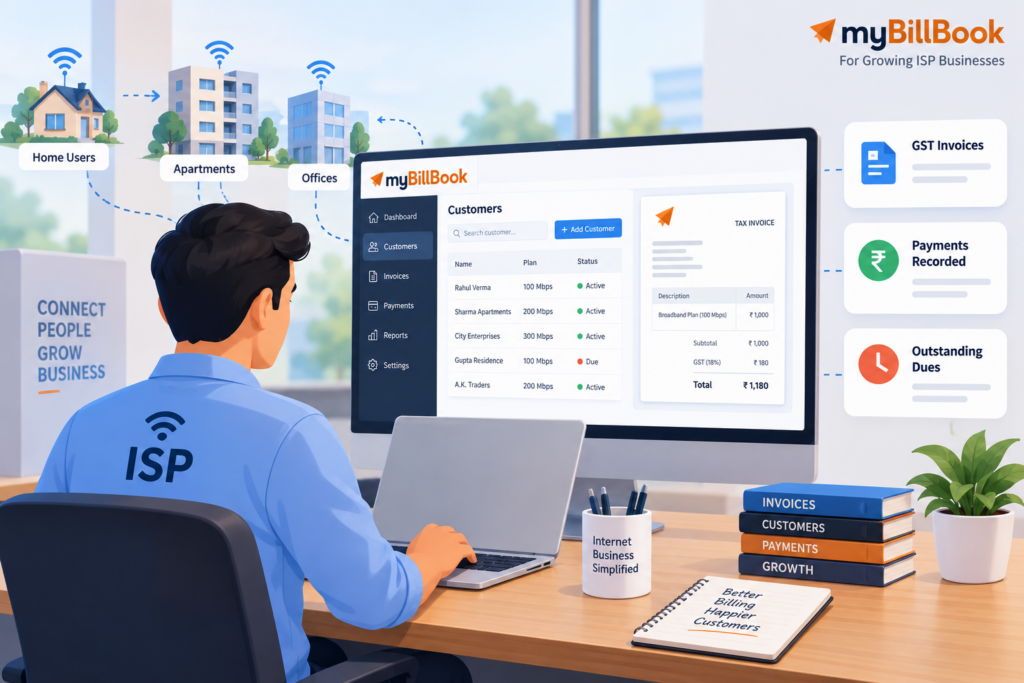
myBillBook ISP billing software is designed for Local ISPs and broadband providers that need billing, recurring invoices, payment tracking and business reports without a complex OSS/BSS setup.
Trusted by 1 Crore+ Businesses

What is ISP Billing Software?
ISP billing software helps internet service providers create customer invoices, manage recurring billing cycles, record payments, track outstanding dues and maintain billing history. More advanced ISP platforms may also connect billing with subscriber authentication, network provisioning, RADIUS and customer self-service systems.
myBillBook focuses on the billing and business-management side of ISP operations, making it suitable for local and growing ISPs that primarily need GST invoicing, recurring billing, payment tracking and reports.
Is myBillBook a Full ISP Management or OSS/BSS Platform?
| Requirement | myBillBook | Full ISP OSS/BSS Software |
|---|---|---|
| GST invoicing | ✓ | ✓ |
| Recurring billing | ✓ Available on supported plan | ✓ |
| Customer billing records | ✓ | ✓ |
| Payment and dues tracking | ✓ | ✓ |
| Invoice sharing | ✓ | ✓ |
| Sales and receivable reports | ✓ | ✓ |
| RADIUS/AAA integration | Not positioned as a core capability | Usually available |
| MikroTik/network provisioning | Not positioned as a core capability | Usually available |
| Automatic connection suspension | Not positioned as a core capability | Often available |
| Subscriber self-service portal | Not positioned as a core capability | Often available |
| OLT/network management | No | Often available |
When is myBillBook suitable for an ISP?
myBillBook is suitable when your main requirement is managing invoices, recurring billing, GST, customer balances, collections and business reports.
If your ISP requires RADIUS authentication, automatic service activation or suspension, MikroTik or OLT integration, bandwidth management or advanced subscriber provisioning, you should evaluate a specialised ISP OSS/BSS platform alongside your billing requirements.
Key Features of ISP Billing Software
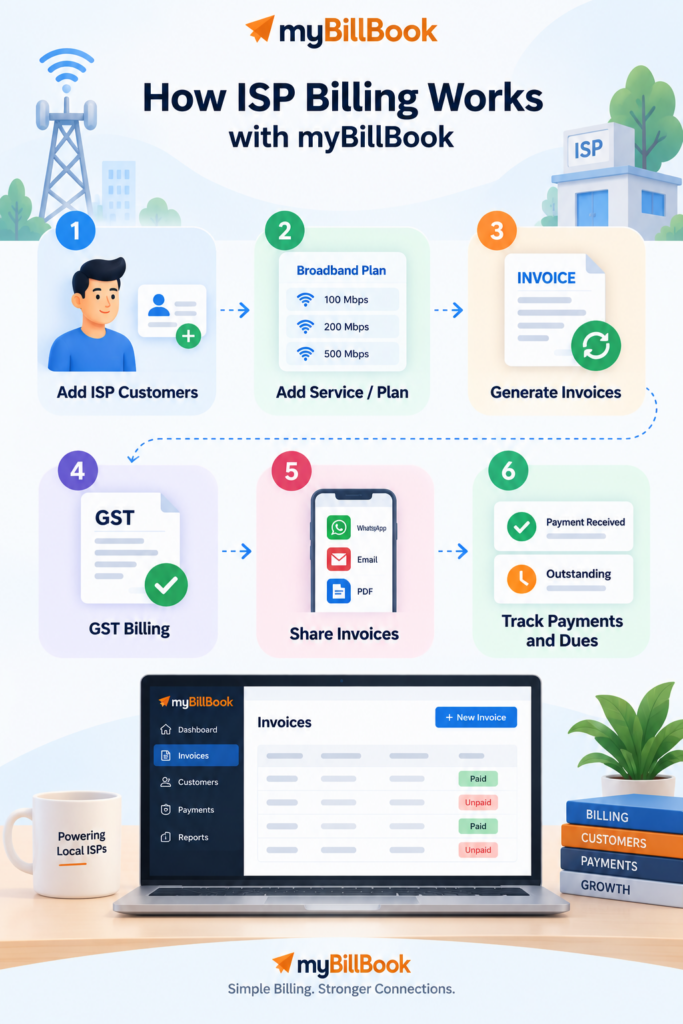
How Can an ISP Manage Billing with myBillBook?
1. Set up your business
Add business details, GST information, logo, invoice settings and preferred payment methods.
2. Add customer records
Create customer profiles with contact and billing details so invoices and payment history remain organised.
3. Add your broadband service or package
Create the relevant service item with its billing amount and applicable tax details for use while invoicing customers.
4. Generate or automate recurring invoices
Create regular invoices for customers, or use recurring billing where supported by your myBillBook plan.
5. Share invoices
Send invoices digitally through supported sharing options or print them when required.
6. Record payments and monitor dues
Record collections and review customer-wise outstanding balances for follow-ups.
7. Review business reports
Use sales, payment and receivable reports to understand collections and outstanding amounts.
Why Use myBillBook for ISP Billing?
Reduce repetitive monthly billing
Recurring invoices can reduce repetitive invoice creation where customers are billed at regular intervals.
Keep customer dues visible
Track outstanding balances customer-wise instead of relying on spreadsheets, notebooks or separate payment lists.
Simplify GST invoicing
Create GST invoices with automatic calculations and maintain invoice records in one system.
Improve payment follow-ups
Use outstanding-payment visibility and reminders to prioritise customers requiring follow-up.
Maintain organised billing history
Access customer invoices and payment records when checking past transactions or resolving billing queries.
Monitor collections
Use sales and receivable reports to understand billed amounts, collected payments and pending dues.
How to Choose ISP Billing Software
| Check | Why it matters |
|---|---|
| Billing model | Confirm whether you use fixed monthly, prepaid, postpaid or usage-based billing |
| Recurring invoicing | Important when customers are billed on regular cycles |
| GST invoicing | Check tax handling and invoice requirements for your business |
| Payment tracking | Make sure paid and outstanding customers can be identified easily |
| Customer history | Billing and payment records should be quickly accessible |
| Network integration | Check whether you need RADIUS, MikroTik, OLT or provisioning integration |
| Automation | Determine whether billing, reminders or service suspension must happen automatically |
| Reports | Check collection, outstanding and revenue visibility |
| Scalability | Consider users, customers, branches and future operational complexity |
| Data export | Make sure business and billing data can be exported when required |
For a small ISP with fixed subscription plans, billing, GST invoices, recurring invoices and payment tracking may be sufficient. ISPs requiring network authentication, automatic service suspension or subscriber provisioning generally need specialised ISP management software.
Manual ISP Billing vs Billing Software
| Manual billing | ISP billing software |
|---|---|
| Customer data across notebooks/sheets | Centralised billing records |
| Repeated invoice preparation | Faster or recurring invoice creation |
| Manual GST calculations | Automated invoice calculations |
| Separate payment lists | Customer-wise dues tracking |
| Manual payment chasing | Structured outstanding follow-up |
| Difficult historical lookup | Accessible invoice/payment history |
Which myBillBook Plan is Suitable for ISP Billing?
ISPs mainly needing invoicing, customer records and payment tracking can compare myBillBook plans based on device access and users. If recurring billing is an important requirement, check the plan that includes recurring billing before subscribing.
- Create unlimited invoices
- Access to 1 business, 1 user & 1 CA
- Inventory management
- Android, iOS & Web
- Custom Invoice Themes
- Create your Online Store
- Generate, Print & Scan Barcodes
- Desktop app
- SMS + WhatsApp marketing*
- Unlimited Godown management
- Print Barcode (Label printer)
- Bulk Download & Bulk Print Invoices
- Access to 2 businesses, 3 users & 1 CA
- e-Way Bills (Unlimited)
- Generate e-Invoicing
- Loyalty & Rewards
- Automate Recurring Billing
- POS Billing (Desktop App, Web app)
- Data Export to Tally (on request)
- User Activity Tracker
Frequently Asked Questions
How do self-service portals in ISP billing software empower customers?
A self-service portal lets customers view invoices, download receipts, check outstanding balance, and sometimes update details or pay online—reducing support calls. If you don’t run a full portal, tools like myBillBook still help by letting you share invoices/receipts instantly on WhatsApp/email, so customers can access them anytime.
How does ISP billing software handle complex data usage and overage charges?
Usage-based billing usually requires importing consumption data (from your network/AAA/RADIUS/CRM), applying slabs/rates, and calculating overage charges accurately. If your ISP runs mostly fixed monthly plans, you may not need this complexity—choose software based on whether you truly bill by usage, speed upgrades, or fixed subscriptions.
How do I evaluate the scalability of ISP billing software for future growth?
Check whether it supports: multi-user access, cloud sync, fast billing at higher volumes, customer-wise billing history, strong reporting, easy data export, role-based access, and the ability to add branches/plans without messy workarounds.
When should an ISP consider upgrading or implementing new billing software?
When you’re seeing frequent missed renewals, billing errors, delayed invoicing, rising overdue payments, growing subscriber count, multiple staff handling collections, or difficulty finding customer billing history during support calls.
What are the common misconceptions about ISP billing software?
Common myths include: “it’s only for large ISPs,” “it will run on autopilot without process changes,” “it fixes network issues,” or “it automatically ensures full compliance.” In reality, it improves billing accuracy and visibility—but your billing rules, plans, and follow-up discipline still matter.
Which is the Best ISP Billing Software available?
“Best” depends on your billing model. If you need simple subscription invoicing, GST-ready bills (where applicable), quick sharing, and dues tracking, myBillBook is a strong fit for many local ISPs. If you need usage-based rating, prepaid charging, self-care portals, and deep network/provisioning integrations, shortlist a full ISP BSS/OSS-grade system that supports those workflows and run a pilot with real subscriber data before committing.