
Business Quotation Format
Download a ready business quotation format in Word, Excel, or PDF to present product or service pricing, GST where applicable, validity, payment terms, delivery details, and customer-specific commercial terms.
Powered by myBillBook - India's #1 Billing Software

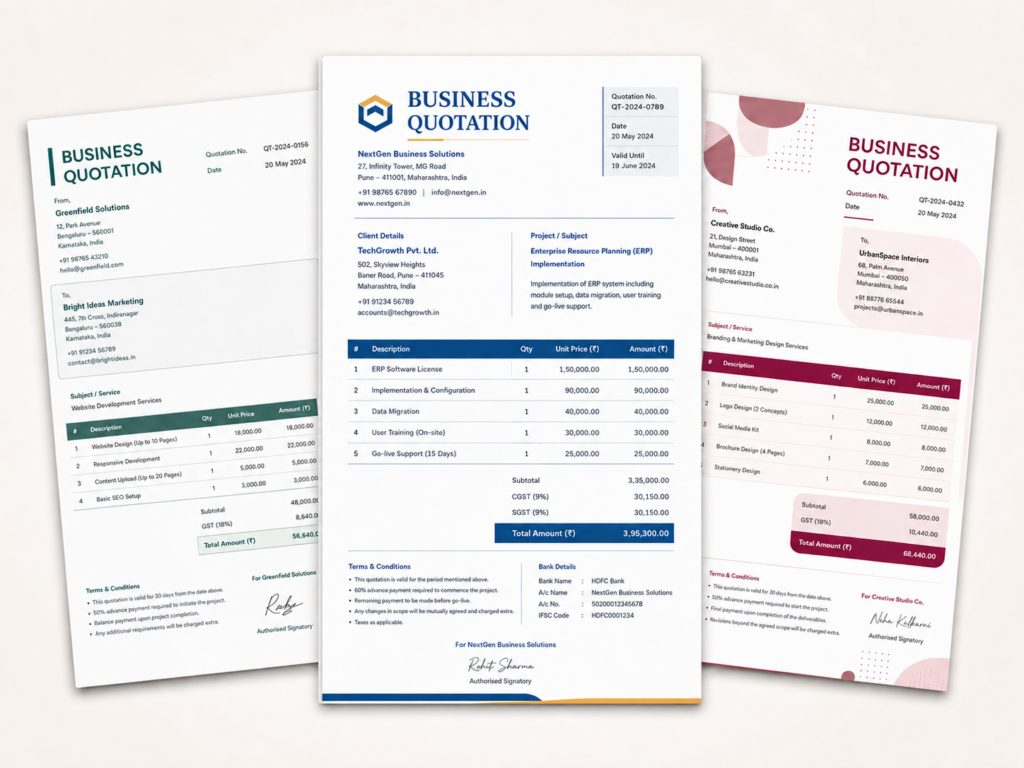
What Is a Business Quotation Format?
A business quotation format is a structured pre-sale document a business sends to a prospective customer to explain what it is offering, how much it will cost, what is included, and the commercial conditions that apply before an order is confirmed.
Unlike a basic price message, a business quotation brings the complete offer into one reference document. It can cover product quantities, service scope, unit rates, discounts, taxes where applicable, delivery or completion timelines, payment terms, quotation validity, exclusions, and acceptance details.
Download Free Business Quotation Templates
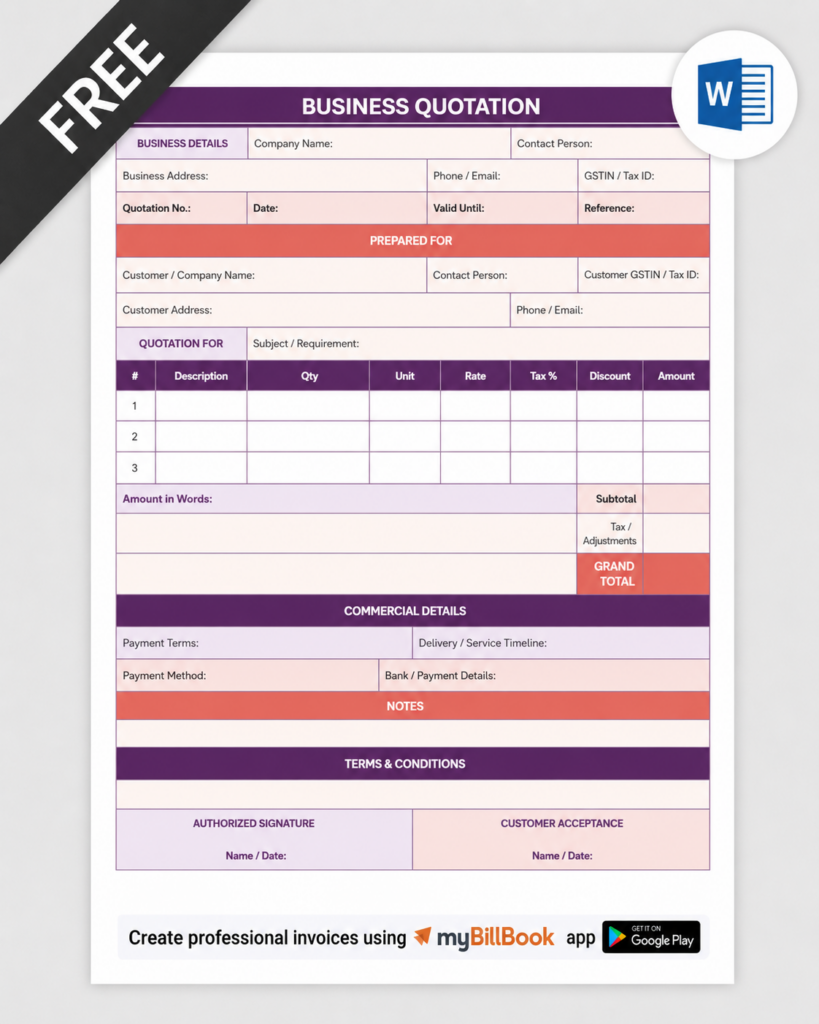
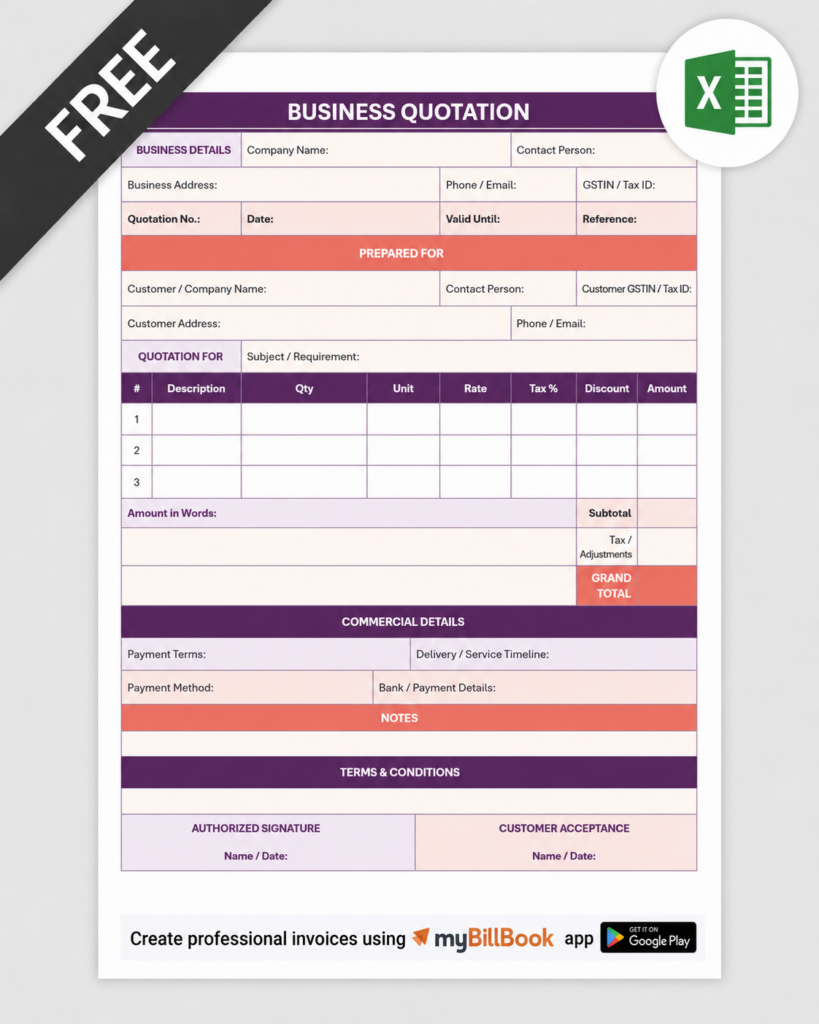
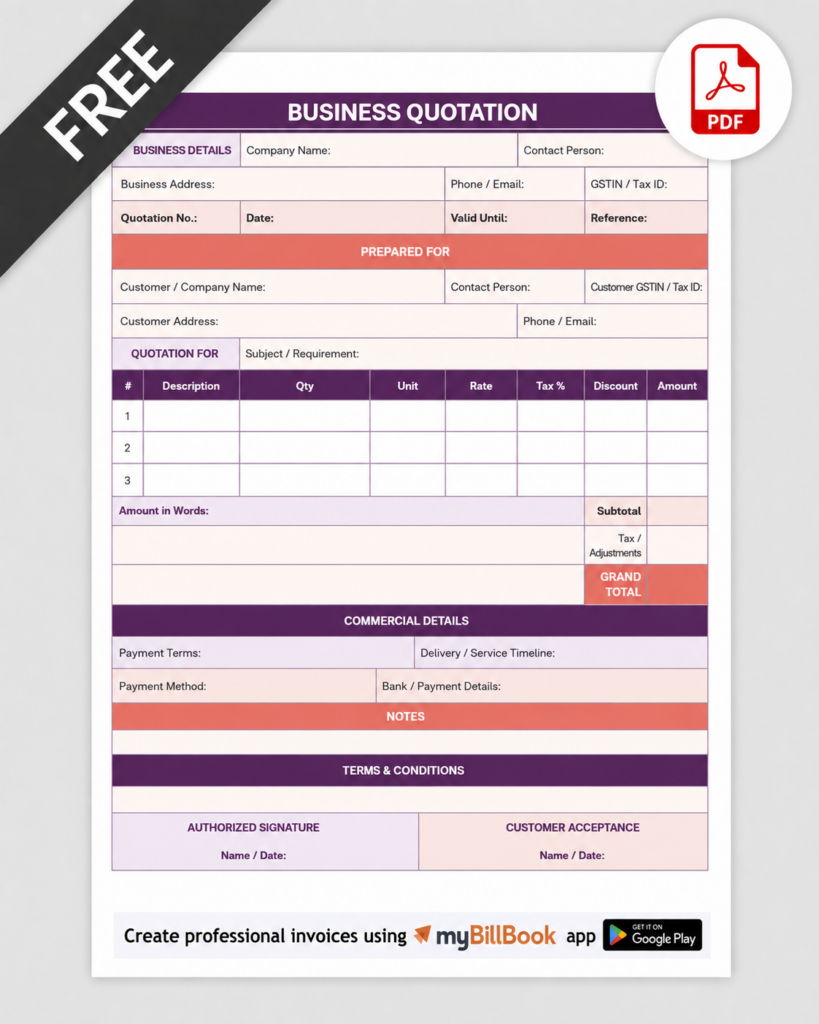
How to Create a Business Quotation Format
How Does a Business Quotation Format Differ for Products and Services?
The basic structure of a business quotation remains similar for both product and service businesses, but the information used to describe the offer changes. Product quotations focus more on quantities, specifications, unit prices, stock, and delivery, while service quotations need a clearer definition of scope, deliverables, timelines, and exclusions.
| Quotation Element | Product Business | Service Business |
|---|---|---|
| Main Description | Product name, model, size, SKU, specification, brand, or variant | Service description, scope of work, package, task, or project deliverable |
| Quantity Basis | Units, pieces, boxes, kilograms, metres, packs, or other measurable quantities | Hours, days, visits, projects, milestones, retainers, or fixed service packages |
| Pricing | Unit rate × quantity, quantity-based pricing, discounts, and product-wise totals | Fixed fee, hourly rate, milestone-based fee, monthly fee, or project-based pricing |
| Additional Charges | Freight, packaging, installation, handling, or delivery charges | Travel, additional revisions, materials, third-party expenses, or out-of-scope work |
| Timeline | Dispatch date, stock availability, lead time, and expected delivery | Service start date, project duration, milestone dates, and expected completion |
| Important Terms | Minimum order quantity, delivery location, warranty, return conditions, and price validity | Number of revisions, customer responsibilities, dependencies, support period, and exclusions |
| Customer Approval | Approval usually confirms product, quantity, price, and delivery terms | Approval should confirm both the commercial value and the agreed scope of work |
Example: Product Business Quotation
A wholesaler supplying office chairs may quote 50 chairs at a specified unit rate, along with model details, GST, freight, delivery timeline, payment terms, and quotation validity. If the price changes at higher quantities, the quotation can also mention the applicable quantity slab.
Example: Service Business Quotation
A digital marketing agency may instead quote a monthly service package covering defined deliverables such as SEO activities, reporting, content requirements, and review meetings. The quotation should specify what is included, what requires an additional charge, the service period, payment schedule, and any limits on revisions or additional work.
For businesses selling both products and services—for example, equipment along with installation—the same business quotation can include separate line items for the product, installation, transport, maintenance, or other services. Keeping these charges separate makes the final offer easier for the customer to understand and approve.
What Should a Professional Business Quotation Template Include?
Business Identity and Quote Reference
Include the business name, address, contact details, GSTIN where applicable, quotation number, issue date, subject, salesperson or contact person, and a clear validity date. A unique quotation number makes later revisions and customer follow-ups easier to track.
Customer and Delivery Details
Add the customer or company name, billing or communication address, contact person, delivery or service location where relevant, and GSTIN if the buyer has provided it for a taxable business transaction.
Products, Services, and Scope
Describe what is being offered in enough detail to avoid ambiguity. Product quotations may need model, size, unit, quantity, or specification. Service quotations may need scope, deliverables, milestones, visit count, or completion criteria.
Price Breakup
Show quantity, rate, line amount, discount, extra charges, taxable value, applicable GST, and final quoted amount. Where a cost is optional or provisional, mark it clearly rather than mixing it into the confirmed price.
Commercial Terms
State payment schedule, advance requirement, credit period if any, delivery or completion timeline, freight or installation treatment, quotation validity, cancellation or revision conditions, warranties, support, exclusions, and customer responsibilities.
Acceptance and Authorisation
Add an authorised signatory or business stamp if your workflow uses one. You can also include a customer acceptance line, purchase-order requirement, or instruction such as replying by email with written approval. Clear acceptance instructions help move a quote into an order without confusion.
How to Price a Business Quotation Format Without Losing Margin
A professional-looking quotation can still hurt profitability if the price is built only from the visible purchase cost. Before sending a customer quote, calculate the complete commercial cost of fulfilling the order or service.
Start With Direct Cost
For products, this may include purchase cost, inward freight, packing, or handling. For services, it may include labour hours, subcontractors, materials, travel, software, or equipment directly required to complete the work.
Add Relevant Overheads
Recurring costs such as staff time, delivery operations, administration, rent allocation, payment collection effort, or service support may need to be considered when deciding the selling rate, even if they are not separately shown to the customer.
Protect the Intended Margin
Do not treat markup and margin as the same calculation. Decide the minimum acceptable selling price before offering discounts. If a customer negotiates, know how far the price can move without making the order unattractive.
Separate Pass-Through Charges
Freight, installation, government fees, travel, third-party costs, and optional add-ons should be identified separately when they can change. This reduces the risk of the customer assuming that every incidental cost is included in the base price.
Apply Tax After the Commercial Price Is Clear
Where GST applies, show taxable value and the applicable tax breakup clearly. A quotation is a pre-sale commercial document, not a tax invoice, so it should not be presented as proof that GST has already become payable or that the buyer can claim input tax credit from the quotation itself.
Business Quotation Validity, Revisions, and Version Control
Business prices can change because of supplier rates, raw materials, currency movement, freight, availability, project scope, or customer negotiation. A quotation template should therefore make it easy to identify which version is current.
Add a Valid-Until Date
Instead of saying that prices are “subject to change” without a time limit, mention a clear validity period. If the buyer returns after the validity date, the business can recheck prices and issue an updated quotation.
Use Revision Numbers
When only part of a quote changes, keep the original quotation reference and add a revision marker such as Rev-1 or V2. This gives the customer and internal team one visible trail of what changed.
State That a Revision Replaces the Earlier Version
If a new quotation supersedes an older one, say so. Otherwise, customers may approve an outdated price or scope that your team no longer intended to offer.
Record Why the Quote Changed
For internal tracking, note whether the revision was due to quantity, specification, discount, delivery location, additional scope, or customer negotiation. This becomes useful when analysing why quotations are won, lost, or repeatedly revised.
Business Quotation vs Estimate vs Proposal vs Proforma Invoice
| Document | Main Purpose | Typical Detail | When Used |
|---|---|---|---|
| Business Quotation | Present a defined commercial offer | Price, scope, taxes if applicable, validity, payment and delivery terms | Before customer approval or purchase order |
| Estimate | Give an approximate expected cost | Expected quantities, rates, assumptions, approximate total | When final scope or quantity is still uncertain |
| Proposal | Persuade the buyer with a broader solution | Problem, approach, deliverables, team, timeline, value, and pricing | For consultative, project, agency, or complex B2B sales |
| Proforma Invoice | Present an invoice-like pre-sale document | Seller/buyer details, goods or services, price, tax information, expected transaction value | Often used for advance, internal approval, shipping, or transaction confirmation before the final invoice |
The right document depends on the stage of the sale. If the customer mainly needs a clear price and commercial terms, a business quotation is usually the most direct option. If the work is not yet measurable, an estimate may be more appropriate. A proposal suits complex solution selling, while a proforma invoice is useful when the buyer needs a more invoice-like pre-sale document.
Know More About Business Quotation Template in Word, Excel, and PDF
Business Quotation Template in Word
A business quotation template in Word works well when the quotation needs customised wording, service descriptions, project notes, detailed terms, or branded presentation. It is easy to duplicate for a new customer, edit the offer, and export the final version as a PDF. Word is especially useful for agencies, consultants, service providers, and businesses where each quote needs more narrative than calculation.
Business Quotation Template in Excel
A business quotation template in Excel is useful when the quotation contains many products, quantities, rates, discounts, taxes, or optional price combinations. Formulas can calculate line totals, discounts, taxable value, GST, and the final quoted amount automatically. Excel is a practical option for traders, wholesalers, suppliers, manufacturers, and product businesses that revise quantities frequently.
Business Quotation Template in PDF
A PDF business quotation is best for sharing the final customer-facing version after the details have been reviewed. PDF helps preserve the layout across devices and reduces accidental editing. Businesses can send it through WhatsApp or email, store the approved version with the customer record, and refer to the same document when an order or invoice is later created.
Turn Approved Business Quotations Into Invoices Without Re-entering Everything
Use myBillBook’s online quotation maker to create, revise, share, and store quotations, then convert an accepted quotation into an invoice when the sale is confirmed.
What to Check Before Sending a Business Quotation
- Check that the customer name, company, contact person, and delivery or service location are correct.
- Use a unique quotation number and confirm the issue date and valid-until date.
- Make every product, service, optional item, and exclusion easy to identify.
- Verify quantities, rates, discounts, additional charges, taxable value, taxes, and final amount.
- State whether freight, installation, travel, packaging, or third-party charges are included or extra.
- Confirm payment schedule, advance, credit period, delivery timeline, and customer responsibilities.
- Add revision or version details if the quotation has changed after negotiation.
- Make sure outdated quotation versions are not still being shared internally.
- Export or share the customer-facing version in a fixed format such as PDF after final review.
- Keep the approved quotation with the related customer order, purchase order, or invoice for reference.
Frequently Asked Questions
Can a customer accept a business quotation by email or WhatsApp?
A customer can communicate approval through email, WhatsApp, a purchase order, signature, or another agreed channel. For important transactions, the business should keep a clear written record of what was accepted and which quotation version the approval relates to.
What happens if the customer approves a quotation after its validity date?
The business can recheck prices, stock, freight, timelines, and other commercial conditions before accepting the old quote. If anything has changed, issue a revised quotation with a new validity period instead of relying on an expired price.
Should a revised business quotation use a new quotation number?
You can either issue a new number or keep the original reference with a revision marker such as Rev-1 or V2. The important point is to make the latest version unmistakable and record that it replaces the earlier version.
Can a non-GST-registered business create a quotation?
Yes. A business can issue a quotation even if it is not registered under GST. It should not display GST as if it were being charged by a registered supplier. Use the business and tax details that actually apply to the seller.
Should bank details be included in a business quotation?
Bank or payment details are optional. Include them when the customer may need to pay an advance after approval. If you add them, ensure the account details are current and clearly identify the accepted payment method.
Can a business collect an advance against an approved quotation?
Yes, if the commercial terms require an advance. The quotation should state the amount or percentage, when it is due, and what triggers work or dispatch. The business should then issue the appropriate payment or tax document required for the actual transaction.
Does sending a quotation reserve stock or a delivery slot automatically?
Not unless the quotation says so or your business separately confirms the reservation. If availability is limited, mention whether stock, production capacity, or delivery dates are subject to confirmation when the customer accepts the quote.
How long should a business keep quotation records?
Keep quotations long enough to support customer follow-ups, revisions, pricing decisions, disputes, audits, and the related order or invoice trail. The exact retention period can depend on your accounting, contractual, and regulatory requirements, so businesses should follow their applicable record-retention policy.