
Money Receipt Format
Use a clear money receipt format to acknowledge money received for rent, fees, deposits, donations, advances, subscriptions, loan repayments, or other personal and institutional transactions. Record the payer, amount, purpose, date, payment mode, and authorised signature in one simple document.
- Suitable for broad personal, institutional, and non-invoice payments
- Records amount in figures and words with payment purpose
- Provides written proof for both payer and receiver
Powered by myBillBook - India's #1 Billing Software

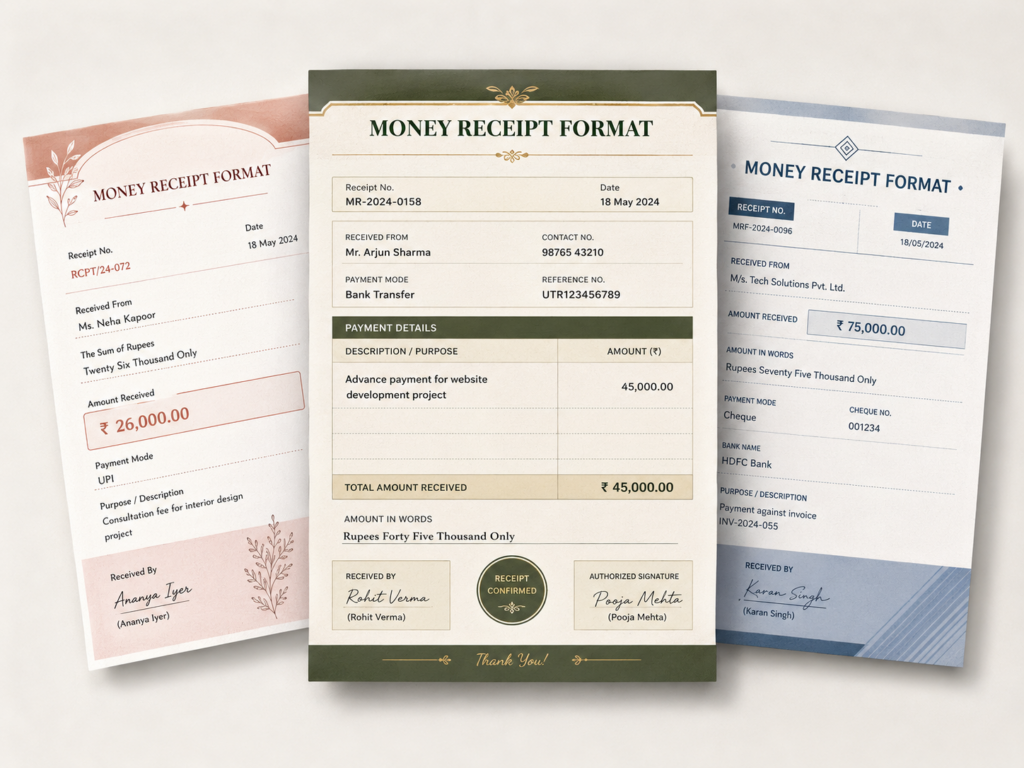
What Is a Money Receipt Format?
A money receipt format is a structured acknowledgement confirming that a person, landlord, school, trust, club, lender, business, or organisation has received a specific amount from another party. It normally contains a receipt number, date, payer name, amount in figures and words, reason for payment, payment mode, reference number, and receiver authorisation.
Unlike a payment receipt used mainly for customer collections linked to invoices and outstanding dues, a money receipt has a broader purpose. It can document rent, tuition fees, deposits, donations, membership fees, advances, loan instalments, reimbursements, or other general transfers of money.
Download Ready to Use Money Receipt Format Templates
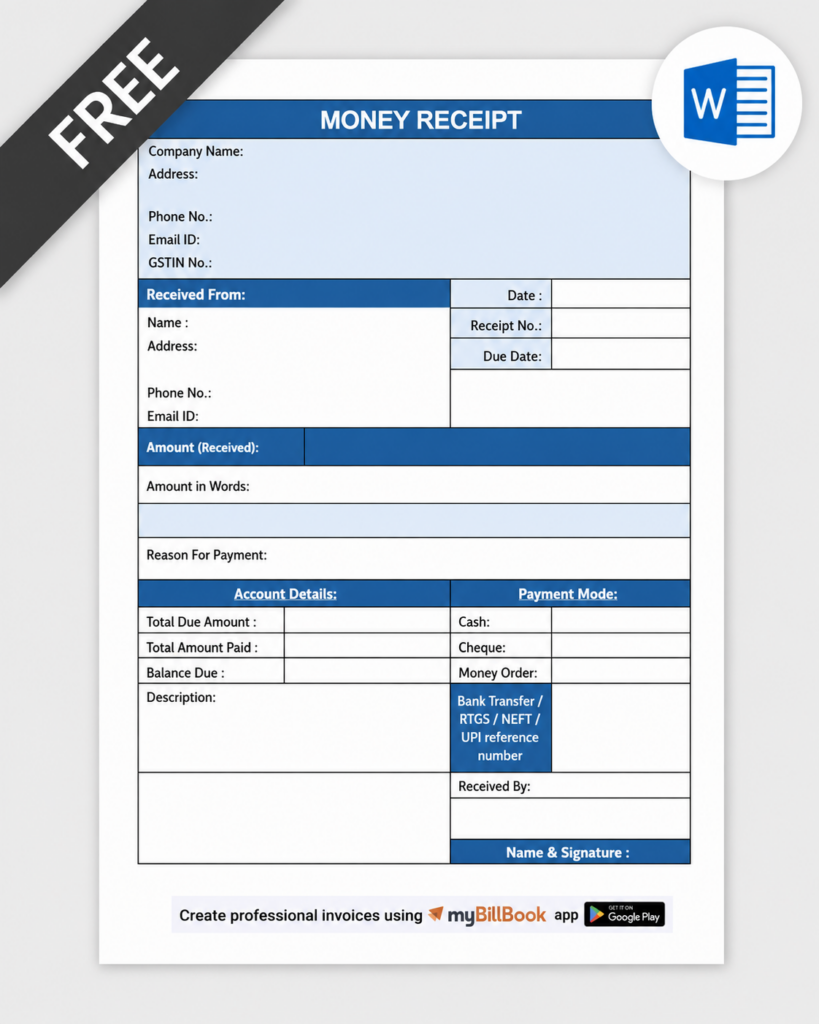
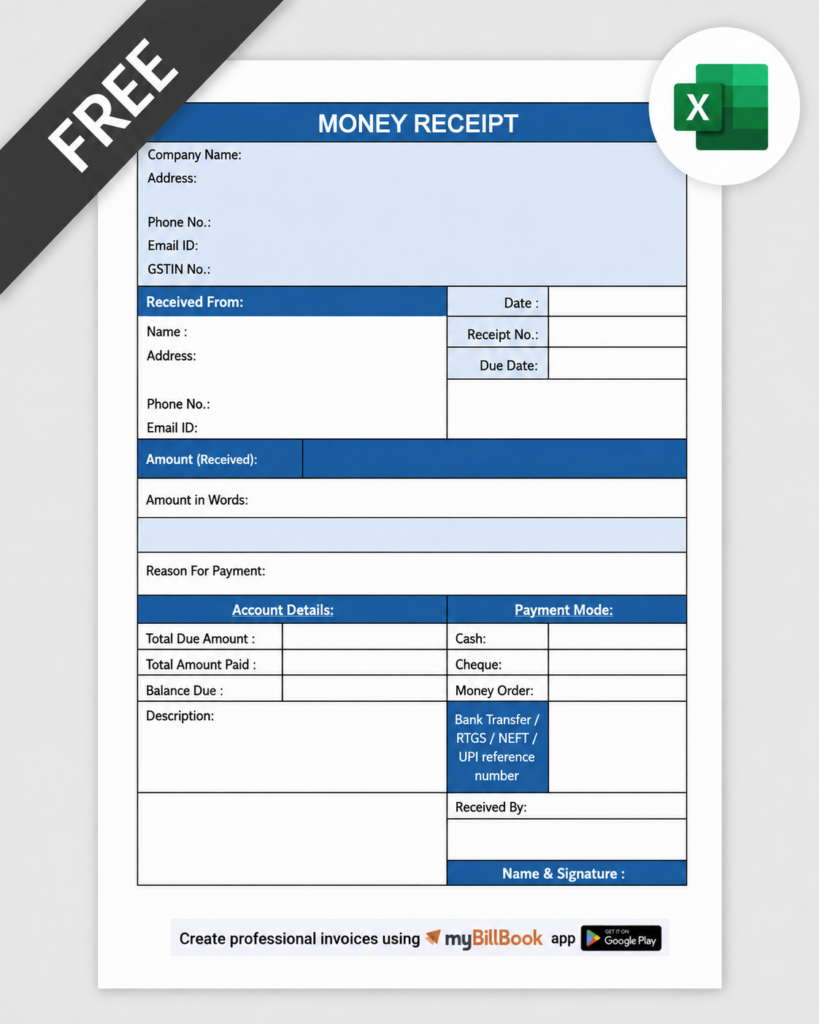
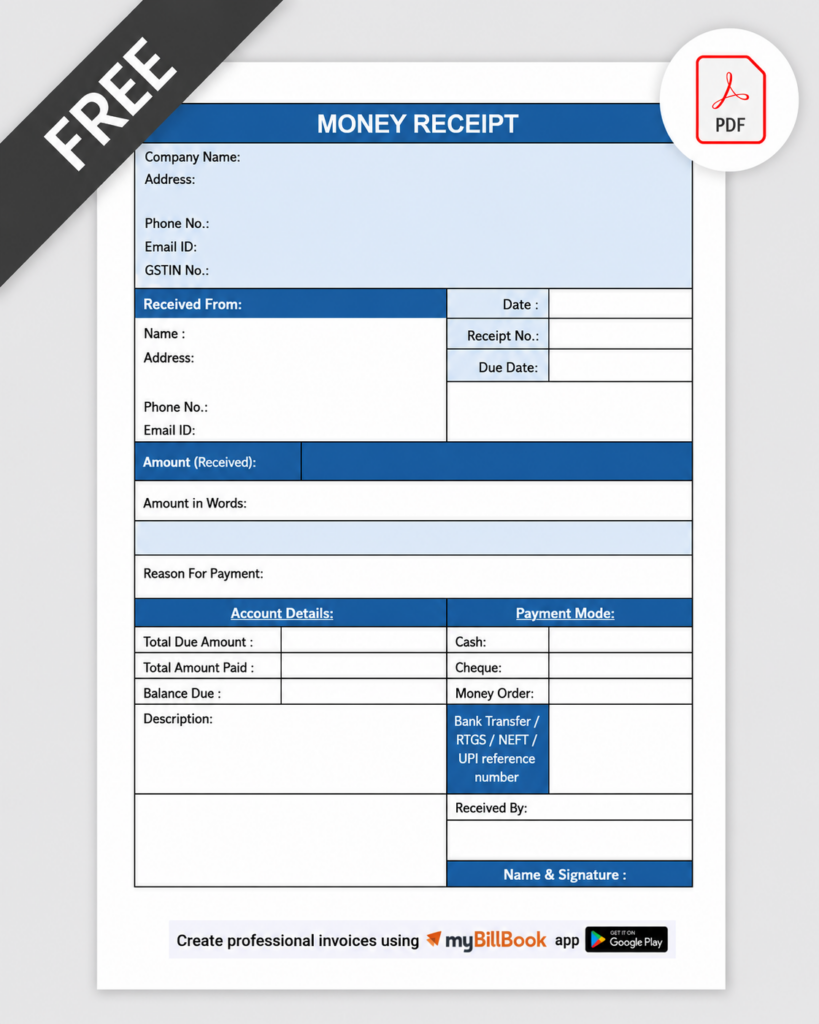
How to Create a Money Receipt Format?
Essential Fields in a Standard Money Receipt Format
Receipt Number and Date
Use a unique sequential number and clearly record the date on which the money was received.
Receiver Details
Add the receiver’s name, organisation, address, contact information, and registration or identification details where applicable.
Payer Details
Include the payer’s name and a relevant reference such as tenant ID, student ID, membership number, or loan account.
Amount in Figures and Words
Writing the amount both ways helps prevent misunderstanding, alteration, or data-entry mistakes.
Purpose of Payment
State the exact reason, such as rent, fee, donation, deposit, advance, instalment, subscription, or reimbursement.
Payment Mode and Reference
Record cash, UPI, cheque, card, or bank transfer together with any available transaction reference.
Remarks or Conditions
Add a brief note where needed, such as refundable deposit, payment in full, subject to cheque clearance, or part payment.
Authorised Signature or Stamp
The receiver’s signature, name, designation, or official stamp confirms that the money has been acknowledged.
Money Receipt Format in Word, Excel, and PDF
Money Receipt Format in Word
Best for customising names, logos, wording, signature areas, and transaction notes. It suits occasional receipts and users.
Money Receipt Format in Excel
Useful for sequential receipt numbering, amount tracking, balance calculations, and maintaining an organised register of multiple receipts.
Money Receipt Format in PDF
Ideal for issuing a final, fixed-layout copy that can be printed or shared digitally without accidental changes to the receipt.
Common Uses of a Money Receipt Format
Rent and Security Deposit
Landlords can acknowledge monthly rent, maintenance, refundable deposits, and other property-related payments.
School, College, or Coaching Fees
Educational institutions can confirm tuition, admission, examination, transport, and activity fee collections.
Donation and Contribution
Trusts, NGOs, clubs, religious bodies, and community groups can acknowledge general contributions and donor payments.
Loan or Instalment Repayment
Individuals and organisations can document principal, interest, or instalment amounts received against a loan or financial arrangement.
Membership and Subscription Fees
Associations, gyms, clubs, and societies can confirm membership fees, renewals, and subscription payments.
Advance or Refundable Deposit
A receipt can record money received before service completion or as a deposit under an agreement.
Who Can Use a Money Receipt Format?
A money receipt format can be used by any individual, institution, property owner, association, or organisation that needs to acknowledge money received for a clearly stated purpose. It is particularly useful for transactions that may not begin with a regular sales invoice.
Landlords and Property Owners
Landlords can issue money receipts when they receive:
- Monthly house or commercial-property rent
- Security deposits
- Maintenance charges
- Advance rent
- Parking or utility contributions
The receipt should mention the tenant’s name, property address, rental period, amount received, and whether the amount is rent, maintenance, or a refundable deposit.
Schools, Colleges, and Coaching Institutes
Educational institutions can use a money receipt format to acknowledge:
- Tuition fees
- Admission fees
- Examination charges
- Transport fees
- Activity fees
- Hostel or accommodation fees
The receipt should include the student’s name, student ID, course or class, fee period, amount, and authorised institutional signature.
Housing Societies, Clubs, and Associations
Housing societies, resident associations, clubs, gyms, and community organisations can issue money receipts for:
- Membership fees
- Monthly maintenance
- Event contributions
- Subscription renewals
- Facility deposits
- Community collections
Adding a member ID, flat number, membership period, or contribution purpose makes the receipt easier to identify later.
Individuals Receiving Personal Payments
An individual may use a money receipt when receiving money for a personal arrangement, including:
- Loan repayment
- Shared expenses
- Refundable deposits
- Sale of a personally owned asset
- Advance under a private agreement
- Reimbursement from another person
The receipt should clearly identify both parties and explain why the amount was received. For important or high-value transactions, the receipt should be retained with the related agreement and bank record.
Lenders and Private Financiers
Individuals or organisations receiving loan instalments can use a money receipt to record the amount received, instalment date, loan reference, and the period or instalment number covered.
The receipt should not state that the entire loan is settled unless the full amount has actually been received.
Trusts, NGOs, and Community Organisations
Trusts, NGOs, religious bodies, and community organisations may issue money receipts for general contributions, programme fees, event collections, or other amounts received.
Where a contributor requires a specialised donation receipt or tax-related certificate, the organisation should issue the appropriate document instead of relying only on a general money receipt.
What Are the Benefits of Using a Standard Money Receipt Format?
A standard money receipt format ensures that every transaction is acknowledged with the same essential information. It gives the payer and receiver a clear, organised record instead of relying only on a verbal confirmation or payment screenshot.
Provides Clear Proof of Receipt
A signed money receipt confirms that a stated amount was received from a named person on a particular date.
It also records the payment purpose, which may not be evident from a bank statement, UPI message, cheque entry, or cash transaction.
Prevents Misunderstandings
A properly completed receipt explains whether the amount was received as rent, a fee, deposit, advance, instalment, membership charge, or another payment.
This reduces disagreements about why the amount was paid or which period, property, account, or arrangement it covered.
Supports Better Record-Keeping
Sequential receipt numbers and consistent fields make transactions easier to arrange by date, payer, purpose, or receipt category.
Institutions and individuals can locate earlier receipts without depending entirely on messages, handwritten notes, or bank transaction histories.
Helps Track Recurring Collections
Landlords, educational institutes, societies, clubs, and lenders often receive recurring payments.
A standard receipt format helps them identify which months, terms, instalments, subscriptions, or membership periods have been paid.
Improves Transparency Between Both Parties
The payer can verify the amount and purpose before accepting the receipt. The receiver can retain a duplicate copy as evidence of what was acknowledged.
Both copies should carry the same receipt number and transaction information.
Creates a Professional Process
A properly designed and authorised receipt appears more reliable than an informal note. It also encourages the receiver to consistently record essential details such as the amount in words, payment purpose, transaction reference, and signature.
Supports Physical and Digital Storage
The same standard format can be maintained in a receipt book, Word document, Excel register, or PDF.
Digital receipts are easier to search and share, while printed or handwritten formats may be convenient for occasional collections. Regardless of the medium, both parties should retain a readable copy.
Need Better Control Over Invoices and Customer Payments?
A money receipt works well for general acknowledgements. For business billing, myBillBook helps create invoices, record collections, track outstanding balances, and maintain customer transaction histories.
Frequently Asked Questions
Is a money receipt the same as an invoice?
No. An invoice records a sale and requests payment. A money receipt confirms that money has already been received for the purpose stated on the receipt.
Can a money receipt be used for rent or fees?
Yes. It is commonly used by landlords, schools, colleges, coaching centres, clubs, and institutions to acknowledge rent, tuition, admission, membership, or other fees.
Can a money receipt be issued for a deposit or advance?
Yes. Clearly describe whether the amount is refundable, adjustable, or an advance and mention any related agreement, booking, or account reference.
Can I issue a money receipt for UPI or bank transfer?
Yes. Mention the payment mode and record the available UPI transaction ID, UTR, bank reference, cheque number, or card reference.
Should the amount be written in words?
It is strongly recommended because writing the amount in figures and words reduces ambiguity and helps prevent alteration or transcription errors.
Does a money receipt need a signature?
A signature, stamp, or digital authorisation is recommended because it confirms that the receiver has verified and acknowledged the transaction.
Can I create a money receipt in Word, Excel, or PDF?
Yes. Word is useful for editable layouts, Excel supports numbering and records, and PDF is suitable for the final fixed-layout copy shared with the payer.