
GST Transport Compliance
e-Way Bill
Generate an e-Way Bill from a sales invoice in myBillBook without re-entering the same invoice details.
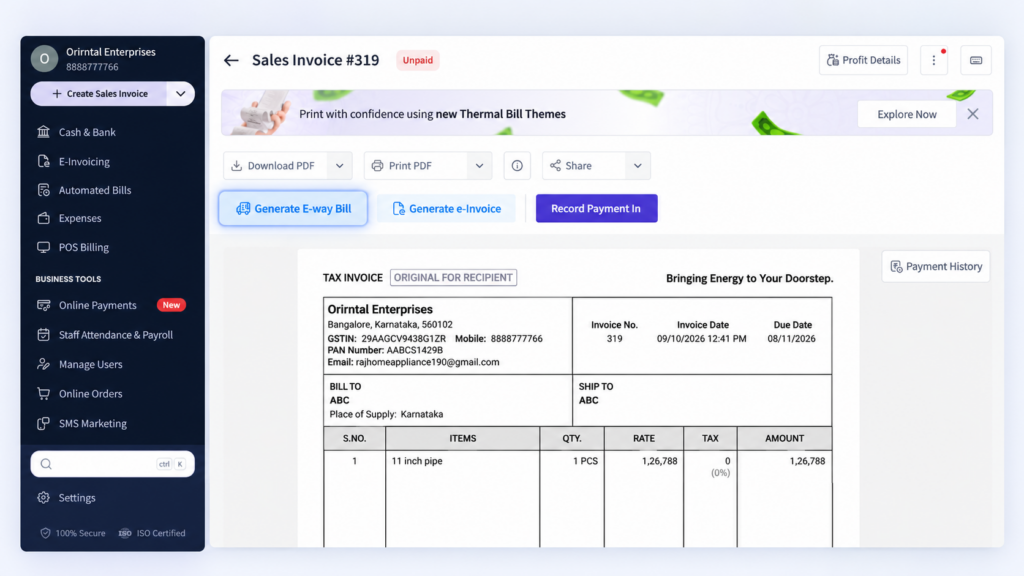
e-Way Bill Feature in myBillBook
The e-Way Bill feature in myBillBook helps businesses generate an e-Way Bill from an existing sales invoice. Instead of typing the invoice information again on a separate portal, myBillBook reuses relevant sales invoice details and lets you complete the transport information required for e-Way Bill generation.
This page explains the myBillBook feature itself — how the workflow starts from a sales invoice, what details are required, and what users should know before generating or cancelling an e-Way Bill.
How to Generate an e-Way Bill in myBillBook
Step 1: Create or Open a Sales Invoice
Start with the sales invoice for the goods being transported. The invoice contains the customer, item, tax and transaction information used in the e-Way Bill workflow.
Step 2: Choose Generate e-Way Bill
From the sales invoice, open the e-Way Bill generation option. If e-Invoicing is applicable to the transaction, myBillBook may also show the relevant combined e-Invoice and e-Way Bill workflow.
Step 3: Complete the Required Setup
For first-time use, complete the required e-Way Bill/GSP setup and save the credentials needed to connect the myBillBook workflow with the government e-Way Bill system.
Step 4: Review Invoice Details
myBillBook carries relevant sales invoice information into the e-Way Bill flow, reducing repeated entry of customer, item and tax details.
Step 5: Add Transport Details
Enter the transport information required for the shipment, such as approximate distance and the applicable transporter, mode of transport, vehicle number and vehicle type details.
Step 6: Review and Generate
Check the information before submission and generate the e-Way Bill through the connected workflow.
What the e-Way Bill Feature Helps You Do
Generate from a Sales Invoice
Start the e-Way Bill process from the invoice already created in myBillBook.
Reduce Repeated Data Entry
Reuse relevant invoice information instead of entering the complete transaction again.
Add Shipment Details
Complete transporter, distance, mode and vehicle information before generating the e-Way Bill.
Keep Billing and e-Way Bill Details Connected
Work from the sales transaction that the e-Way Bill relates to, making the compliance workflow easier to follow.
Details You Should Check Before Generating an e-Way Bill
Sales Invoice Information
Check the customer, invoice value, item and tax details in the sales invoice before starting the e-Way Bill flow.
Transporter Details
Enter the applicable transporter information when the goods are being moved through a transporter.
Distance
Add the approximate transport distance required for the e-Way Bill.
Mode and Vehicle Details
Select the applicable mode of transport and enter vehicle details when required for the movement of goods.
Final Review
Review the information carefully before generating the e-Way Bill because changes after generation may require additional action.
Important Things to Know About the e-Way Bill Feature
First-Time Setup Is Required
The e-Way Bill workflow requires the applicable setup and credentials before you can generate e-Way Bills through myBillBook.
Transport Details Are Not Fully Automatic
Invoice information can be reused, but shipment-specific details such as distance, transporter or vehicle information still need to be provided where applicable.
Check the Invoice Before Generation
Generate the e-Way Bill only after confirming the sales invoice details. If the underlying transaction needs to be changed after generation, the existing e-Way Bill may need to be cancelled and generated again as applicable.
Cancellation Is Time-Sensitive
An e-Way Bill can be cancelled only within the permitted cancellation window. myBillBook’s current help guidance states that cancellation should be completed within 24 hours of generation.
Government Rules Still Apply
myBillBook simplifies the workflow, but the e-Way Bill itself remains subject to applicable GST and government e-Way Bill rules.
e-Way Bill Feature vs e-Way Bill Software Page
This page is specifically about the e-Way Bill feature available inside myBillBook and the workflow users follow from a sales invoice.
For a broader overview of e-Way Bill software, business use cases and compliance-related software information, visit the e-Way Bill Software page.
Who Can Use the e-Way Bill Feature?
Wholesalers & Distributors
Generate e-Way Bills for eligible goods movement connected to customer sales invoices.
Manufacturers
Use the invoice-led workflow when dispatching eligible goods against sales invoices.
Retailers
Use the feature when a sales transaction involves goods movement that requires an e-Way Bill.
GST-Registered Businesses
Keep invoice creation and e-Way Bill generation connected instead of managing the same transaction separately.
Frequently Asked Questions
Can I generate an e-Way Bill from a sales invoice in myBillBook?
Yes. The feature supports generating an e-Way Bill from a sales invoice after completing the required setup and transport details.
Do I need to enter all invoice details again for the e-Way Bill?
No. myBillBook reuses relevant sales invoice information, while shipment-specific details such as distance, transporter, transport mode or vehicle information still need to be added where applicable.
Is any setup required before generating an e-Way Bill?
Yes. First-time users need to complete the applicable e-Way Bill/GSP setup and save the required credentials before using the connected generation workflow.
Can an e-Way Bill be cancelled after generation?
Yes, subject to the permitted cancellation window. myBillBook's current help guidance states that an e-Way Bill should be cancelled within 24 hours of generation.
Is this the same as the myBillBook e-Way Bill Software page?
No. This page explains the e-Way Bill feature and its product workflow inside myBillBook. The e-Way Bill Software page covers the broader software, compliance and business-use intent.