
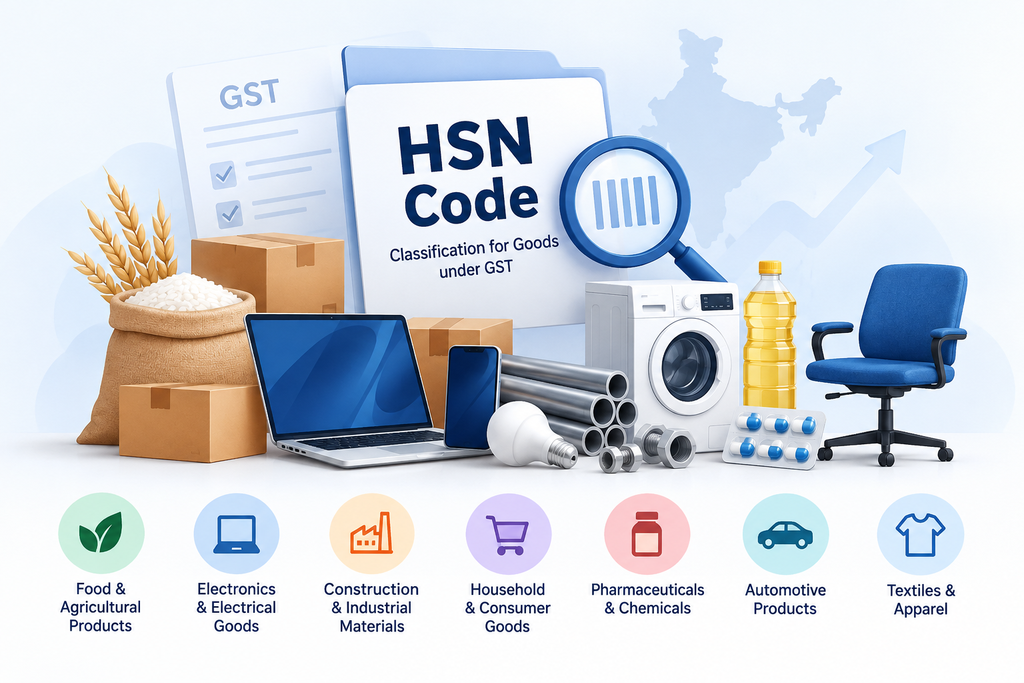
HSN (Harmonised System of Nomenclature) codes classify goods under GST in India. They help businesses identify products, apply the appropriate GST rate and report supplies correctly in tax invoices and GST returns.
HSN codes are used for goods, while SAC (Services Accounting Code) is used for services. The number of digits businesses must report depends on their aggregate annual turnover and applicable GST rules.
What Is an HSN Code?
An HSN code is a standardised numerical classification assigned to goods. The Harmonised System was developed by the World Customs Organization (WCO) to support consistent identification of products in international trade.
India uses HSN classifications for customs and GST purposes. Businesses use these codes to identify the correct classification of goods and determine the relevant GST treatment.
For example, rice, electrical equipment, medicines and furniture fall under different HSN headings.
How Does the HSN Code System Work?
HSN codes follow a hierarchical structure. Each additional pair of digits identifies a more specific product classification.
| Digits | Classification | Example |
|---|---|---|
| 2 digits | Chapter | 10 – Cereals |
| 4 digits | Heading | 1006 – Rice |
| 6 digits | Subheading | 100630 – Semi-milled or wholly milled rice |
| 8 digits | Indian tariff item | 10063010 – Rice, parboiled |
The exact code should be selected based on the product’s description, composition, processing and relevant classification rules.
How Many HSN Digits Are Required Under GST?
The HSN/SAC reporting requirement depends on the taxpayer’s aggregate annual turnover in the preceding financial year.
| Aggregate annual turnover | HSN/SAC requirement |
|---|---|
| Up to ₹5 crore | Minimum 4 digits for B2B tax invoices |
| Above ₹5 crore | Minimum 6 digits for tax invoices |
| Up to ₹5 crore, B2C invoices | Four-digit disclosure may be omitted from the invoice under the applicable notification |
Businesses should also comply with the HSN/SAC reporting requirements in GSTR-1. From the May 2025 return period, Table 12 separates B2B and B2C supplies, and the portal requires selection from its HSN/SAC dropdown.
Difference Between HSN Code and SAC Code
Both HSN and SAC are used to classify supplies under GST, but they serve different purposes.
| Basis | HSN Code | SAC Code |
|---|---|---|
| Full form | Harmonised System of Nomenclature | Services Accounting Code |
| Used for | Goods | Services |
| Examples | Rice, machinery, medicines, furniture | Consulting, transport, insurance, repairs |
| Classification | Goods tariff chapters and headings | Service classification headings |
| Purpose | Identify goods for tax and trade | Identify services for GST |
For example, a business selling vehicle spare parts uses the relevant HSN codes for those goods. A workshop charging for automotive repair services generally uses SAC 998714.
HSN Code List by Product Category
Goods are organised into 21 broad sections under the Harmonised System.
| Section | Product category |
|---|---|
| I | Live animals and animal products |
| II | Vegetable products |
| III | Animal, vegetable and microbial fats and oils |
| IV | Prepared food, beverages and tobacco products |
| V | Mineral products |
| VI | Chemical and allied industry products |
| VII | Plastics and rubber products |
| VIII | Leather, hides, skins and related articles |
| IX | Wood, cork and articles of plaiting materials |
| X | Pulp, paper, paperboard and printed products |
| XI | Textiles and textile articles |
| XII | Footwear, headgear and similar articles |
| XIII | Stone, cement, ceramics and glass products |
| XIV | Precious stones, metals, jewellery and coins |
| XV | Base metals and articles of base metal |
| XVI | Machinery, electrical equipment and related parts |
| XVII | Vehicles, aircraft, vessels and transport equipment |
| XVIII | Optical, medical, measuring and precision instruments |
| XIX | Arms and ammunition |
| XX | Miscellaneous manufactured articles |
| XXI | Works of art, collectors’ pieces and antiques |
Popular HSN Codes and GST Rates
Find the applicable HSN classification and GST information for commonly traded products.
Food and Agricultural Products
Electronics and Electrical Goods
- Laptop and Computer HSN Codes
- LED Bulb HSN Code
- Hard Disk HSN Code
- Insulated Wire and Cable HSN Code
- Solar Panel HSN Code
Construction and Industrial Materials
Household and Consumer Goods
- Pressure Cooker HSN Code
- Office Chairs HSN Code
- Washing Machine HSN Code
- Hair Oil HSN Code
- Toothpaste HSN Code
The applicable GST rate may depend on the product description, packaging, composition and current rate notifications.
How to Find the Correct HSN
- Identify whether the supply involves goods or services.
- Describe the product or service accurately.
- Search the relevant classification on the official GST Portal.
- Check the classification notes and applicable GST rate notifications.
- Use the appropriate HSN or SAC code in invoices and returns.
- Review classifications when products, services or GST rules change.
Use the GST Portal’s HSN/SAC search to check available codes.
Why is HSN Code Important for GST Billing?
Correct classification helps businesses prepare tax invoices, apply the relevant GST rate and report supplies consistently.
HSN and SAC details are also used in Table 12 of GSTR-1, which summarises outward supplies by classification and tax rate.
Businesses should verify the classification independently rather than assuming the GST rate solely from a product’s common name.
For a practical invoicing review, refer to this GST invoice validation checklist.
Find the Right HSN Code While Creating GST Invoices with myBillBook
Finding the correct HSN code for every product can be time-consuming, especially for businesses dealing with multiple items. myBillBook simplifies this process by helping businesses search for and select relevant HSN codes while creating GST invoices.
With myBillBook’s GST billing software, businesses can find suitable HSN codes for their products, add them to item details and use them when generating GST invoices. This reduces the need to search for codes separately and helps maintain consistent product classifications across transactions.
Businesses can also manage product records, apply applicable GST rates and generate professional invoices from one platform. However, the selected HSN code and GST rate should always be verified against the official classification and current tax rules.
Frequently Asked Questions
What is the full form of HSN?
HSN stands for Harmonised System of Nomenclature, an internationally recognised classification system for goods.
Is HSN mandatory on GST invoices?
HSN disclosure requirements depend on aggregate annual turnover and the type of invoice. Businesses above ₹5 crore generally require six-digit disclosure, while businesses up to ₹5 crore generally require four digits for B2B invoices.
What is the difference between four-digit and six-digit HSN codes?
A four-digit code identifies a product heading, while a six-digit code identifies a more specific subheading.
Can one HSN code have different GST rates?
Different goods within a broad HSN heading can have different tax treatment based on their precise description and applicable rate notifications. Businesses should verify the relevant entry rather than relying on the heading alone.
Where can I find an HSN code list?
Businesses can use the official GST Portal’s HSN/SAC search and download the classification list available in the GSTR-1 reporting interface.
Are HSN and SAC codes the same?
No. HSN codes classify goods, while SAC codes classify services. Both are used for GST-related reporting.
